|
Both World Wars
WAR-RELATED DEATHS IN
DOVER
Sometimes we find
people whose deaths were not directly the result of enemy
action, yet occurred owing to war-time circumstances. This
section also includes service deaths in Dover in war-time owing
to other causes, for example ill health.
GREAT WAR
A
|
Axford, A. D.
Arthur David Axford was one of eleven people to be killed
in the Dover Tram accident on 19 August 1917. He was in the habit
of taking the tram to Kearsney on Sunday afternoons as he felt that was
safer than remaining in the town under threat of air raids. See
The Dover Tramway Accident |
B
|
Baker, J. J.
John James Baker, 1191/SA, was a Second Hand in the Royal
Naval Reserve, serving with HM Drifter IFS. He died on 24 January 1917
after having been injured by a fall of some five feet from the dockside
onto the drifter at around 20.30 on 22 January. He had tripped over an
old anchor stop on the quay and fallen head first into the vessel. A
trimmer, Harry Smith, witnessed the accident, and, with Alf Mentripp, a
deck hand, bathed John Baker's head near the right eye. John Baker said
he did not require a doctor, stating that he'd received only a scratch
and would be fine by the morning, but by midday that following day, 23
January, was admitted to hospital where he lost consciousness completely
and died at 12.30 on 24 January. The verdict was that he had fractured
the base of his skull.
John Baker was 49 and came from 28
George Street, Great Yarmouth. He was buried at Caistor Old Cemetery,
Norfolk, C 59, leaving a widow, Elizabeth. |
Bishop, T. H.
Thomas Humphrey Bishop was a Private, TR/10/27534, in the
31st battalion of the Training Reserve. He died at the age of 18 on 22
April 1917 in Dover. He is buried in the Bognor Regis Cemetery, 2393.
Born in Finchley in about 1899, he was the son of Sidney
Harold Bishop and his wife Hilda Mary, née Boyce, who had married
in 1895. Mrs Bishop was widowed in 1906 and she remarried to George Henry Cowley
later that year. In 1911 they were living at
Eden Vale, Highfield Road, Bognor Regis with Thomas and with his older
brother John and younger sister Hilda Mary, along with a new
half-brother, just two months old, George Christopher Cowley. Mr Cowley
later lived at Westfield, North Bersted, Sussex.
At the foot of his headstone are the words, "The peace of
God which passeth all understanding". |
|
Bobson, H. J.
Henry John Bobson, born in the Westminster, London, area
in 1891, had been working as a Stoker on the destroyer HMS Ghurka
when he accidentally drowned in the Wellington Dock on 8 April 1915.
Stoker Charles Bell, from the same destroyer, had been
with Stoker Bobson; they had had leave from 13.30 until 21.30. It was on
their return to the ship through Snargate Street that they turned off
one of the lanes into Strond Street. They assumed it was the lane by the
Barley Mow, which would have taken them straight over to the Pier, but
probably, although they had been in Dover some eight months, they had
mistaken the lane and entered one nearer the dock, probably by the
Golden Anchor Inn. Stoker Bobson, who was about three yards ahead, could
not be seen as it was so dark owing to the war-time blackout. No nearby
houses showed lights, and the lamp near the spot was blacked, with only
some two inches of light showing. Additionally the chains around the
docks were down, usually cast off by mischievous boys. The chains were
some yards from the dock edge and may have acted as a warning of the
nearby water if up, but even when up were only shin height so tripped
people most nights. The nightwatchman confirmed that some 18 people had
fallen into the dock since the black-out began, and a juryman suggested
some five people had fallen just in the last week. The Coroner confirmed
this was a dangerous area, with an average of one or two people a year
having drowned after falling in just there over the past thirty years.
Just before Stoker Bobson fell over the edge, he may have
been trying to check the time on his watch, which was subsequently found
on the dockside, as they were soon due back on board HMS Ghurka. He
called back to Stoker Bell, "Come on, mate!" Then Stoker Bell heard a
splash and shouted to his friend. There was no answer.
At the sound of the splash a light flashed out from a
nearby trawler. Several men rushed ashore, and when they saw bubbles
arise threw in grappling irons. They hooked a body on the second attempt
but it dropped back into the dock again, and it took several minutes
before they could retrieve it. Stoker Bobson would have been in the
water some fifteen or twenty minutes before he was brought ashore.
Warrant Officer John Barwood, from the trawler Confier, and Police
Constable Dane attempted artificial respiration but with no success.
Stoker Bobson was a strong swimmer but may have hit a buoy during his
fall as there were several in the area and when the body was examined a
contusion was found on his forehead.
There is a headstone at St James cemetery, which reads:
"In Loving Memory of Henry John Bobson, Stoker HMS Ghurka, who was
accidentally drowned in Wellington Dock, April 8th 1915, aged 24 years.
Born London.
headstone found by Jean Marsh, enabling futher research |
|
Butler, F. C.
Frederick Charles Butler was a 2nd Lieutenant,
serving in the RAF, 65 Squadron at Dover. On 25 April 1918, at the end
of his flying course, on the last type of machine to learn, he went up
at 08.00 and 20 minutes later was seen diving steeply below the
unexpected mist. At about 150 to 200 feet up he saw he was close to the
ground, which the mist had concealed. He pulled the machine over, and
the plane landed on its back. He was killed instantly.
The son of Joseph Henry and Lilla
Butler from Bower Chalke, Salisbury, he is buried in the Bower Chalke (Holy
Trinity) Churchyard, Wiltshire. On his gravestone are
the words "Killed on
duty". He was 20. |
C
|
Cade, T.
Not exactly war-related but worth noting is that Thomas
Cade, a deckhand in the motor launches, was one of eleven people to be
killed in the Dover Tram accident on 19 August 1917. See
The Dover Tramway Accident |
G
|
Goddard, J.
John Goddard of
the Royal Fusiliers was accidentally crushed between the
buffers of two railway trucks at the Ordnance
Yard near Dover Priory around 11.25 am on 8 July 1915.
He had been one of a working party there of some
thirty-two men, on fatigues. This included lifting heavy
boxes, despite some of the men having been at the front
and returned wounded. There had been some grumbling
amongst the men, who felt that the work was "navvying",
and also that they were being ordered by civilian yard
foremen.
Some of the men had been
moving three trucks together. The third was moved up to
the middle, and the brake removed on the middle truck,
which then moved up to the first one. Private Goddard,
who had no previous experience of this work, had been
pushing the first truck and was caught between the
buffers of the middle and first trucks. The trucks
bounced apart, and Private Goddard stepped aside and
then fell beside the tracks.
He was
reported dead from shock and internal haemorrhage at the Western Heights
Military Hospital. He was 19 and came from
Staffordshire, where he is buried in the churchyard at Gildenhall. |
H
|
Hames, C. R.
Clifford Robinson Hames was 23, born on 5
March 1895, when he was
killed on 25 April 1918. He was a 2nd Lieutenant in the
RAF, serving with 63 Training Squadron, Dover. Halfway
through his training course, he was flying
alone at 08.15 when a mist came up unexpectedly. At a height of 200 feet, he went into
cloud. He shut off the engine and almost stalled.
Restarting he flew into another cloud, shut off the
engine again and stalled. This time the plane nose-dived into ground.
He was badly injured and died on the way to hospital.
He was the son of Rev Arthur Benjamin and Sarah Jane Hames, née Power,
from Aurora, Ontario, Canada. He is buried at St James,
WD1. At the
foot of his headstone are the words, "For me to live is
Christ and to die is gain". |
F
|
Fleet, A. R.
On 11 November
1918, Armistice Day ("Joy Day"), the ending of the Great
War was celebrated in Dover by the firing of many
rockets. Albert Richard Fleet, aged 14, a yard boy in
the Dockyard engaged on salvage work, had, at 5.30pm on
that day, brought home to 13 Athol Terrace what he
believed was the head of a rocket. It was six inches
long and two inches wide, and he placed it in the centre
of the fire to heat.
When it
was red hot he pulled it out with tongs and told his
younger brother John ("Jackie") to "come and see the
pretty light", telling his other younger brother, Henry,
to keep back owing to his wearing glasses. He took the
rocket up the area steps outside the kitchen and was
just about to throw it in the road, believing the lights
would go up into the air, when it exploded. Jackie was
injured in the eye, but Albert was blown back down the
steps, severely injured at the shoulder, and a piece of
metal had pierced his chest and right lung. Police
Sergeant Reilly, who attended, said that the body
resembled that of soldiers killed by shells landed at
Dover.
Albert's father, Alfred
Ruben Fleet, a chargeman of fitters at the dockyard,
said he believed the article had been a detonator, used
for exploding explosives, while the coroner at the
inquest suggested it may have been a navy signaller.
Albert was buried on 18
November 1918 at St James. There were many floral
tributes, including one from "his chums at the Repair
shop, HM Dockyard" |
|
Franklin, E.
Ellis G
Franklin, 10288, was a Private in the 3rd battalion of
The Buffs (East Kent Regiment). He died at the age of 40
on 6 November 1916 and is buried at Middleton Cheney,
Northamptonshire.
Suffering from a bad back, he had not been sent to the
Front with the last draft, and had been returning to his
quarters from the town at approximately 5.45 on a dark
and windy evening. His body was found two days after he
was last seen alive, in the dry moat at the Western
Heights.
With a fractured skull and broken thigh he
had evidently toppled, found the inquest, from the edge
of the moat, a fall of some forty or fifty feet. At some
distance from his quarters, he may have been attempting
to visit his former company from which he had recently
been transferred, or seeking the nearby latrine.
Private Franklin had joined
the army on 15 December 1915. On 13 April 1903 he had
married Rosina Emily Pennills; the couple had two
children, Ellis Walter, born 26 May 1905, and Dorothy
Kate, born 11 July 1910. Private Franklin is buried at
Middleton Cheney, his childhood home. The memorial stone
in Chacombe parish church where he is commemorated notes
that he died at Dover.
In 1918,
Mrs Franklin wife remarried, becoming Mrs J H Perry. She
died on 4 December 1945, and is now buried next to Ellis
Franklin. Joseph Henry Perry died 19 years later and is
also buried in the churchyard.
family information
with thanks to Nancy Long |
H
|
Hanson, E. E.
Edith Ellen Hanson, 11, died as a result of an exploding
hand-grenade. In the dummy trenches at Copt Hill troops were taught to
throw bombs, and quite often pieces of theordnance were found there.
They were collected and exchanged by little boys.
Albert King unusually found a whole
grenade behind St James cemetery and brought it home. He had thrown it
several times and even taken it into his house to polish it. and on 19
July 1916 threw it into the air outside 6 Churchill Street. It fell into
the street and exploded, injuring several boys nearby, Edith, who was
standing about six yards away in the street, and a sailor who was
passing by. Walls and doors were damaged and the blast blew out the
windows of 1, 4, 5, 6, 16, and 18 Churchill Street, and others in London
Road. The crust of the road was ripped up.
Albert King, 10, received puncture
wounds to his legs and left shoulder and was admitted to hospital, where
he stayed A lad surnamed Parks was treated at the hospital, as was
George Trout, of 10 Churchill Street for wounds to his hand. G S Hogben,
aged 7, was treated at home by the doctor. The sailor, G E Robinson,
suffered a cut to his face.
Little Edith, from 15 Churchill
Street, was hit in the chest by fragments of the grenade. She was taken
into a shop in a faint, and said that her chest hurt. The doctor
attended twice more and in the evening, collapsed, she was admitted to
hospital. Although it was a very small wound just above the right
breast, tiny fragments had penetrated one of her lungs, possibly
carrying threads of clothing with them. An inflammation occurred, with
matter forming, and although Edith underwent an operation on 25 August
it was impossible to remove the tiny fragments and the inflammation
continued. Edith was a frail child, and deteriorated further, and at
11.30 in the evening of 31 October, then aged 12, she died at the Royal
Victoria Hospital.
Edith was buried at Charlton, and
amongst the wreaths was one from "her playmate, Albert King". |
|
Hibberd, A. W.
Arthur William Hibberd, of 2 King's
Avenue, Sandwich Bay, was riding his bike down Whitfield Hill, and on
turning at the bottom, collided with the 29th Training Reserve battalion
of recruits. His head was badly injured when he was thrown from his bike
and he died 12 hours later at the Royal Victoria Hospital, on 8
September 1916. The husband of Agnes Hibberd, he was a butler, aged 46
The bicycle was hired, and there was
no front brake while the back brake was found to be inoperative
(although at the time of testing the wheel had been buckled by the
accident). Mr Hibberd had already returned that bike to the hirer as it
had a puncture, and a replacement, of which the pedal had fallen off. |
L
|
Livermore, W
Not exactly war-related but worth noting is that William
Livermore, a Private in the Royal Fusiliers, was one of eleven people to be
killed in the Dover Tram accident on 19 August 1917. His
wife was injured; they were parents to five children. See
The Dover Tramway Accident |
M
|
Mitchell, P.
Sergeant Peter Mitchell, 35199, was in
the 40th Company, Royal Garrison Artillery, stationed at Langdon Bay,
Guston. He died on Monday night, 15 March 1915 after a fall down eight
or steps leading to the latrines at the Western End of the Battery
He is buried at St James, Dover FV 3. His
wife, J Mitchell, lived at Maker Vicarage, Plymouth |
|
Murphy, H. E.
Harry Eustace Murphy, a Captain in the RAF, 65
Squadron, died on 23 April 1918 in the same accident as William John
Salmon, below.
He was the son of Charles E Murphy,
from Inchera, Glanmire, Co. Cork. He is buried at Cork, St Finnbar's
Cemetery, grave B2,12. |
P
|
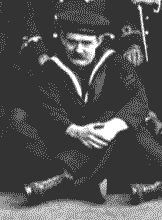 Parker,
F. W. Parker,
F. W.
Leading
Seaman Frederick William Parker, 122668, a retired naval veteran of twenty-three
years service and who was described as a "big, heavy man" with "a scar
on his chest", was a naval pensioner turned Leading Seaman in the Dover
Anti-Aircraft Corps. Born in 1867, he had enlisted into the Royal Navy in 1883 and
served as an able-bodied seaman on many vessels, with spells ashore with
HMS Pembroke. He was promoted to Leading Seaman in April 1905 before
retiring the next year. Following the outbreak of the First World War he
immediately re-enlisted and was assigned to a shore role with the Dover
Anti-Aircraft Corps, a small unit run by the RNVR and composed mostly of
local citizens enlisting on watch duty over the town.
Parker was one of the initial 25 active service RN members and the only
member to die whilst in still in service of DAAC. He was stationed with
B Crew of No.1 Co. (Drop Redoubt) at the Western Heights in Dover under
Sub. Lt. W.T. Rust. As such he would have been responsible for the
maintaining the searchlights and engines and manning the telephone as
opposed to operating the searchlights directly, and providing
instruction on equipment operation. At the time of his death he was have
been assigned to HMS Arrogant,
a old cruiser turned submarine supply ship moored in the Camber, but had
been living with his brother and his sister-in-law at 63 Limekiln Street
for the previous eight years.

On Easter Monday
5 April 1915 he had finished
his night shift early in the morning. He took
part in the DAAC Sports Day at Crabble Athletic Grounds
directly afterwards. He had acted as an anchor man in the tug-of-war for his
Drop Redoubt crew but had come home to his brother-in-law's house after
parade complaining of pains in his side and chest. The pain became
steadily worse but he refused to see a doctor and continued in his
shifts as usual, even walking up the Grand Shaft staircase to the
Redoubt. After going to the town in the afternoon of the 19 April
he suddenly collapsed at home, and had died by the time the doctor
arrived. At the inquest it was determined that he had died of natural
causes, the attending doctor had diagnosed a cerebral haemorrhage and
stated that the strain of the tug-of-war had probably been a
contributory cause and expedited the end.

A full
military funeral (pictures above and below) took place at 14:15 on 24
April and was
covered in great detail in the local newspapers.
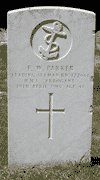 His coffin was
transported draped with a Union Jack drawn on a gun carriage with full
military escort from the Chapel at Dover College to his last resting
place at St. Mary's cemetery. Lt. Cdrs. Henry D. Capper and Ian
Howden
gave speeches and the Rev. V. Hayward Fisher of Dover College
administered the service. A volley was fired by the Royal Fusiliers and
he was buried to the Last Post. Virtually the whole of the Anti-Aircraft
Corps was in attendance and he was buried with full naval honours. He
died single at the age of 48 and left no children, but was regarded with
affection by his nieces and pephews, who knew him as "Uncle Pum" and
"Uncle Titchie". His coffin was
transported draped with a Union Jack drawn on a gun carriage with full
military escort from the Chapel at Dover College to his last resting
place at St. Mary's cemetery. Lt. Cdrs. Henry D. Capper and Ian
Howden
gave speeches and the Rev. V. Hayward Fisher of Dover College
administered the service. A volley was fired by the Royal Fusiliers and
he was buried to the Last Post. Virtually the whole of the Anti-Aircraft
Corps was in attendance and he was buried with full naval honours. He
died single at the age of 48 and left no children, but was regarded with
affection by his nieces and pephews, who knew him as "Uncle Pum" and
"Uncle Titchie".
with grateful thanks to Phil Eyden for
the research, words, and pictures
picture of Mr Parker, courtesy Dover Museum, pictures of funeral,
courtesy Dover Express, picture of gravestone, Phil Eyden
|
|
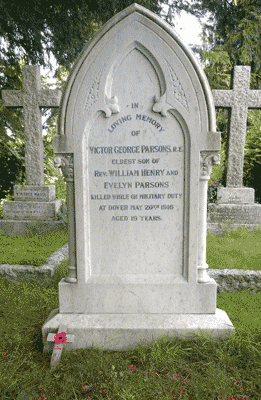 Parsons, V. G. Parsons, V. G.
Victor George Parsons was a lance corporal serving with the Royal
Engineers Motor Cyclists Section. He had been in Dover about four
months, having left school not long before. He was killed on 20 May 1916, the day
before his 19th birthday. He
had turned right from Woolcomber Street, returning after duty to
the Castle where he was quartered, when at 4am he struck a
lorry coming down the hill, approximately opposite Laureston Place. The lorry
was transporting twelve members of the Dover Anti-Aircraft Corps
and driven by Stanley Joyce, a Stoker in the RN.
Victor Parsons was admitted to the
Military hospital at 4.35 am and died there about ten minutes later. He
had a fracture to the base of his skull. The subsequent verdict
was accidental death.
He was the son of the Rev William Henry Parsons and his wife Evelyn,
from St John's Vicarage, Tunbridge Wells. He is buried at Tunbridge
Wells, B 2 62 .
The words on his headstone read, "Inn loving memory of
Victor George Parsons, RE, eldest son of Rev William Henry and Evelyn
Parsons. Killed while on military duty at Dover May 20th 1916, aged 19
years".
Right, the location of the accident. Victor Parsons probably turned out
from the road on the left to go up the hill, while the lorry was coming
down the hill, as is the cyclist in this picture. The lorry driver
believed that Victor was attempting to pass in front of him, and was
travelling quickly, as would be necessary to climb the steep hill to the
Castle.
with thanks to Phil Eyden |
R
|
 Royal, E Royal, E
Not exactly war-related but worth noting is that Ernest
Royal, a seaman in the drifter patrols, was one of eleven people to be
killed in the Dover Tram accident on 19 August 1917.
His
companion, Dolly Hunt, from Snargate Street, was injured. see
The Dover Tramway Accident |
S
|
Salmon, W. J.
William John Salmon MM was a 2nd Lieutenant,
serving in the RAF, 65 Squadron. He went on a flight
with Capt H E Murphy, above, at 14.00 on 23 April 1918.
They had climbed to 2,000 feet when the plane turned
then span; at 500 feet it nose-dived straight into
ground, was wrecked and caught fire.
The son of William and Anna Maria
Salmons of 26 Norfolk Street, Coventry, aged 23, he is
buried in grave 26.153, Coventry London Road Cemetery. |
T
|
Treacher, G. G.
George Gilbert Treacher, S/388, had been a
London fireman before enlisting and going to the Front.
After some two and a quarter years' service with the
Royal Fusiliers he joined as a Sergeant one of the
Training Reserve Battalions at Dover.
He died on 4 March 1917, aged 34,
having slipped down the embankment of the Dover-Deal
railway near the Guston tunnel when attempting to put
out a fire. A train had gone past at about 21.45 and
immediately afterwards a fire broke out, to which some
thirty soldiers attended. They were stamping it out and
also using sacks and water. The greater part of the fire
was inside the fence along the railway, which was some
ten feet from the edge of the cutting. Sergeant Treacher
and others passed the fence to extinguish the fire; he
stamped on lit grass near the edge - this gave way and
he tumbled onto the track, turning in the air. He died
at about 22.08 from a fractured skull, three minutes
after his arrival at the medical inspection hut.
He was buried at St James, LH23,
leaving a widow, Florence, of 85 Meyrick Road,
Battersea. |
W
|
Wilson-Walker, A.
A.
A Second Lieutenant, he was serving in the
RFC and was accidentally killed on 20 March 1916 when
his plane flew
slowly and dropped 1,500 feet from the sky. He crashed
near the Dover end of the Guston tunnel.
Aged, 22, he was the son of Mrs.
Charles Wilson-Walker, of Pynble, Sydney, New South Wales.
He is buried in St James, Dover, WC36. |
WORLD WAR
II
A
|
Atkinson, N S
Norman Slinger Atkinson, P/J 44575,
was a Chief Petty Officer in the Royal Navy (H.M.S. Lynx). He died at the
age of 30 on 15 October 1939 after having been run over by a railway
engine at the Marine Station, Dover, during the blackout. He is buried
at the Portsmouth (Milton) Cemetery, Plot U, Row14, Grave 13
He was the son of Harry and Ellen
Atkinson, and married to Lilian M Atkinson, of Southsea |
B
|
Banks, W. H.
William Henry Banks of 7 Shakespeare
Road, was knocked down by a bus at the junction of Folkestone Road and
Elms Vale Road on 4 October 1939 during the blackout
The bus had been travelling from East Cliff, leaving there at 7.30 pm, for Elms Vale. It
was dark and raining slightly, and the headlights and sidelights of the
bus were screened. The driver, William Edward Ealden, of 42 Alfred Road,
saw a person in the nearside beam and braked. He felts a bump and saw a
man disappear under the windscreen .A dog jumped from the man's arms,
yelped, and ran off up the road. Mr Banks was lying by the offside front
wheel, having been struck by the headlamp, the shade of which was
buckled
Mr Banks' skull was extensively and fatally fractured; he died the same
evening in the Royal Victoria Hospital. He was 52, and a
WD Constable
Mr Banks was buried
at Charlton, Dover. The first part of the service was held at St Martin's.
Bearers of Mr Banks' coffin were workmates: Sgt, Boulsbee, Sgt. Ord,
P.C. Jacobs, P.C. Bryson, H. J. West, Dowsett and Chilton of the
Ordnance. The funeral was semi-military, with the coffin draped with the
Union Flag, and thereon Mr Banks' cap and medal. The coffin was taken to
Charlton on a gun carriage and at the graveside a Bugler sounded the
Last Post and the Reveille. Amongst the mourners were Mrs Banks, his
widow, Mr and Mrs W Banks, son and daughter-in-law, and Mr and Mrs
Banks, parents
1939 - Sadly missed by his loving
Wife, Son and Daughters
1940. Treasured
memories of our dear son, who was accidentally killed October 4th
1939. Always in our thoughts From Mum and Dad (Appledore)
Mr Banks' widow,
Léonie Helen (née Dangremont), "passed peacefully away" at Appledore on
29 July 1940, "after much suffering, patiently borne" "Reunited" |
|
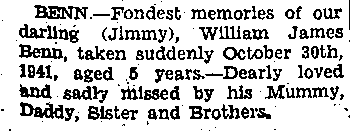
Benn, W.
William Benn. He was four years and ten months old when he died on 30
October 1941 from carbon monoxide poisoning while sleeping in a private
cave shelter
He was the son of lorry driver Mr and Mrs Reginald James Benn, from 2
New Cottages, Finnis Hill, Dover. They had moved here after being bombed
out of their home several weeks before (RH). Adjoining number 4 was a
cave some 45 feet long, and Mr and Mrs Benn and their four children, and
Mr and Mrs Dunigan and their son Kenneth, used it each night as shelter
from air raids. There was a wooden partition across the cave, which
making sleeping accommodation around 7 feet wide by 7 feet high by 18
feet long, accessed by a door in the partition. The children had been
put to bed at 8.15, after the stove had been warming the cave for an
hour. A coal fire in a bucket was placed just outside the door, for
extra warmth. This was found inside the cave by PC Hogben, who attended
the incident with the ambulance at 11.40, and who said that the
atmosphere was "stifling" when he first entered
William, his
brothers Bertram, three years six months, Francis, two years six months,
and his sister Sylvia, 15 months, and Kenneth, three years, were checked
at 9pm by Mrs Benn, who thought they were all asleep, but when she and
Mrs Dunnigan went to bed at around 11pm, they discovered one child
seemingly "dreaming", and that another, Sylvia, had been sick and was
stiff. The adults took the children into the house, while Mr Dunnigan
sent for a fireman. Fireman Howell found William on a table, and
attempted first aid before the ambulance arrived to take him to the
casualty hospital. Artificial respiration continued in the ambulance and
at the hospital after William arrived at 11.50, with additional oxygen,
but the doctor eventually stated that William had been dead for two to
three hours A blood test showed that he had inhaled fumes in high
concentration
 The
coroner at the inquest returned a verdict of misadventure, and extended
his very deep sympathy to the parents The
coroner at the inquest returned a verdict of misadventure, and extended
his very deep sympathy to the parents
William was buried
on 4 November 1941 at Charlton, Dover. YB 46
note: Ernest J Smith, died 24 February 1945, also lived at 2 New
Cottages |
D
|
Durman,
J.
Jesse Durman. Living at 43 Heathfield Avenue, he was a
Constable in the Police War Reserve, having been previously a Special
Constable. He had been a chef at a Dover Hotel, and later a fish and
chip monger, of the "Silver Grill" in the High Street, Dover. He had
also opened another fish and chip shop in Priory Street
He came on duty at the Police Station
on 23 May 1942, complaining of feeling unwell. He was found collapsed
in the lavatory, and when removed to the hospital was found to be dead,
owing to heart trouble. He was 37
From 43 Heathfield Avenue, he was buried
on 27 May at Charlton,
Dover 18 2T, with PCs Crush and Harman,
and War Reserves Dunnigan, Pascall, Minter, and Brook as bearers of his
coffin
He was the husband of J M S Durman, who was in Wales
with their two children at the time of his death
Note: The Silver Grill former premises
is pictured
here; it's the shop with the yellow doors next to the Salvation Army
details Joyce Banks |
G
|
Groombridge, A. H.
Arthur Herbert Groombridge was a corporation employee,
labourer. He lived at 3(33) St Martin's Road, Guston
He was 43 when, in March/April
1942, he was accidentally shot in Union Road while a naval sentry was
being taught how to unload a revolver. He died on 1 April at the Casualty Clearing
Hospital. He was buried on 7 April at Charlton, Dover 12 2T |
H
|
Higgs, A. E.
Private Albert Edward Higgs, aged 20,
was accidentally shot in his billet by his friend Private Taylor. When
he heard they were to go on guard duty again at 9pm, Private Higgs
jokingly said, "Here is my rifle, Taylor, shoot me!" Private Taylor took
the rifle and pointed it at Private Higgs. A cartridge had gone into the
chamber after loading, and unfortunately the gun went off and Private
Higgs was shot directly through the head. Date uncertain, possibly March
1941 (or August 1914?) |
L
|
 Lockyer,
R. E. Lockyer,
R. E.
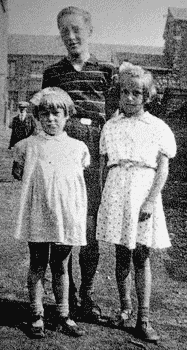
Rosetta Lockyer was evacuated to Wales from Dover on 2
June 1940, with her brother John and older sister Primrose
Born in 1935, she died, aged 8, in 1943. She had been
dropped off by the local postman, who was helping with his van to bring
evacuees from their school, a distance of some two miles. While
crossing the road she was struck by an army convoy lorry driven by an
ATS. The ATS was severely injured, having gone through the windscreen of
the lorry and fallen into the road.
Rosetta's brother remembers that just
a few weeks before she had been singing of her home town - "There'll be
bluebirds over the white cliffs of Dover". She
is buried in Mamhilad churchyard, near Pontypool
with thanks to John Lockyer |
|
Lucas, E.
Ernest Lucas was a seaman with the
Royal Naval Reserve, H.M.S. Skiddaw. He died on 13 December 1939 after
having fallen into the Wellington Dock and drowned during the blackout.
He is buried at St James, Dover, Row E, Joint Grave 5 |
|
Long, A. E.
Albert Edward Long, 3964192, was a serjeant in
Reconnaissance Corps, 43rd (2/5th Battalion Gloucestershire Regiment.
The son of Reginald George and Elizabeth Long, from Canton, Cardiff, he
is buried in his home town at Cariff (Cathays) Cemetery, Section EL
grave 1030.
He died on 2 September 1942 at the age
of 23. He had reported sick that morning at 8am with severe pains in his
stomach. At 4pm he was admitted to the casualty hospital with symptoms
of acute peritonitis. An operation began at 5.45pm and it was discovered
he had a perforated gangrenous appendix. At 6.30 he suffered convulsions
and a weak pulse and although he was revived once the team were unable
to save him and he died just as the operation was completed. Death was
owing to appendicitis and a perforated appendix leading to a "severe and
extensive" peritonitis which in turn caused a toxic myocarditis and
cardiac failure. |
M
|
Manton, W. F.
William Frederick
Manton lived at 3 Beach Street. He died, aged 51, on 3 November 1939, a victim of the blackout which was ordered from 1
September 1939
William had been painting during a 12
hour nightshift at the Naval Stores depot beginning at 7pm. His
companions had noticed he was missing shortly after 9.30 pm, but assumed
he had gone outside for a smoke. When they had not seen him by midnight
they went outside, searching with torches. When they had been unable to
find him they assumed he had gone home, and reported the matter to the
foreman the next morning
All the doors at the Naval Stores had
been fastened, apart from the main and office doors. The outer door of
the office opened directly on to the sea wall, which was around five
feet wide. There were no chains or barriers, and, coming out of the
light into the darkness, Mr Manton probably had missed his step
The water at that time would have been
low, but the fall would have been about twenty feet and Mr Manton was
wearing heavy clothing which would have made it almost impossible to get
up out of the Granville Dock. He would probably not have been heard if
he had called out, though his wet cap was found in a boat moored nearby,
and one wonders if perhaps he had tried to attract attention that way,
or if perhaps this had happened when he had fallen. His body was not
found until 10.30 the next morning. The Police Surgeon stated that on
viewing the body at the mortuary, his opinion was that Mr Manton had
drowned.
Mr Manton left a wife, Ann, and two daughters. He was
buried at St Mary's cemetery, and a large number of floral tributes were
laid in his memory.
Note: One of Mr Manton's brothers was Percy Manton,
of 1 Archcliffe Road, Dover. |
|
May, A. M.
Agnes May May, 74, of 107 London Road, the wife of
carpenter Jehu May, was found on 26 May 1941 on her bed with her throat
cut. Her husband said that she had been ill for some time, suffering
from nervous depression since a shell fell near her; she was afraid of
it happening again.
Mrs May had seen the doctor at
lunch-time, and he had treated her for heart trouble and nervous
depression. She had thanked him for all he had done, and stated she did
not think she would live much longer. However there was no indication
she intended to take her own life.
The afternoon had been stormy and
there had been some gunfire. Her husband stated that at 4.15 that
afternoon she had had "some kind of a fit come on for about quarter of
an hour" but that a cup of tea had made her feel better. On going
upstairs for a rest she had apparently taken her husband's razor from
the living room, and Mr May discovered her on the bed at around 5pm when
he came in from the garden. He wrestled the razor away from her, but she
was too severely injured to survive. She had left a note on the window
sill. |
|
McGrath, D.
David McGrath, an army pensioner from
22 Clarence Street, died in November 1940 at the age of 55. He died from
double pneumonia in a cave in Trevanion Street, where he had been
sleeping (owing to raids?)
He was buried on 4 December at St
James, Dover. 20 CR |
O
|
 Osterroth,
V. G. Osterroth,
V. G.
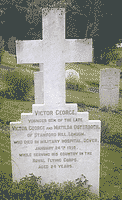
Victor George Osterroth was a cyclist attached to the
RFC. He died possibly as the result of an accident, and
was buried with full military honours at St James. The
inscription on his headstone reads, "Victor George,
younger son of the late Victor George and Matilda
Osterroth, of Stamford Hill, London, who died in
Military Hospital, Dover, January 24th 1916 while
serving his country in the Royal Flying Corps. Aged 24
years". |
P
|
Phelan, E.
Ernest Phelan was a Bombardier, 1433227, in the Royal
Artillery, 416 Battery, 173 HAA Regiment. He died on 24
March 1944, aged 23. He was a gunfitter and on an AA
site at Dover he had been working on a fuse setter in
the fitters' shop, testing it by using a drill round
from the gun pit. After two keys had bent, he attempted
to remove the fuse with a hacksaw. At about 14.30 there
was an explosion. Bombardier Phelan was badly injured,
internally and with a gash in his throat; he had also
lost his left hand and his face was burnt. Although he
was conscious and could speak when taken to hospital he
was too severely injured to survive and died around
17.30. He was 23.
Bombardier Phelan had very
recently married, to Joyce Evelyn Burrow, then of
Woodford, Cornwall. Although born in Stockport, the son
of Ernest Phelan and his wife Elizabeth Alice Dale, née Barratt, his address was at St David, Marwenstow, near
Bude, Cornwall. He was buried in the Woodford Methodist
Chapelyard. At the foot of his headstone are the words,
"God loved him too and thought it best to take him
home with Him to rest". |
R
|
Rusbridge, M. J.
Marjorie Jessie Rusbridge had been nine
years a teacher of maths at
the County School for Girls and was evacuated with them.
Her bicycle was crushed against a wall of a house at Caerleon by a
lorry in 1942; On 23 October she had been cycling from
her billet in Cross Street and at a bottleneck in the High Street the
lorry, with a trailer, had skidded. Despite immediate attention Miss
Rusbridge died in the Royal
Gwent Hospital, Newport. She was 38.
She ran a Guide troop
at Caerleon, and had been district commissioner in Dover
before the war. She formed a Guide company in Wales,
named the 2nd Carleon (County School) Company, and was
renowned for her knowledge of trees and flowers and her
tales, especially "Brer Rabbit" tales, around the
campfire when the guides were at camp.
She was the "dearly loved only
daughter" of Mr and Mrs Rusbridge of Lyn Garth, Benfield
Way, Portslade. Miss Rusbridge was buried at Portslade.
The following week a memorial service was held for her
at St Cadoc, Caerleon. The evacuated girls decorated the
church with flowers which were later, with a collection,
sent to the Royal Gwent Hospital. Miss Cambrell,
mistress at the school, was the organist for the
occasion, which was attended by Miss Gruer, head of the
County School, with many other members of staff and
representatives from councillors and other schools in
Wales and in Dover. |
S
|
Skelton, J. E.
John Edwin Skelton, aged 6, was drowned at Cwmbran
just a few days after he had been evacuated with his brother. He had
been billeted with Mr and Mrs William Jenkins, of 31 Oak Street,
Cwmbran. He had left the house about 9.30 on 19 June 1940 with his
brother Billy to go out to play, and two girls remembered giving him a
swing at the Cwmbran playground. He had later been sitting on a rock
while Billy bathed in the Clay Hole Pool. At the junction of Grange Road
and Llantarnam Road, the Pool was a water-filled pit up to 60 feet deep
in places, which had been abandoned by the Star Brick and Tile Company
some 15 years previously.
From that moment, despite extensive searches, including
swimming searches and a dive search of the Pool, John was not seen
again. His body was eventually recovered from the Pool on 10 July. He was buried on 13 July 1940 at Cwmbran
cemetery, with the funeral service taking place in the cemetery chapel.
A pupil at the Pier infants' school,
fair-haired and blue-eyed, John was the son of
Mr Arthur Skelton, of King Lear's Way, Dover, and his
wife Amelia, née Blogg. Amelia was the sister of
James Blogg, who died on 18
November 1916. |
|
Smith, W.
F.
William Frederick Smith and his
friends had been
collecting mortar bombs in a barrow from an army training field. They
found a live one and took turns in throwing it at a gate post. On 15
October 1942 Billy, aged 10 years and 8 months,
died from wounds after the mortar exploded. His mother told the inquest,
held two days later at the Royal Victoria, then at Waldershare, that she
had told her son, "It was a silly thing to do, Billy"
Billy was probably the son of
William Smith
"Treasured memories of my only beloved
son" - Mummy and Edwin - 1943
"In loving memory of my dear son, Petty Officer William Smith ... also
grandson Billy" - their loving Mother and Grandmother. |
|
Stenning, E. R.
Edmund Robert Stenning died on 17 February 1945, aged 31.
He was a general labourer and was working with a number of others at 12
Liverpool Street, which had been damaged by bombing. On 9 February,
while the remains were being demolished and the site cleared, the
chimney stack collapsed and he was struck on the head by bricks. He died
in the casualty hospital on 17 February. |
T
|
Thomas, G. and J.
Georgina, aged 11, and
Joan Thomas,9, were killed by an express train while going to
school on Tuesday, 9 July 1940. They had been evacuated to Undy, Wales,
with their school, and were walking to their lessons with their older
sister Julia, 12, when they stopped at a level crossing to let a goods
train past. Thinking the line was then clear they began to cross; an
express train fatally knocked the two younger children against an
embankment. They are buried at Undy.
Mr Thomas, their father, worked at the
Dockyard, and lived at Buckland Farm. |
|
Tucker, T. S.
Thomas Sydney Tucker,
164610,
was a Captain of the Welsh Regiment. He died at the age of 30 on 18 September 1943 in
Dover County Hospital, as the result of an accident. He was the fourth
son of Mrs Tucker of Oxford and the late Edward Tucker, of Ashbury,
Berkshire, and the husband of Angela Tucker
He was buried on 21
September 1943 at St James, Dover. 4 JR |
W
|
?Wells, E.
Edward Wells, aged 67, of 13 River
Street, was found drowned in the River Dour. He did not go out in the
dark as he was "afraid of the blackout"
An inquest was reported on 12
February 1943, where evidence from a post mortem revealed Mr Wells had
drowned. There were no injuries, though there were signs of arthritis
which was probably painful. An open verdict was returned, as there
was no evidence to suggest how Mr Wells came to be in the water, nor as
to his state of mind |
|
