|
 An
obituary published in a newspaper after the death of Wing Commander
Butler reads: An
obituary published in a newspaper after the death of Wing Commander
Butler reads:
Buried in France
Wing Commander Butler Killed in Action
Formerly reported missing, it is now known that Wing Commander Vernon
Stanley Butler, DFC, son of the Chief Constable of Ramsgate (Mr S F
Butler) and Mrs Butler, was killed in action in France in March and has
been buried in the French Military Cemetery, Beauvais.
Wing Commander Butler's observer, Flying Officer B M Sayers was also
killed and was buried in the same cemetery. The air gunner of the plane,
Pilot Officer Weston Robertson, died in hospital three hours after the
machine crashed. Wing Commander Butler led the daring and successful
daylight raid on the Matford factory at Poissey and met his death on the
homeward flight.
One of the youngest wing commanders in the RAF, he was within a week of
his 26th birthday. Born at Wallessey, Cheshire, shortly before his
father came to Ramsgate as Chief Constable, Wing Commander Butler was
educated at Dudley House School and St Lawrence College, Ramsgate. He
entered the RAF in 1935, being granted a commission as acting pilot
officer after a year's training. Shortly afterwards he joined No 226
Squadron, which had been reformed having been dissolved after the last
war. He completed five years with the squadron in the week he lost his
life, and had the unique distinction of rising from the lowest
commissioned rank to commanding officer. he was promoted pilot officer in
1937, flying officer 1938, flight lieutenant 1940, squadron leader 1941
and acting wing commander a month later. From 1937 to 1940 he was
adjutant of the squadron.
On the outbreak of war, Wing Commander Butler, then a flying officer,
went to France with the Advanced Air Striking Force, returning to
England on the collapse of France, having taken part in many raids over
enemy territory. After nine months in Ireland he joined the Bomber
Command, and in August 1941 he was among 51 officers and men to be
decorated for gallantry in large-scale attacks on German warships at
Brest and La Pallice, including the Gneisenau , Scharnhorst, and Prinz
Eugen. He was awarded the Distinguished Flying Cross, which he received
from the King at an investiture at Buckingham Palace in December last.
 The
official announcement at the awards stated that the operations were
carried out in daylight against heavy opposition and demanded great
skill and courage. The great success of the operations was largely due
to the bravery, determination and resource displayed by those who
participated. The
official announcement at the awards stated that the operations were
carried out in daylight against heavy opposition and demanded great
skill and courage. The great success of the operations was largely due
to the bravery, determination and resource displayed by those who
participated.
A keen sportsman, Wing Commander Butler was a prominent hockey player
and an excellent shot. He had represented St Lawrence College at Bisley
and also in Kent. Rifle Club Association matches. He had also shot as a
member of the RAF team at Bisley.
Before the war, Wing Commander Butler captained his squadron hockey XI.
Since the outbreak of war he had played in France and was a member of
the RAF team in Northern Ireland in 1940-41. He also played squash,
golf, and cricket.
Wing Commander Butler had an inventive mind and as a boy took a great
interest in wireless. He was at one time the youngest holder of a
transmitting licence in the country.
The deepest sympathy will be extended to the Chief Constable and Mrs
Butler, and to Wing Commander Butler's wife, now living at Harwell,
Berks, with their baby son Beverley.
|

above, Squadron 226, date and place unknown |
| |
|
|

(left) The daylight bombing raid at Poissy on
8 March 1942. It
was deemed successful, but Wing Commander Butler's Boston was
caught by the blast and crashed during an emergency
landing.
He and his observer, Flying Officer Basil Sayers,
were killed instantly; the air gunner, Pilot Officer Weston
Robertson, died on 26 March 1942 |
| |
|
|

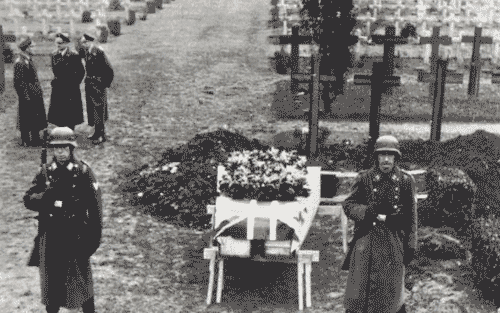
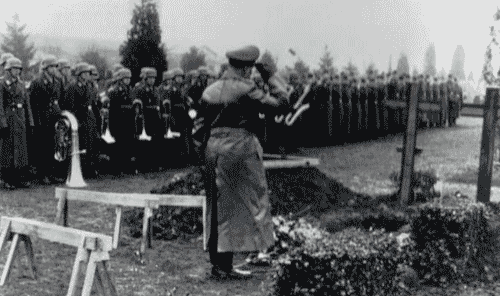
The men were buried with honour by the enemy
in a full military funeral
at Marissel French National Cemetery, Beauvais. |
| |
|
 |
| |
|
 |
| |
|

They
lie in graves next to each other, with Basil Sayers in grave
219, Vernon Butler in grave 220, and Weston Robertson in grave
221.
Wing Commander Butler's cross, left, bears
the name "Robert"; he was nicknamed "Bobby" after his father,
the Chief Constable of Ramsgate. |
|
with grateful thanks to Damian
Butler |
Citation and Fatal Mission |
