|

HMS Warspite in 1942
Account from a crewmate of Len Saunders.
Following the ship's participation in the invasion of
Sicily in July to August 1943, the Warspite returned to Malta, where some four members of the
ship's company contracted polio, and as little was then known of the
condition, the ship was placed in quarantine.
No one really knew what was the disease, and we were
told to take all precautions. If we were to eat a piece of fruit we were
not allowed to have it already peeled but peel it ourselves to ensure it
wasn't contaminated.
 |
|
 |
| The Italian fleet proceeding to Malta after
surrender in September 1943. Warspite's ensign is at the bottom
of the photograph; she is following HMS Valiant |
|
One of the Italian ships
arriving at Malta, taken from the aircraft catapult deck of the
Warspite |
 |
|
|
After covering the landing at
Catania, Sicily, the Warspite was used to bombard as required.
Above is a helmet picked up by a shore party at Reggio |
|
The ship moved from Valletta to Marsaxlokk, a bay
further along the coast of Malta. The bay had a boom across its
entrance. The Italians (they then had yet to surrender) had a well-known
reputation for swimming, fixing timed explosive devices to the hulls of
ships. To deter any attack from the swimmers the boom was patrolled
by a motor boat equipped with explosives in the stern compartment,
and a small charge was dropped by the boat at regular intervals with a
large charge at slightly larger intervals.
Len was the torpedoman (electrician) in the boat,
together with another torpedoman, who could best be described as
eccentric. Apparently he was smoking a cigarette close by the box
holding the charges, lighting the fuse of a charge with his cigarette
and then dropping it overboard; unfortunately he dropped his cigarette
into the box of charges and they exploded.
There were ten men in the boat's crew, five of whom
died immediately, a Royal Marine suffered a broken ankle, together with
other injuries. He could not swim, but he managed somehow to cover the
fifty yards back to safety. The cox'n of the boat, a Leading Seaman Bell, took
the full force of the blast on his back, and had large splinters of wood
driven into his legs and back from top to bottom. He was transfixed, but he did survive.
It took over a year to get all the splinters out.
The ship had been refitted in Seattle, USA, after sustaining serious
damage in the Mediterranean in 1941 in a dive bomb attack. Whilst in
America, Len married a local girl, and when the ship left she felt it
was desertion and divorced him. Unfortunately he did not alter the name
of his next-of-kin, so the notification of his death went to the
divorced wife, and Mrs Saunders did not know of her son's death until
some three months later when she received a letter of commiseration form
the ship's chaplain.
Along with the effects of the other dead men, Len's
clothing etc was auctioned before the foremast, as was the naval custom.
The effects would be bought for high sums; I bought Len's shoes for
£7.50, and I was earning only thirty shillings a week. The other
torpedoman had only a blanket and a couple of Woodbines, so they kept
putting them back into the sale after they'd been bought until enough
money was raised. The proceeds of the sales were sent home to the next-of-kin;
in Len's case this
must have been to the former wife.
Len died on 22
August 1943, when he was 22. He was a lovely chap, so clean
and tidy - a glowing example of how everyone should be
|
Our Captain, Herbert Packer
(later Admiral Sir Herbert Packer), had been the Captain of HMS
Excellent, the main gunnery school, near Portsmouth, when Noel
Coward was filming "In Which We Serve" (1942). Captain Packer
had lent naval ratings as extras for various scenes. As a "thank
you", when Noel Coward came out to Malta to entertain the
troops, the Warspite had her own private show, on the aircraft
catapult deck. Captain Packer is immediately to the left of the
piano. |
|
 |
Post Script
 |
|
(left) At Salerno the enemy
were preventing the army from the toe of Italy coming up to
reinforce the Salerno forces and break the encircling enemy
forces.
The image shows the
battle ensign being hoisted as the Warspite enters Salerno bay;
the proximity of the shore can be noted in the background. From
then onwards bombardments were carried out at the requirement of
the army.
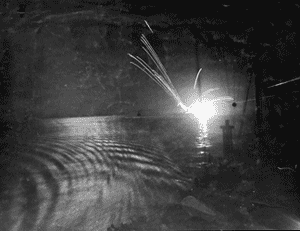 On
16 September 1943, the enemy sent over what we thought were six
planes - they were actually three planes, each with its own
radio-controlled glider bomb. One of the bombs
exploded off the starboard side, one off the stern, and
the last went straight down the funnel and blew out the bottom
of one of the boiler rooms. Nine men were killed. On
16 September 1943, the enemy sent over what we thought were six
planes - they were actually three planes, each with its own
radio-controlled glider bomb. One of the bombs
exploded off the starboard side, one off the stern, and
the last went straight down the funnel and blew out the bottom
of one of the boiler rooms. Nine men were killed.
(right) A night attack on HMS
Valiant in Salerno bay. |
|
|
|
 |
|
(left) The Warsprite was towed
back to Malta. When we were hit we had been bombarding, so the
guns were hot and had cooled around and gripped the charges. We
had to fire the guns out at sea, in order not to hurt anyone,
and men then went round with wood to fill up all the holes where
the rivets had popped out. The Warsprite was patched with a big
slab of concrete, and then towed a thousand miles from
Malta to Gibraltar. Four tugs were used. The ship ahead of the
tugs is HMS Palomares, an anti-aircraft escort which was a
converted Fyffe banana boat. At Malta the bays were filled with
ships hit by bombs; low in the water with the waves lapping over
the gunwhales. When the Warspirte was first hit we were baling
her out for over a day until they the pumps were supplied.
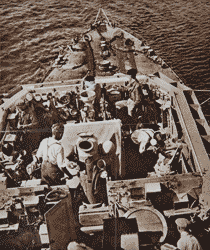 (right)
"The illustration from The Sphere: An Illustrated Newspaper for
the Home) what happens to a spick and span ship when she gets
into the hands of the shipbreakers." The Warspite was scrapped
in 1947. She was intended for breaking at The Clyde but a severe
storm during the voyage beached her on the south coast of
Cornwall, and there she was scrapped. (right)
"The illustration from The Sphere: An Illustrated Newspaper for
the Home) what happens to a spick and span ship when she gets
into the hands of the shipbreakers." The Warspite was scrapped
in 1947. She was intended for breaking at The Clyde but a severe
storm during the voyage beached her on the south coast of
Cornwall, and there she was scrapped.
Note: The Sphere newspaper
spanned three wars - the Boer, The Great, and the Second World
Wars. It closed in June 1964. |
words and pictures with grateful thanks to
Mr Ronald Jarvis
Keepsakes

Len is the first rower on the left |

Envelope written by Len to his brother Roy. The letter was
postmarked in Dover on 18 November 1941. |
|

On Dover seafront, Len, on the left, with a friend
|

On the right, Len Saunders, with Roy, his brother,
left, and, in front, their father |
|

Christmas card sent from Len to his younger brothers Roy and
Gordon |
|
|
|
images with sincere thanks to
Wendy Cunningham |
|
