|
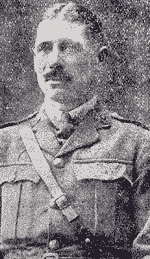 Dixon, W. A. Dixon, W. A.
William Alfred Dixon was a Lieutenant in the Suffolk Regiment. He was a Dover resident
and professional soldier having enlisted in 1905. He served throughout
the Great War being wounded in the first battle of Ypres and for three
years at Salonika and also in Russia. He gained a rapid promotion for
an invention in trench warfare. In November 1915 his commanding
officer wrote "I can thoroughly recommend him. He is a very superior
type of NCO with good manners and well-fitted for a commission. I
understand that his wife is also well-educated and has nice manners. He
was wounded with the Expeditionary Force and did really well out there" He died in Ireland on 22 October 1920, when he was
39, having returned there just two days before, after ten days leave in
Dover. He had been travelling in the second of two military motors and
on a secluded stretch of road between the villages of Innishannon and
Ballinhassig, Ireland some half an hour after they had left at 09.30 the cars were fired upon by people
concealed by fences. The first of the cars had important dispatches which may have been the motive. This car escaped
and a Corporal from it leapt out and gave covering fire until he
fell with a wounded knee after some four of the attackers advanced upon
him, firing in return
The second car however, in which Lieutenant Dixon
was travelling came under heavier fire. Lieutenant Dixon
leapt out when shots immobilised the engine and/or wounded the driver
and was immediately hit in the shoulder by a rifle bullet. He ordered
his men to line the road and had lain down when a second shot hit him
in the left nostril penetrated upwards into his brain and killed him
instantly. (The examining medical officer later stated that this shot
had come from a revolver and that in his opinion it had been "fired at
close range" The verdict of the military court of enquiry which
sat at Cork Barracks and the inquest was that
Lieutenant Dixon had been killed by an act of "wilful murder") Private
Reid of the Essex regiment was also killed and five others wounded,
Sergeant Bennett later
dying. A number of the attackers then
took away all arms and weapons, and searched the pockets of the officer,
leaving untouched the only uninjured person a Private of seventeen
years save for taking his rifle
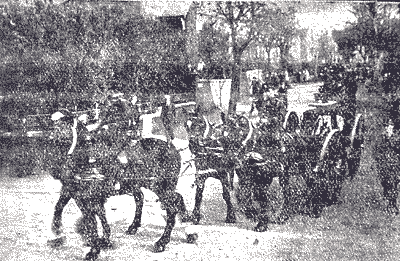 Lieutenant
Dixon's funeral service began at St Paul's where he had lain in state
the night before. Father Grady officiated and the coffin with the
Union Flag draped over it was then carried on a gun carriage to St
James, H X 13. The pall bearers were from the Essex regiment and it was a
funeral with full military honours with a band from the 2nd battalion
of the Royal Irish Fusiliers and a party from the 1st battalion of the
Royal Sussex firing three volleys over the grave. The Last Post was
sounded. There were many mourners including his wife and child, his
sister, Mrs Hatton, and his brother, Alfred Dixon, who was musical
director at the Lord Warden Hotel.
The funeral expenses amounted to £14 15s. with an additional £20 for the
coffin which were paid by the Military as "the estate is very small" Lieutenant
Dixon's funeral service began at St Paul's where he had lain in state
the night before. Father Grady officiated and the coffin with the
Union Flag draped over it was then carried on a gun carriage to St
James, H X 13. The pall bearers were from the Essex regiment and it was a
funeral with full military honours with a band from the 2nd battalion
of the Royal Irish Fusiliers and a party from the 1st battalion of the
Royal Sussex firing three volleys over the grave. The Last Post was
sounded. There were many mourners including his wife and child, his
sister, Mrs Hatton, and his brother, Alfred Dixon, who was musical
director at the Lord Warden Hotel.
The funeral expenses amounted to £14 15s. with an additional £20 for the
coffin which were paid by the Military as "the estate is very small"
 In 1924 his widow
staying in Folkestone with the family of his brother Ernest Dixon, a casualty in the Great War
requested that William's name should go on the Dover Town Memorial. This
request was turned down because although Lieutenant Dixon had served
through the Great War and had died in service his death was not
attributable to that War In 1924 his widow
staying in Folkestone with the family of his brother Ernest Dixon, a casualty in the Great War
requested that William's name should go on the Dover Town Memorial. This
request was turned down because although Lieutenant Dixon had served
through the Great War and had died in service his death was not
attributable to that War
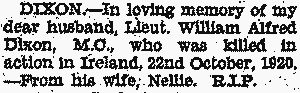
above: in memoriam announcement from
1942
The sad story of William Dixon and his non-commemoration on Dover
Town Memorial was discovered by research of the
Dover War Memorial Project. For William Dixon's family tree see
Faded Genes and for further information see
biography
both by Dave Dixon. With thanks to Neil Clark and Kyle Tallet for
kindly supplying copies of the service papers of Lieutenant Dixon
Note: the family lived at several addresses in Dover
including 7 Priory Gate Road, 65 Clarendon Street, 64 Clarendon Street
February 2008 - some good news. The CWGC, thanks to the
work of Kent Fallen have agreed that
Lieutenant Dixon may be placed on their records. He will eventually
receive a Commonwealth War Graves Commission headstone and his grave
will be cared for in perpetuity.
September 2008 - Edith Dixon sister of William has been
identified by Dave Dixon as the daughter-in-law of Mrs Mary Ann Asseling
who was on her way to hospital in Dover when subjected to the air raid
of 19th March 1916 |
|
Dummer, F. C.
Frederick Charles Dummer, 3665, was a Rifleman in B
company of the 2nd battalion of the Rifle Brigade. He was the son of the late Moses Dummer and
the late Elizabeth Ann Dummer, née Lemon who had married in Dover in
1872. Frederick had been born in 1886; his mother, aged 39, died the
same year and was buried at Buckland on 7 October. Moses died in Dover in 1898;
he had been a bugler in the Rifle Brigade, and in 1871 was recorded as
being 33 years of age, and stationed at the South Front barracks,
Western Heights, Dover.
In 1891 the family
were living at 5 Magdala Road, with children Stephen, aged 15, Mary,
aged 14, George, aged 10, and Grace, aged 8, as well as Frederick. By 1901 Frederick was lodging with
William and Elizabeth Ayes at 180 London Road, Dover, and was
occupied as a
papermaker. He had a tattoo on his arm: "in loving memory of my dear mother".
On service, Frederick had been wounded in
action three times; by a gun shot on his right side on 10 March
1915 and another in his left ankle on 4 April 1917, and by being
buried by shell and shocked on 13 November 1916. He was killed on 9
July 1917 in Belgium, and was buried in Vlamertinghe New Military
Cemetery, Ypres, I F 15.
He was the husband of Mary Ann Dummer, née Macbeath, of 59 Kinnaird
St, Wick, Caithness, and they had a son, Frederick Henry Macbeath Dummer,
born on 23 September 1916. Mary Ann remarried, to Alexander Rosie
on 14 December 1922 in The Manse, Wick, CAI, SCT. She died on 28
December 1969 in Inverness.
Frederick's brother, George, married Eliza Jane Fagg
at St Andrews, Buckland, on 1 January 1899, and on 9 December 1900 Hilda
May, their daughter, was christened, followed by Grace Mary on 23 August
1902 and Dorothy Emily on 5 May 1906.
with thanks to Joyce Banks |
