|
Dover Cemeteries
"Jottings" -
spotted by volunteers as they visit the cemeteries
(Index).
SERVICE
MEDAL WINNERS
1. GEORGE CROSS WINNERS
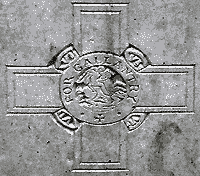 Reginald
Harry Maltby died on 17th December 1943, a month before his 62nd
birthday, after a
very short illness. He is buried in Charlton
Cemetery, 14 SJ. In the Great War Reginald
Harry Maltby died on 17th December 1943, a month before his 62nd
birthday, after a
very short illness. He is buried in Charlton
Cemetery, 14 SJ. In the Great War
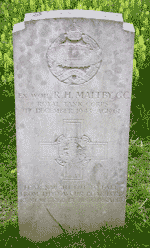 he was a Motor Engineer, and became WOII in the Royal Tank Corps, from which Corps he retired in
1939. He then became the landlord of the Five Alls in Market
Street, and later the Dewdrop Inn at Tower Hamlets. he was a Motor Engineer, and became WOII in the Royal Tank Corps, from which Corps he retired in
1939. He then became the landlord of the Five Alls in Market
Street, and later the Dewdrop Inn at Tower Hamlets.
He was awarded an Empire Gallantry Medal in
1926. Serving in India, he had climbed down a 40 feet well in
Lahore to
rescue a little girl who had fallen in. After Mr Maltby's death,
the medal was exchanged for the George Cross. He had also been
awarded the Territorial Efficiency Medal in 1922, while serving
in Kirkee.
Funds for his headstone were raised by
donations from the Royal Tank Regiment Association, and the stone was placed in 1998.
At the bottom are the words, "Fear naught but to fall from Thy
favour, dear Lord. Remembered by his comrades"
He was the dearly-loved husband of Beatrice
Maltby, and father of Reginald Charles, b 1903, and Freda May, b
1906. Mourners at his funeral with his family included friends,
the president and secretary of the Dover and District Licensed
Victuallers Association, and Freemasons from the Peace and
Harmony and Military Jubilee Lodges.
with thanks to Joyce Banks and
Tony Belsey
2. DISTINGUISHED FLYING CROSS WINNERS
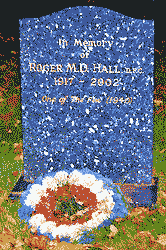 Roger
Montague Dickenson Hall ("Sam") now lies at rest in St James
cemetery near the World War II Commonwealth War Graves. He was one of
"The Few". During the Battle of Britain he flew Spitfires with
No 152 Squadron, based at Warmwell in Dorset. They were
defending the Portland area. Roger
Montague Dickenson Hall ("Sam") now lies at rest in St James
cemetery near the World War II Commonwealth War Graves. He was one of
"The Few". During the Battle of Britain he flew Spitfires with
No 152 Squadron, based at Warmwell in Dorset. They were
defending the Portland area.
He was gazetted on Tuesday, 24th November
1942, with the citation, "Flight Lieutenant Roger Montagu
Dickinson Hall (43009), No 91 Squadron. This officer has
completed a large number of sorties, including sweeps, shipping
reconnaissances, and many air-sea operations. He has always
displayed great keenness to engage the enemy."
Born on 12 August 1917, in Lincolnshire, he
attended Haileybury College between 1931 and 1935, and then went
to Sandhurst as an Officer Cadet. He became a 2nd Lieutenant in
the Royal Tank Regiment in 1938
In March 1940 he applied to the RAF, and in
August, after completing his training, he went to No 1 School of
Army Co-operation at Old Sarum. He volunteered for Fighter
Command and went to Warmwell on 1st September 1940. Fighter
pilots were needed urgently, so Mr Hall had just four days
training before he was in action with his Squadron, No 152. He
recalled, in an interview in 1985, that the need to survive in
combat was when a pilot really learnt to fly, achieving the
previously unimaginable with the plane. Mr Hall even
survived being shot down, picked up by a trawler from the sea by
Folkestone.
In December
he joined 255 Squadron, and gained the first victory for the
squadron when he brought down a He111 over the Humber in
February 1941. In September that year he became a Flight
 Commander
with No. 72 Squadron at Gravesend, and in April 1942 he went to No
91 Squadron at Hawkinge. He left this squadron in October, and
transferred to Administration. Commander
with No. 72 Squadron at Gravesend, and in April 1942 he went to No
91 Squadron at Hawkinge. He left this squadron in October, and
transferred to Administration.
He left the RAF in 1944, with the rank of
Flight Lieutenant. As an administrator with British European
Airways he helped organise the Berlin Airlift. Thereafter he
worked for thirty years for the RAC, including as a motorcycle
patrolman, until he retired.
He came to Dover in 1952, and joined the RAFVR in July 1960.
He became Commanding Officer at Dover and Sandwich for the Air
Training Corps, and later chairman of the Dover ATC management
committee, also being elected President.
He never forgot his Battle of Britain days.
He wrote a book, "Clouds of Fear", about that heady summer. He attended reunions at Bentley Priory,
the former Fighter Command
Headquarters, and the yearly Remembrance at the Battle of Britain memorial
at Capel in July. He was present there even in the year he died. In the 1980s
he featured in a "Songs of Praise" from Dover, and in May 2000
he was one of twenty-five presented with a
specially-commissioned Battle of Britain Pilots' watch
On 19th December 2002, after having become
increasingly frail, Mr Hall was found dead at his home in Camden
Crescent. He was 83. His funeral was held on 2nd January 2003.
*
This is an extract from "Clouds of Fear", a
moving book to read, referring to one of Roger Hall's
operational sorties when he was based at Manston, Kent.
About three miles off the French coast we
were attacked again by nine 109s who had been waiting for our
return ..... When they had finished their dive they were on the
same level as we were, and coming into us almost head-on at a
phenomenal rate. Black and Yellow sections on our right and
nearest to the 109's pulled to starboard a bit to engage them,
and fired at them as they approached. The leading 109 was hit
somewhere in the engine and flames started to come away from its
nose. I think the pilot must also have been hit, for the 109
continued to come straight at Black and Yellow sections as
though intent upon ramming into them. The leader, now a mass of
flames, came straight into the section and hit Yellow two about
his port win with its starboard wing. It was a fantastic sight.
Yellow two's wing came clear off and was thrown high into the
air above. The remainder of the machine spun round like a
catherine wheel in a horizontal plane at an incredible speed but
seemed to lose no altitude at all. The 109 lost its starboard
wing and, on fire, proceeded towards the sea like a rocket. Its
other wing came off before it hit the sea. Yellow two, or the
remains of it, spun more slowly until it in turn went into the
water. The pilot never got out.
After this incident we remained unmolested
for the rest of our channel crossing. The white cliffs of Dover
became something more than just a symbol of our ultimate safety
when we were half way across the straits. they appeared to
embody all that had ever been written about them. They had been
called, among other things, silent sentinels, bastions of
freedom and white bulwarks. As we swept over them to the
sanctuary of the Kentish fields beyond they seemed all that and
much more.
information supplied by Dean
Sumner
also from article in the Kentish Express, 1st January 2003
thanks also to Joyce Banks
Edmund Frank Grover was 23 when he died on 23
June 1947. He is buried at Charlton, QL 12. He was awarded the
DFC.
3. DISTINGUISHED FLYING MEDAL WINNER
Rex Ronald Boyce Durtnall,
buried at St Mary's, who died aged 21 in 1941.
4. DISTINGUISHED CONDUCT MEDAL WINNER
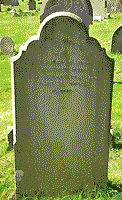 Henry Augustus Horn died on 24th November 1926, at his home at
43 Lowther Road. He was buried at Charlton on Saturday, 27th
November. Amongst the floral tributes were those from his
"broken-hearted wife", Elsie, and his shipmates, the
greasers, and firemen, on the ss Riviera. Henry Augustus Horn died on 24th November 1926, at his home at
43 Lowther Road. He was buried at Charlton on Saturday, 27th
November. Amongst the floral tributes were those from his
"broken-hearted wife", Elsie, and his shipmates, the
greasers, and firemen, on the ss Riviera.
He had served during the Great War from 1914
to 1918, and had won the DCM in the retreat from Mons in the
Battle of Landrecies. He was then in the 1st Loyal Lancashires.
Mr Horn had also been a POW for eight months.
In civilian life he had been for 12 years a
foreman on the Cross Channel Ferries. He was the son of Mr James
Horn, a dairyman from Townwall Street, and his wife, Agnes. The
headstone reads: "In loving memory of my devoted husband, Henry
Augustus Horn, DCM, who died 24th November 1926, aged 36 years.
At rest."
with thanks to Joyce Banks | 