FIRST DOVORIAN DECORATED FOR WWII SERVICE

Frederick Henry Gardiner was the first man from Dover to
be decorated for War Service in the Second World War. He was 25
and the youngest of a family of twelve; his parents, Mr and Mrs
William Gardiner lived at 57 Tower Hamlets Street. William
Gardiner had enlisted in the Middlesex regiment in 1883, and
during the Great War, aged 54, had rejoined.
Sergeant Gardiner was an old St Bart's schoolboy. He left when
he was 15 to work in Buckland Paper Mills, and then joined the
RAF as an aircraftman in June 1934. He became a wireless
operator, and, after service abroad, trained as an air observer.
 He passed and was promoted sergeant.
In November 1939 Sergeant Gardiner was awarded the Medal of the
Order of the British Empire for meritorious services.
The
citation read: "The plane in which Sergeant Gardiner was air
observer was attacked during September by enemy aircraft and was
seriously damaged. Despite much bleeding from a gunshot wound
over the right eye, Sergeant Gardiner continued his duties and
set an accurate course to the base. The aircraft caught
fire on landing. Although his own clothes were alight, Sergeant
Gardiner began to extinguish the burning clothing of the
wireless operator by rolling him on the ground and beating the
flames with his hands. Not until these efforts had succeeded did
he attend to his own clothing"
Sergeant Gardiner s pent several weeks in hospital, recovering. He was engaged to be married
to Miss Clara Elizabeth Hood, second daughter of Mrs M L Hood of
6 Pioneer Road and the late Mr J B Hood, CPO TC of the Royal
Navy, but the wedding had been
postponed, owing to the outbreak of the war. The new date set
was 25th November 1939, and they married at St Andrews,
Buckland. The bride was attended by her sister, Mrs Thompson,
and the groom's niece, Miss Nora Ricketts, and was given away by
her brother-in-law, Mr Thompson. The best man was Mr P (Mick)
Gardiner, the groom's brother.
pent several weeks in hospital, recovering. He was engaged to be married
to Miss Clara Elizabeth Hood, second daughter of Mrs M L Hood of
6 Pioneer Road and the late Mr J B Hood, CPO TC of the Royal
Navy, but the wedding had been
postponed, owing to the outbreak of the war. The new date set
was 25th November 1939, and they married at St Andrews,
Buckland. The bride was attended by her sister, Mrs Thompson,
and the groom's niece, Miss Nora Ricketts, and was given away by
her brother-in-law, Mr Thompson. The best man was Mr P (Mick)
Gardiner, the groom's brother.
Owing to the groom's award, the wedding attracted much interest,
with a large number of people waiting outside the church and
along the path to the lych gate to see the couple.
Sergeant Gardiner was on leave after the wedding when he was
suddenly recalled to France. Believing he was going back to
duty, he was surprised to discover that the recall was in fact
so that he could receive his award from the King, then in that
country. As the King pinned on the medal he said to Sergeant
Gardiner, "I am pleased to meet you, and wish you good luck."
Sergeant Gardiner was then returned to England, to continue his
honeymoon.
source: Dover Express
Some other Firsts for Dover:
First Great War bomb that landed in
Britain, 24 December 1914 (two bombs had been dropped
off the Admiralty Pier, Dover, on 22nd December)
(Dover was also the last town to receive
an air raid before the Armistice was signed)

above - garden where bomb landed |
Taswell Street

broken windows at St James rectory nearby
|
|
First insurance claim paid out in
England for damage done by hostile aircraft, after the
bomb dropped on Christmas Eve
|
by agents Messrs Boyton and Son of 5
Martin's Place, Dover in February 1915
(cover could be arranged at 3s 4d per £100 per annum for
damage by bombs or aircraft, and 15s per £100 per annum
for full war risks) |
| First gun fired by the British Army in
the campaign in France |
"E" battery, to which belonged Capt Bartram, son of
Canon Bartram |
| First black army combat officer (Walter
Tull) - his mother born in Dover |
Alice Palmer |
| First black outfield professional
football player (Walter Tull) - his mother born in Dover |
Alice Palmer |
| First (and only) Jewish winner of the VC
in WWII - born and educated Dover. He was also the first
VC winner born in Dover. He was given the freedom of
Dover on 11 January 1943 |
Thomas Gould |
| First winner of the VC from the Essex
regiment |
William McWheeny, buried in Dover 1866 |
| First town to be attacked by the German
navy in the Great War (submarines tried to enter the
harbour and torpedo battleships) December 1914 |
from Dover Harbour |
| First town in England to suffer a
moonlight air raid - January 23 1916 - also called the
first "real" air raid |
9 bombs across from SECR station and machine-gun
over Langdon battery |
| First victim of such a raid (above) |
Harry Sladden, Red Lion Inn |
| First Great War Dovorian civilian casualty - 23
January 1916 |
Harry Sladden, Red Lion Inn |
| First raid against the barrage (mined
nets across from the Goodwins to the French coast) |
27 October 1916 |
| First Great War baby born to a soldier
of the Berkshire Regiment |
Ivy N B ("Norma") Fussell, born 14 August 1914 |
| First Dovorian Reservist to apply for a
rail ticket on call up |
Harry Sole |
| First Dovorian known to have died in the
Great War - 14 August 1914 |
Frederick Geard |
| First Dovorian to receive Great War
Military Cross and bar - Gazette 17 September 1917 |
Alexander F Worster |
| First fatal flying accident at Dover -
Martin Mill - 7 September 1915 |
Geoffrey Brian Hobbs, buried at St Margaret's |
| First Great War fatal accident on a
Dover firing range - 10 October 1917 |
Private F. Dunn |
| First WWII black-out fatality in Dover
(probably) - knocked down by a bus when walking his dog
on 27 September 1939 |
William Banks |
| First WWII casualty recorded from the
County (Grammar) School - 13 January 1940 |
Stanley Mornington West |
| First military funeral and volleys for
civilians in Dover |
SS Maloja victims February 1916 |
| First WWII War Dovorian civilian casualty - 6
June 1940 |
Edith Wells |
| First Dover injury in the Battle of
Britain - bullet in leg of ambulance driver standing at
Matthew's Place (RH) - 10 July 1940 |
George Knight |
| First Dover injury in WWII - from
"goofing" - watching dogfights (HRPB) |
William Ransom(e) (Deputy Town Clerk) |
| First WWII shells in Dover - from K5
railway-mounted guns |
12 August 1940, Edgar Crescent |
| First casualties from shelling in Dover
12 August 1940 |
Helen Barker, Alfred Reid, St Radigund's Road |
| First time Zeppelin illuminated by
searchlights - 17 May 1915 (the Dover Anit-Aircraft
Corps received silver badge awards for this, which
occurred on the first Zeppelin raid on Dover) |
Langdon Battery |
| First war vessel sunk in Straits of
Dover, having left Dover the afternoon before. Torpedoed
from submarine |
HMS Hermes (31 Oct 1914) |
| First Yule Log (Christmas cake) in Dover
(or anywhere?) was said to have been brought by a cook/confectioner
working at Holmes Morris, the baker and cakemaker. He
later became a Great War victim |
George Bates |
| First church bellringer to die in the
Great War, a Dover ringer who had rung at St Mary's and
St James |
Archibald Percy Randolph Gibbs |
Novemcentennium!
 From the Kentish Express, 5 March 1943 -
on 27
September 1940, during the Battle of Britain, a Spitfire
forced down an Junkers 88 bomber on the marshes between Whitstable and Seasalter. When British soldiers went to capture them, the crew
opened fire with machine-guns. The British soldiers, from the
1st battalion London Irish Rifles, replied, and
eventually the crew of the plane surrendered. The aircraft,
saved from an explosive charge intended to destroy it, was
From the Kentish Express, 5 March 1943 -
on 27
September 1940, during the Battle of Britain, a Spitfire
forced down an Junkers 88 bomber on the marshes between Whitstable and Seasalter. When British soldiers went to capture them, the crew
opened fire with machine-guns. The British soldiers, from the
1st battalion London Irish Rifles, replied, and
eventually the crew of the plane surrendered. The aircraft,
saved from an explosive charge intended to destroy it, was
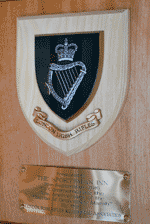 subsequently
examined at Farnborough, providing much useful information.
subsequently
examined at Farnborough, providing much useful information.
This event, said the newspaper, was small in
comparison with the battle in the skies, but "actually of" great
historical significance". The Battle of Graveney Marsh was "the first time Englishmen ...
fought with foreign troops on British soil since the Battle of
Hastings, 1066"
In September 2010,
a commemorative plaque (right) was presented to The Sportsman
public house, where the London Irish Rifles battalion had been
stationed in 1940. The plate reads: Presented to The Sportsman
Inn 26th September 2010 to commemorate the 70th Anniversary of
"The Battle of Graveney Marsh" by the London Irish Rifles
Regimental Association".
* Notes:
On 6 January 1781, the Battle of Jersey was fought against a
French army attempting to invade. A later battle on British soil
was fought at Fishguard between 22-24 February 1797 against
invading French Revolutionary troops.
