|
Memories
We've been fascinated by
stories of war-time Dover and its people. Here are some of them.
But there must be many more. What do you remember of
Dover during the Wars? Do
tell us!
WORLD WAR
I
|
My mother is 94 now. She can remember
sheltering in the cave during the first World War. She
remembers the light from the oil lamps flickering on the
walls.
LS |
 |
Oil Mill Caves, Dover
1915
courtesy Dover Museum |
|
My father was killed in the Great
War. To survive then my mother took in washing
from Connaught Barracks. Mr Farrier went up there with
his horse and cart, and I went with him to get the
washing. Mrs Jackson was my mother's friend, and she
helped with the washing. They had a big copper that they
had to boil up in the yard to put the clothes in.
Uncle Bert lost his leg in the
Great War. It got machine-gunned off. He was in the
platoon, and the man carrying the Lewis gun said it was
too heavy, so Uncle Bert carried it. Then the bullets
from the cross fire killed everyone except Uncle Bert.
That was because he was carrying the gun, and the
bullets pinged off it. But he lost his leg.
He was shell-shocked by the war,
and when they were bombed in the second World War Uncle
Bert was eating his dinner. The peas on his fork went
straight up in the air, and even without his leg he
bolted straight across Liverpool Lawn and into the
caves. He passed out when he saw the damage
afterwards, but no one in the family was hurt. LB |

Poem from the collection at Dover Museum, written by Miss
Frances ("Fan") Boughton Spice
The author died in Dover in 1940
|
My father died in the Great War. My
mother fainted when she was told. Her pension was very
poor, and she had me and my brother to look after. Lady
visitors came to help, and all they said was, "Put the
children in a home and sell the house." Mother wouldn't
let us go like that. She would cook, and darn and mend
by candlelight, so she could get money, and her parents
helped too. They kept us in shoe leather and gave us
vegetables from the allotments. We stayed out of the
soup kitchens and never went hungry because of that.
IH |
|
My dad was in the
Marines for four years in the first war. He was a
Corporal Saddler; he was a leatherworker. One time he
was on a horse and it got shot and killed under him. His
first son, my brother, died when he was 18 months, and I
think my dad got some compassionate leave to come back
and be with my mum. That was before I was born. LDR |
|
My dad was born during an air raid!
25th November 1915. NC |
|
My dad was in
both wars. In the
Great War he was gassed, and his wife thought he had
died. She took another man and had a daughter by him.
Then my dad came back, and he had to lock the other
man out of the house.
The civilians on the continent wanted
to charge the soldiers for water when there was the
relief. So the soldiers shot all their guns in the air,
and frightened them all away, and then milked all their
cows.
He made a banjo from all the
bits he found in France, and used to sing songs he had
made up. You should have heard the songs he sang about
the enemy - they weren't politically correct! An5 |
Aftermath
|
It wasn't uncommon, when walking
along the streets, to hear men coughing away in the
front rooms. They had been gassed during the war.
Military men who'd died would be given full military
honours, and they'd be taken to the cemetery on a gun
carriage. You often saw gun carriages going past. RJ |
WORLD WAR
II

Dover Residents' Documents, from the collection at Dover Museum
|
My mum was a Dover girl, but we were away from
Dover when World War II started. My dad was at
sea, and she wanted to come home. Later the
authorities asked how we'd got in without any
papers, and we said we hadn't seen any
sentries. It was quite true. My brothers were 13 and
15 and they found out where all the sentries were
stationed. We'd come in over the hills one dark
night and avoided them all!
EP |
At Home
|
The beach was all barbed wire,
and it was a restricted area. It was possible though
to go swimming there if you were a resident, but if
we girls went out in our swimming costumes all the
soldiers would whistle and call out. So we didn't go
VE |
|
We boys used to go round the
cliffs at St Margaret's, looking for things that had
been washed up by the tide. One day I found a large
bomb lying flat on its side; it was yellow and about
four feet long. It was a job to lift it out of the
water, so I asked my pal to go and get more help and
a low wheel hand-cart. The bomb was too heavy to
push up the road so we decided to lift it one step
at a time up the cliff steps. There were about a
thousand, and it took us ages.Four of us took it up,
and the other lad went up the hill with the cart to
wait for us. Then we took it home. On the way an
army officer and soldiers stopped and asked where we
had found the bomb, and said that as it had been
under water it would be safe. I took it home to the
bungalow where we lived and we lent it against my
bedroom window. Mother was worried but I said it was
safe, and lots of people came to look at it. Then my
brother came home on leave from the navy, and
immediately made us all leave the bungalow. He
called the bomb and mine squad, and they took it out
to sea and exploded it. The Naval Officer said that
it was a delayed action bomb, and he was very
surprised it hadn't exploded when we were bringing
it home. FS |
|
You could go up Plum Pudding on a Bren gun carrier
-
the soldiers would give you rides for 1d. (Plum
Pudding is the local name for the hill, Stepping
Down) ME |
|
If you went down the Town
Hall you could buy savings
stamps for 6d. You could
show them to the soldiers
and they'd give you a ride
on a Bren gun carrier, from
the Town Hall, along
Folkestone Road, up Plum
Pudding, and back again. We
used to show them the same
stamp several times, so we
got quite a few rides
JC |
|
When we were at sea, they gave us dehydrated food. Meat,
vegetables, and vitamin tablets to make sure we had all
we needed. The first time we tried the dehydrated food,
we didn't know what we were doing. We put some carrots
in a pot and added water, and began cooking them; they
swelled up and there was so much it overflowed out of
the saucepan. But there wasn't much taste. You could
tell it was meant to be different things, but everything
tasted so bland. RJ |
|
There was an exhibition in
the Town Hall of military
equipment, and there was all
army stuff there, and a
display of food, what we'd
call compo rations. With
them were sweets. We didn't
see sweets during the war,
so I nicked some. I was
really worried afterwards,
going home for my dinner, I
kept thinking "What if I
can't eat my dinner, what
will my mum say?" JC |
|
There was The Spot by Dodds
Lane, and the man kept
chickens and ducks up there.
He had a caravan there too,
and - this is really true! -
in the caravan he grew
tobacco. ME |
|
My mum had eight sisters and two brothers. During the war they all moved to be near their mother,
so there was a whole group of them together and at one stage there were 50 of them from the same family all together in the same road. ME |
|
I was thirteen when the war started
and I wasn't evacuated because you left school at
fourteen. So instead I went out and got a job. I got two
jobs. In the morning I'd help in the fish shop, getting
the fish ready and cutting up the chips, and in the
afternoon I went to help the coalman. Then I'd go back
in the evening to help with the fish. When I was fifteen
I could start on the railway; I started as a cleaner.
When I was eighteen I got my call-up papers, and I went
to report. When I got there the officer took one look
and said, "You're in a reserved occupation. What are you
doing here - you're wasting my time. Get out!" What a
way to talk to someone. If I hadn't gone they would have
been after me. But I went back home and finished the war
on the railway. AE |
|
The soldiers at St Margaret's erected a small pier
on twelve foot stilts, about fifty feet long. At the
end of this pier was a small hut, room for three men
and a machine gun and searchlight facing out to sea.
When the minesweepers cut loose the sea mines the
mines sometimes drifted in with the tide. Day and
night the soldiers watched out for the mines. They
would fire and blow them up. You had to hit the
horns to blow them up. If they were close to the
shore they would shoot a hole in the mine so the
water would get in and sink it, and then the Royal
Navy mine and bomb quad would walk out and defuse
them. Some of the mines were trick ones, with little
blue round windows, and if one rubbed away these
little windows to look in the sun or daylight would
shine in and up would go the mine. I don't know if
any other shores had this arrangement for mines, but
St Margaret's was an ideal cove for them to float
in. It makes you wonder how many mines were still
floating the seas after the war. In 1949 I was on
honeymoon at East Cliff, and a mine collided with
one of the ships doing a day-trip from Dover to
Dunkirk and blew up. Fortunately the ship didn't
sink but I don't know how many people were hurt. FS |
|
There were big batteries up by Shatterlocks and it was the New Zealanders who ran them.
The batteries were to serve the search lights, and there were generators to charge them. I used to play in and out of the batteries,
and the soldiers used to shout at me to "clear off!". There
was a barrage balloon up at Shatterlocks too. ME |
|
My mother used to do odd jobs for the soldiers. She
would darn their socks and send them soup to heat up. I
used to take these items to the soldiers. One Saturday
afternoon in August the tide was out and all the
soldiers and an officer were looking down the beach.
There, coming up the beach, was a tall and giant
penguin. Where had he come from? Had he been a sailor's
pet on a ship that had been sunk? What a mystery! The
soldiers caught him in a large net and put him in a
spare hut and tried to feed him. The huts were where
they slept when they were erecting concrete barriers and
they were also on sentry duty. On Sunday morning I
went down with my mother as she wanted to see the
penguin, but we were told that a man with a van had come
from London Zoo to collect him. FS |
Caves
|
I didn't go to school for years because of the War.
We used to have to go into the caves. It was so boring.
After the last shell had come over each time we had to
wait for an hour before the all-clear. That was because
of the way the guns worked, and you knew if nothing had
happened for an hour then it would be safe. But if a
shell came after 55 minutes then you'd be stuck for
another hour. You could be in the caves for days. The
people who were killed at the Tower Hamlets cave had
gone to the entrance because they thought it was safe.
It had been nearly an hour since the last shell. But
then one came over.
The Salvation Army man brought round cups of tea. He
went all through the raids and then he was killed at the
Red Shield club. I thought he was ever so brave, going
through all the raids like that.
DE |
 |
Salvation Army bombed
courtesy Dover Museum |
|
When we were in the air raid shelters we would sing
"Under the Chestnut
Trees" and "This Old Man, He Played One".
If your mum said "move",
you moved.
Children were obedient then. They had to be or
they got killed in the air raids. EP |
|
During the war we had to be very
responsible and we grew up really fast. I took the
ration book shopping when I was six. Woe betide you if
you lost it! I was responsible for my little sister at
school as we were away from our parents; every time
there was a problem, like if she wasn't well or scraped
her knee, they would call for me to look after her. BS |
|
I was at school in Mill Hill. Every
time there was bombing we had to go in the shelters.
There was no real light so we had to do things by
memory. We
spent hours in there in the dark reciting our times
tables. GS |
|
I was in London and the school had a
tariff. If the raid was a couple of hours in the night
you could get in a few minutes later in the morning. If
it was seven hours, then you could have the morning off.
During the day we had to go into the air raid shelters
- I did a lot of learning in the half-dark in those
shelters! EL |
| In Noah's Ark Road there was a cave and it went all
through to Coombe Valley Road and came out by the
gasworks. We used to go in there, or in the Anderson
shelter. Me, mum, and the dog.
EK |
Raids
|
My grandmother lived at Clarendon Street. Aircraft
dropped a load of bombs on it, eleven in all. Numbers
135 and 139 were destroyed. My grandmother's house was
134, and she threw me down on the floor and laid on top
of me. I was all right, but my grandmother got bomb
splinters in her back.
DC |
|
I went out into
the garden, and my dad said, "Come in!" I said, "No,
it’s all right." Then I looked up into the sky - pure
blue it was - and I saw a tiny star. It was a
Messerschmitt. An1 |
|
My friend and I were walking along Cambridge Road.
We heard an airplane and turned round to see if it was
theirs or ours. But at the same time we heard a rat a
tat tat and we dived into a doorway. The next moment we
saw the bullets hitting the ground, screaming up the
street towards the monument. It was one of theirs.
It roared as it flew very close overhead.
JC |
 |
Borough of Dover
Fire Prevention Service
Training
Please note that your attendance is
requested for the purpose of receiving instruction as
laid down in the Civil Defence Duties (Compulsory
Enrolment) Order, 1942, and the Fire Prevention
(Business Premises) (No 3) Order 1942
addressed to Mr Pearce,
of the Invicta Inn, Snargate Street, requiring
attendance on Tuesday December 9th 1942, at Peter Street
with thanks to Derek
Yeomans |
|
My mum told me how a German plane went over the
Danes. It shot at all the footballers, and then it went
right up St Peter's Street, leaving a bullet trail along
the middle of the road.
DA |
|
My early memories
of the war whilst in Dover was of being put in the
indoor coal cupboard, my mother telling us to pray as
the German planes machined gunned the roof tops.
DC2 |
|
My mother was walking across the
fields in front of the Boys' Grammar with a friend, and
a German plane went over head. It machine-gunned them,
and they had to run for cover. They were very lucky
because they weren't hit. AH |
|
My granddad was shocked after the
first World War. When the sirens went off he was always
first to bolt for the shelter. But he was getting a bit
deaf, and one time the wind was in the wrong direction,
and he didn't hear the siren, so didn't know about the
raid until the first bang. He really ran then!
One time he was sheltering under the
stairs, and was looking for something. He set his hair
alight with the candle! NC |
|
My mother was in the ARP, and she was on the telephones at the exchange near Peter Street. An explosion from one of the
bombs or shells pushed her head right into the telephone exchange equipment. She was back at work after three days, when
the exchange had been tidied up. RJc
|
|
My mum was unhappy living in Dover in 1940 because of the war. She decided to fill a pram
up with family belonging and move from Brookfield Road to be with family members in Hougham, where she thought the family would be safe. But
the following day a Doodlebug landed in the adjoining field. My dad was one of the survivors of HMS Jervis Bay, which was sunk on 5 November 1940
SH |
|
|
I often used to go to bed in
bed and wake up down in the
cellar, where my mum had
taken me because there was a
raid on. They got either
side of our house, well, the
room where we lived, and one
was about 25 yards away, but
they didn't get us. That one
blew in all the windows and
after the war my mum got
compensation for the
curtains. JC |
|
My grandmother's house in Bartholomew Street got bombed.
My granddad had his leg broken. Clarendon got bombed too JC |
|
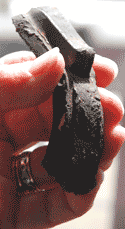 I
was out in the garden at
Buckland, hanging up the
washing. A shell came over,
and then the siren went off.
It was always that way
round, because it took such
a shot time for the shells
to come over so there wasn't
any time to sound the siren
before. I
was out in the garden at
Buckland, hanging up the
washing. A shell came over,
and then the siren went off.
It was always that way
round, because it took such
a shot time for the shells
to come over so there wasn't
any time to sound the siren
before.
I went in, and sheltered
under the stairs while the
raid was on. Afterwards, I
went back out into the
garden to see what had
happened to my washing.
There were two lumps of
metal in the garden,
shrapnel from one of the
shells that had exploded
nearby. I picked one up. Did
I drop it quickly! It was
absolutely red-hot. PJ |
|
My parents ran a
greengrocers' shop and I spent the entire war living in
Dover. Mum worked in the shop and dad served customers
from the back of his little Jowet van. That meant
travelling around Dover whilst shells and bombs were
dropping on a daily basis. They were so proud to have
kept the little shop open every day during the war.
I can't tell you how much the residents of Dover cheered
the sight of the Flying Fortresses heading towards
Germany and when the dreaded German Gun batteries across
the channel were finally silenced. As kids we were so
excited when the 'Yanks' arrived and we knew they were
going to help us beat Hitler. "Have you any gum, chum,"
was a popular kiddies' approach to the serviceman. BD |
|
I can remember the shell that
exploded on the hill behind 125 Clarendon Place.
Christchurch school on Military Hill was demolished
while we were in the caves during a raid. There was no
school to go to, and so I went home afterwards and got a
hiding from my Gran, because she thought I was playing
truant! After that we all went to St Mary's school, but
that's gone now as well.
DY |
|
I had gone over to Pineham, and I saw all the
yellow-nosed Messerschmitts coming. They went over
Canterbury way and then they turned and came back to
fire on the anti-aircraft guns. They were shooting down
the barrage balloons. They were clearing the way - they
were followed by Junkers 87s, but they were met by the
fighters who had come up because of the Messerschmitts. There
was a terrific battle in the sky.
There is a big graveyard out there, out to sea.
KS |
|
Dad had a redundant Jowet van in
the yard behind the shop which he kept for spares as
such were unobtainable during the war.
This van had a soft canvas roof which for me and my
mates became our Ack-Ack- base, with broom handles poked
up through the roof we shot down countless ME109's every
day. BD |
|
We were in London,
at Camberwell, and I could see all the bombs coming down
at the docks, and there was a glow in the sky with all
the flames. We used to shelter in a place near our
flats. There were concrete shelters thee with earth
roofs. My dad used to bring the chair down and my mum
would sit in it all night, and he would stand behind her
to comfort her. My sister used to jump up in the air and
scream when the bombs came. We knew if it was a long
whistle and a short roar they'd be further away, but if
it was a short whistle and a long roar they'd be close.
It didn't matter how many nights we were awake, my dad
never missed a day's work. He couldn't, or he wouldn't
get paid.
The planes used to
follow the river up, and drop their bombs, and one night
we were in the shelter, and two shelters along got hit.
That was at Dulwich. You could feel the ripple through
the floor of our shelter from the shock, and then
everything was deathly silence. It was completely still.
Everyone in that shelter was killed. After that my mum
and dad and sister wouldn't go down in the shelters, and
eventually the bottom of our flats was reinforced with
beams and concrete, and people sheltered there instead.
But I could never settle after that and whenever there
was a raid I used to walk the streets. I couldn't go
back underground. My dad used to say to me, "You be
careful, son". Until the worst was over I used to lie in
the gutter. I was 15 then.
The King and Queen
came out to visit after the shelter - that was in 1940 -
and they were just in the street next to us, and word
went round like wildfire and we all flocked round. I
stood within a few feet of them. The Queen was all
dolled up - she was the Queen! They were answering
questions and commiserating, and asking how people were.
It helped morale to know they had come, gave
encouragement. Everyone was saying, "Innit it marvellous,
the King and Queen!" The King was in uniform, and I saw
he had pancake make-up on, to give him a bit of a tan.
Everyone was wan in those days.
We eventually went
out to Fetcham, where my uncle had a small place, and
stayed there while he was away fighting. But there was a
raid there too, the night after we got there, on the oil
refinery at Leatherhead. The flames were 150 feet in the
air. My mum said, "We've come all the way out here, and
still they've come after us!" My mum couldn't settle and
missed her own home, and so after a year, when the
bombing had lessened, we came back to London. I was in
the Home Guard, until I could join up. Everyone did what
they could to help one another. LDR |
|
There were REME barracks up at Mill
Hill, and tanks would go up and down. It was a mile walk
to the school, and all of us boys would get a lift on a
tank whenever we could, hanging on all round it. GS |
|
"Have you got your torchlight?" This
was a check always said to anyone going out, because it
was so dark. QM |
|
I was 13½ when war started, and I
lived up Pioneer Road. I remember lying in bed when one
of the adjacent houses was completely destroyed. I went
to Barton Road School, and I was evacuated to
Monmouthshire. But I came back to Dover in 1940, and I
worked at Montague Burton, starting as an apprentice.
One Sunday afternoon the shop was destroyed; the shell
hit the electrical and gas mains and blew the shop to
smithereens. The site is still derelict now. It's a good
thing the shell wasn't the next day, or I wouldn't be
talking to you now! JW |
|
My mum was out in an air raid. It was her lunch
hour and she wanted to go home. She was cycling over the
viaduct when a shell exploded right near her and her
friend. They were blown off their bikes and covered with
dust and rubble. A man came running over to them. His
face was absolutely white with shock. He said, "I
thought you'd had it!" He helped them get up and dust
themselves down, and then they went home. My grandmother was
absolutely furious. She called my mum every kind of fool
under the sun for being out during a raid. But
eventually my mum got shell-shocked. She went down in
the caves and wouldn't come out again, and they had to
send her meals down there to her, until she was called
up for munitions work. MW |
 |
Dover Harbour being
bombed courtesy Dover Museum |
|
The V1 came on 13 August 1944. When we first heard
them and then the silence followed by a loud bang we
wondered what they were. Then we saw them, and we knew
that if we could hear them it was all right, but when
they went silent we ran like hell for shelter as we knew
they were coming down to explode. Lots of them passed
over the town, and a great number were shot down by ack
ack guns on the cliff tops or air craft.
Sometimes we saw an amazing sight. A fighter plane
would come out of a steep dive to gain speed and then
fly alongside the V1 flying bomb. then he would place
his wing under or over the V1 wing and by tapping the V!
wing would cause it to turn away. Sometimes it went back
to France. It didn't happen often but when it did we let
out a big cheer.
JC |
|
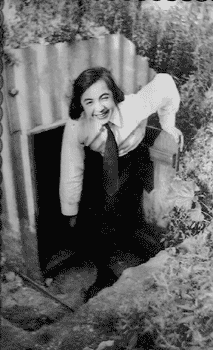 "My
mother, Gertrude Ellen Whitehead was in the WRNS,
serving with HMS Penns on the Eastern Arm of Dover
Harbour. I understand she cooked for the sailors
belonging to the torpedo boats, and that the Duchess of
Kent came to visit them.. "My
mother, Gertrude Ellen Whitehead was in the WRNS,
serving with HMS Penns on the Eastern Arm of Dover
Harbour. I understand she cooked for the sailors
belonging to the torpedo boats, and that the Duchess of
Kent came to visit them..
She lived at Winchelsea Terrace, and
I remember her telling me that she saw the first
Doodlebug go over; next
 day
the newspapers explained it was Hitler's rocket. Her
sister-in-law, who lived in Lambton Road, Dover, was 6
years old when the war started, and remembers seeing a
doodlebug explode in the sky. She also remembers a
property in Randolph Road being hit, and losing the side
of the house. she knew a family called
Revell, who lived close by, and who lost their lives
when a community shelter, the smaller of the two, was
hit in the Union Road. RS day
the newspapers explained it was Hitler's rocket. Her
sister-in-law, who lived in Lambton Road, Dover, was 6
years old when the war started, and remembers seeing a
doodlebug explode in the sky. She also remembers a
property in Randolph Road being hit, and losing the side
of the house. she knew a family called
Revell, who lived close by, and who lost their lives
when a community shelter, the smaller of the two, was
hit in the Union Road. RS
right: Gertrude Whitehead, coming out
of an Anderson shelter at 4 Winchelsea Terrace
left: two of her friends, Win and Mabel
|
|
My mother was in the tunnels at the Castle towards the
end of the war. She was in the plotting room. Sometimes
they would be talking to a pilot and then suddenly there
would be silence; the radio had gone off. They knew what
that meant. She hated it in the tunnels, sometimes not
seeing daylight for weeks on end. Through all the war
Dover was the only place she had to wear her tin hat. CA |
|
|
They were wonderful, the women. You don't hear much
about their role, but they kept the country going, while
the men were away. It was total war; everyone was
involved. They did all the jobs, and looked after the
children too, and they were often hungry. We couldn't
have done it without them. Then, when the men came
back, they told the women they were too silly to do the
work! RJ |
|
|
I recall one lunchtime, which I think may well have been
Christmas as the shelter was crowded with family. The
siren had sounded and we had decamped to the Anderson
shelter. As my mother brought the freshly-cooked rabbit
and vegs to the shelter steps, she suddenly stopped, and
said, 'What's that funny noise?'. The rest of us knew
exactly what it was, but my mother could have many
senior moments. It was a whistle, which ended in a very
loud and nearby CRUMP!
Lunch went flying - Over her! Into the shelter! On
the shelter! And into the next garden! I presume that
we went hungry. But I do recall the gales of eventual
laughter. It was always like that at G'ma's home.
Poorer than Church mice, but always happy.
BM |
|
Four shells landed on houses in
Eastbrook Place just off Castle Street. The houses were
still standing but badly damaged. I always remember
seeing the elegant furniture and curtains. All
badly damaged houses were eventually pulled down and the
contents just put onto lorries and taken to the tip up
St Radigunds. As the lorry went up the hill we would
jump on the back, and rummage through the contents, and
then as the lorry got to the top we would jump off
again.
JC |
|
I used to save the money I earnt as a delivery boy and
go into Curry's in the town to buy Meccano. I was
talking to the man in the shop, and there were four
giant explosions. He dragged me under the counter. The
last explosion blew in the window; there was glass in
the shop and in the road and the window display was
scattered in the road. Fire engines and ambulances were
rushing past. When I tried to go back to the bus station
there were craters in the road and water coming out of
the ground. I will always remember there was part of a
Lipton's sign that had been blown off at the bottom of
one crater. I was looking and a policeman came along and
said, "Come on, you don't want to look at this." There
were no buses running. I had to walk home to St
Margaret's, all the while not knowing if another shell
would come. It was the day the East Kent garage
was hit. If I hadn't stayed talking to the man in the
shop I would have been there. I was evacuated just after
that, to Mayfield in Sussex, and was away eight months.
My family went to Tonbridge afterwards. FS |
|
I was
there in the shelter in the garden when the Paynes were killed
by shell. They had been sheltering in the Morrison when the
house was hit. The ground all moved. ME |
|
They had the sirens; if there was
shelling there were two sirens, and if there was an air
raid it was one siren. We went to the pictures, to the
Plaza. My mum always said that if there was a raid
I was to come home. You wouldn't always hear it, in
there, so they used to put it up on the screen,
"Shelling in Progress". We had to come out, and so we
went back home up the steps by the Priory Station. We
stood there and watched the shelling. I saw St James go
up in smoke and flames, and all go down into rubble.
EK |
|
When we heard the syreen (this is the way it was pronounced)
we would go up
onto the allotments behind. From there we could see the flash,
and we'd wait to see where the shell landed. If it landed in Folkestone
we would stay out, as the guns took a long time to
turn so we knew we wouldn't get shelled that day. But if it landed on
Dover we'd go into shelter as quick as that! ME |
|
The shell landed between Oswald Road
and London Road, and the back of the house was blown
out. All I can remember happening was a great bang, and I
woke up sixteen hours later in my uncle's house. BB |
|
There was a field, up beyond Aycliffe, and all the
children used to go up there and sit on the fence and
watch the planes fighting. They'd be cheering and
calling, encouraging them on, and if one of ours shot
down one of theirs they'd do a huge cheer
NC |
|
The seafront was all blocked off,
with wire along it. There were imitation landing barges
there. The Germans thought the landing in France would
come from there, and they came over and photographed
them. But it was all just a decoy. EK |
|
They had tarpaulins over the barges, and they were
all painted to look like craft. We saw a German plane
come over, looking. It dropped some bombs and they went
straight through the canvas. The canvas blew up in the
air and then settled down again. The gunners on the
cliffs shot the plane down, and it ended in the sea,
outside the eastern arm. JC |
|
Response from correspondent:
I can confirm that the canvas invasion barges at Dover
in 1944 were decoys, to fool the Germans into believing
the invasion would take place at the Pas-de-Calais.
There were also blow-up rubber tanks and planes in many
fields in Kent and Sussex for the same purpose. Also
fake radio messages were 'leaked' onto wavelengths the
Germans monitored. Hitler refused to send some Panzer
Divisions away from the Pas-de-Calais, so the scheme
must have worked.
BB |
|
Dover Express 4 November 1949
For two months the Dover Sea Front and Docks had been
"restricted areas" whither none could go without a pass.
The barricades completely shut off the area from the
view of the ordinary man in the street, and behind this
screen there was intense activity, particularly during
the hours of darkness. The Harbour was being filled with
realistic looking "tank landing craft" which, in fact,
were nothing more than painted cloth stretched over a
framework and floated on barrels. From a distance it
looked a formidable array of craft, and besides leading
the enemy to think that Dover was being used as an
invasion base it must have puzzled him how the vessels
got there, for as each day dawned it was seen that more
had "arrived" during the night. These craft were, in
fact, made mostly at night and launched into the harbour
from an apron opposite the Granville Gardens. |
|
Further note
Juan Pujol was a double agent, known as Garbo to the
British and Arabel to the Germans. He had convinced the
Germans that he had been able to recruit some 27 agents.
In fact, they were all fictitious. Subsequently, three
of his fictitious agents "reported" that there was an
Allied army gathering in south east England, ready to
invade at Calais. This ensured that the 12 German
armoured divisions in the Pas-de-Calais would remain
there, easing the Allied task on the Normandy beaches.
The dummy landing barges in Dover were part of this
deception. Another of Garbo's
fictitious agents "reported" that the Allies were
grouping in Scotland to invade Norway. This ensured
German troops in Denmark and Norway did not move south
to reinforce troops battling the Allies in Normandy.
From information displayed at Bletchley Park, home of
the WWII codebreakers. |
|
 Lord Haw-haw during a wartime propaganda broadcast
announced that the German airforce had inflicted severe
damage on a number of British naval ports, including
"Hougham Harbour". So when I was a child the small
stagnant pond at Hougham village was known as Hougham
Harbour! JB Lord Haw-haw during a wartime propaganda broadcast
announced that the German airforce had inflicted severe
damage on a number of British naval ports, including
"Hougham Harbour". So when I was a child the small
stagnant pond at Hougham village was known as Hougham
Harbour! JB
left: "Hougham Harbour", Broadsole Lane, West Hougham |
|
My most vivid memory is of the shell that exploded at the entrance to the Winchelsea shelters. I was
just inside the door and there was a "whooompf!" I went out and there was the biggest piece of shrapnel there I'd seen.
It had a brown copper band round it, which I know now was the driving band for the shell, and it was red hot. But a big man came along
and said, "I'll have that" and took it off me. DY |
|
My only claim to fame was
being in
Dover when, apparently, the last shell arrived from
Calais
- It landed quite close, and the heaving of the floor of the
Anderson shelter threw me out of bed! Having been hiding from the
war in Wales
it was all very exciting. I used to return home with my pockets full of shrapnel which we
lads used to race for when we heard the clinking noise as it
fell from the skies.
BM |
|
Past where Buckland Hospital is is
the area where they put all the things from the bombed
houses. We used to see the lorries going up there, and
they would take all the stuff, and they used to go
slowly up the hill. So we would hop on the back and see
what we could find, and I found some American stripes
and sewed them on my jacket. JC |
Casualties
|
I was sitting in the class room when
there was a sudden loud bang, and shortly after we heard
the sound of running feet then shouting. The next class
was emptied of children, then we heard moaning. Our
teacher told us to remain seated and went next door. A
short period of time went by and our curiosity got the
better of us. We put our chairs against the wood glass
partition and peered into the classroom next door.
What I saw I shall never forget:- on
the floor lay two children, their faces covered in
blood. The hand of the child nearest to us was
hanging onto his arm by shreds. He lost his hand and his
sight. The other lad escaped serious injury. They had
found a butterfly bomb and were attempting to take it
apart.
(more) JC |
|
On 2nd Sept, about 2 o
clock, the Germans were lobbing shells all the time.
that was because the Canadians were advancing on them.
We were in the shelter, and it was pitch black. There
was an enormous bang. We lived at 14 Lowther, and it
took out the backs of about eleven houses. Number 17 was
destroyed, that was where Sheila Hare lived. She was
killed and her mum badly injured. Mrs Ricketts and her
daughter were safe in the shelter, but the Elkins and
the Moats had to go to new accommodation. Our roof was
taken off. There was an emergency mobile repair service.
They'd come and put a tarpaulin over to keep the rain
out, and there was a clear plastic to put over the
windows when they were all blown out. EK |
|
I was walking up near Randolph Road
after a raid, and I saw a dead baby in the garden.
CD |
|
At Pencester Gardens there was a noticeboard, and
they used to pin up there the names of the people who
had been hurt or killed in the latest air raid or
shelling attack. AW |
|
There was a raid and a shelter got hit.
There were three of us, lads, and we went running with our
pitchforks to dig it out - it was all buried by earth. We
dug and dug, and then we got to the entrance. We cheered -
but then when we went in to see if anyone had been hurt or
trapped, there was no one in there at all! AE |
|
When I was at sea we were hit by a bomb. I was running to
my station, and I saw a sailor all covered in white; he
was like a snowman. He was saying, "Help me! Help me!" I
thought he was messing about, so I said, "Don't be
daft!" and went on as I had to be at my station. It was
only the next day, when I asked after him, that I learnt
he had died. He had been scalded by the super-heated
steam from the boilers and covered with the white soot
from the funnel when the bomb had hit us. RJ |
|
I remember when the Alert was lost. My father went out deep sea, with the tugs, to look for survivors.
He came in, about half past six or seven - it was dark -
saying they were going to go out again the next morning.
FL |
|
I remember there was a German pilot, brought into the
police station round the back of the town hall. There
were some farmers with pitchforks, and along he came
with his hands up. There were about four of us boys
there - we stuck our fingers under our noses, like
Hitler's moustache, and shouted, "Adolf! Adolf!" at him.
He said he'd got our names and would come back to get
us! JC |
Dunkirk
| My mother lived up at Archcliffe, and when it was
Dunkirk the French were burning all the factories so the
enemy couldn't get them. She sat up there with her
brother and could see across the Channel all the
burning. NC |
|
I used to sit up on the cliff by the
Drop Redoubt. I had a telescope and I used to look at
the coast of France. Dunkirk was to the left, and I
could see fires and explosions. I saw the ships coming
across. My father helped the wounded soldiers off
the boats. JL |
|
There was a lot of action around the time of
Dunkirk. We'd spend nights in the caves; that was
Barwick's cave, in Snargate Street. Once I saw an enemy
bomber, just 200 feet overhead. It thundered over. It
was so low because it was trying to escape the gunfire,
the barrage of POM POM from the anti-aircraft
guns. We'd hear shrapnel clattering on the roofs; the
man opposite had his foot severed by falling shrapnel. I
saw a mother dragging her child along to safety, the gas
mask clattering and bouncing on the road as she ran. An
air raid warden went to help her. They were very kind.
It was very frightening though, and I wished I had a gun
to shoot back at these people who were trying to hurt
us. That's the way you feel, when you are very
frightened. JL |
|
There was a
hostel for the nurses at Mangers Lane, and on the roof
was painted a red cross so that the bombers that flew
over would see it was a hospital and not bomb it.
When the
soldiers came back from Dunkirk there were so many that
needed treatment they were all on stretchers along the
road outside the hostel ME |
Evacuation

Dover children in Wales
According to the Book "Children into Exile" by Peter Hayward,
these are the areas to which the Dover Schools went
Blackwood, Monmouthshire, (Bedwelty Urban District Council)
- Astor Avenue, St Martin's Boys and Girls, St Barthlomew's
Boys, Girls, and Infants, and River Mixed
Ebbw Vale Urban District - County School for Boys, St
Paul's RC
Caerleon Urban District - County School for Girls
Cwmbran Urban District - Christchurch Boys and Infants, Holy
Trinity Boys and Girls, Pier Infants
Blaenavon Urban District - St Mary's Boys, Girls, and
Infants, St James' Girls
Severn Tunnel Junction (Chepstow Rural District) -
Buckland Girls
Risca Urban District - Buckland Infants
Ynnysddu and Pontllanfraith with Wyllie
(Mynyddislwyn Urban District) - Barton Road Boys, Girls, and
Infants, Charlton Boys and Girls
|
I was four when we were
evacuated, and my brother, who was 9, was put in a
different valley from me. I remember standing on
Dover Priory station with a gas mask in its
cardboard box around my neck, a label with my name
and address on attached
to my coat, standing amongst hundreds of children
and crying parents. DC2 |
|
You didn't get much schooling in
Dover during the War because the warnings always
went off. You could see the flash across the channel
and know you had a minute or so before the shell
came over. I used to go up through the caves to
school at Christchurch. One time I found an
incendiary bomb in the ground and took it into the
classroom to show everyone. They all scattered!
I had been evacuated first of
all, to Cwmbran, but my mum brought me home again
because I was suffering from malnutrition. The man
of the family worked in a biscuit factory, and I'd
have to pinch the broken biscuits and the pies as
well, because I was starved. If you asked the Mrs
for another slice of bread she'd cut it for you -
but she'd stare at you the whole time while she was
doing it. We didn't get much schooling there either,
just sat and talked.
RE |
|
I had a bad time when I was
evacuated. I was only 9, and wasn't welcome in the
family where I stayed. They made me work; I had to look
after the baby whenever a new one was born, and I had to
shovel the cows' manure too. They took my ration and
anything I was sent. My jellies I had to cut up and roll
in sugar, and then the family sold them as sweets. By
the time I returned home I was nearly grown up. I never
really had a childhood, and I never really knew my own
family.
MP |
|
When I was
evacuated I had nothing but a little brown bag with
string handles to carry my bits of clothes in, no gas
mask or anything else like that. It took a long time to
get there because we went up to London and then changed
trains, and all the way we could see wounded soldiers
from Dunkirk being looked after, and ladies from the
Voluntary Service bringing them cups of tea. There were
train loads of them.
When we got there,
we had to march through the streets, and it was dark.
There was a babble of voices we didn't quite understand,
and as
we went along, people chose who they were going to take
home with them. Brothers and sisters couldn't go
together as girls and boys had to be separated. We
didn't get much schooling to start with because the
schools were overcrowded, so we swapped around with the
Welsh children, one week all mornings, the next all
afternoons. Later more evacuees came from London too.
I went to a family that was very respectable, and
strict too, but I was well looked-after. The daughter of
the family was like a mother and a sister to me; she had
an evacuee too, from London. I helped the family a
lot round the house and the allotment when I wasn't at
school. By the time it came to my National Service when
I was old enough, I was used to all the work and the
discipline, so it wasn't a shock for me at all. DT |
|
I was evacuated
to South Wales. I was five and I thought I was going on
holiday. But I realised in the evening when we were all
in a playground waiting to be chosen. We were the last chosen, my brother and I
- I think people didn't want two boys.
My brother was happy where he was billeted. He was
with an elderly
couple and they treated him like a son. I went to a mining family, and they had
four or five kids already. They used to pinch the things
my mum sent, and I had to help with all the chores. I can remember carrying the
paraffin home and shifting it from hand to hand,
changing it finger to finger as it was so heavy.
I used
to go with the other boys and watch all the miners. They
used to sit in big circles gambling - we used to spy on them.
We made sure we weren't seen though! My mother eventually came and got a flat out there
and we could stay with her. An2
|
|
I wasn't very old when I was evacuated, but I can
remember I was told off when it was my birthday. I
invited all the local children round. My foster mother
was very cross; she said, "How am I going to feed all of
them?" An3 |
|
My sisters were
younger, just 9 and 5, and it wasn't nice for them and
my little sister was very upset.
I couldn't stay with them because I was a boy. But Wales
for me was a great adventure. I loved it and was made
very welcome. The daughter of the family was like a big
sister to me.
It took us 14 hours
to get to Wales, and we had to keep stopping to let the
trains with soldiers through. When we got there it was
dark, and we heard voices that we didn't always quite
understand, and warm hands reached out from the dark and took ours, and we went home with them. JL |
|
We in Wales
took in two evacuees, one for just a couple of days
because he had nowhere else to go, and another one we
kept for two years. We looked after him and he was
included with the family; he got presents at Christmas
the same as we did. He was older than me; I was
five. RG |
|
During the second World War
we went to Derbyshire to escape the shelling. We didn't like it;
the people we stayed with were mean, and we lived on biscuits. I
had to buy my sons biscuits to supplement the food or we'd have
starved. My older boy wouldn't go to school there. We only
stayed six weeks and then we came back to Dover. We used to go
in the caves when there was shelling.
We lived at 171 Clarendon Street then. Anyone who was on
leave could come to stay with us. We would sleep in the
armchairs, so the soldiers could have a good night's
rest in bed.
LB |
|
I stayed with my Gran in Dover, and my mum worked in
London. She was riveter in an aircraft factory. I didn't
want to be evacuated so I ran away with the McGuire
brothers. They were great friends, Alan and Lenny. We
hid for three or four days in the hills. As young boys
we knew the Western Heights and we got into the Heights,
there was an underground barracks and two disused little
rooms. That's where we stayed, and there was a
grocer, Mr Bailey, at the end of the street. He had an
open shed full of goodies, and that's how we managed.
When I went back my Gran gave me a good hiding, and then
she gave me a big cuddle, and said, "You stay here with
me."
DY
*Note: Ernie McGuire, brother to Alan and Lenny, was
killed by a shell at Folkestone Road on 12th September
1944 |
In December 1943, the Dover Express reported
that children were steadily returning from evacuation, and that
in Dover there were 2156 children in schools (compulsory
full-time education had resumed on 31 August 1942), and only 340 in South Wales.
Despite objections by the town council, six schools were
re-opened in October 1941 and 600 children between the ages of
eight and fourteen received 90 minutes instruction per day.
Aftermath
|
We had to leave Dover during the war,
and the soldiers were billeted in our house. We still
had to pay for it, though. When we came back the mess
was terrible. They had thrown all their opened cans down
into the cellar, even some with food still in, and it
was crawling with rats. It took us a long time to get
the house straight and clean again.
EH |
|
The German PoWs worked
on laying the sewer pipes all down Glenfield Road, to serve the
prefabs. They would make wooden toys and exchange them for a
couple of cigarettes. We
saw the prefabs arriving on lorries and being taken up there,
all flat. ME |
|
The prefabs weren't built until 1946.
I could kneel up on the window sill and see my dad
playing football at Crabble. You can't now - the trees
have all grown up. NC |
|
We used to play on the bomb sites,
before the Belgians came to rebuild houses. The Belgians
all wore clogs. MK |
|
We used to play on all the old bomb sites. Burlington Hotel, part of that was
left standing, and you could go up the stairs. They were
fixed to the wall, but the other side was open air. We
went up right to the roof to play. Then a policeman
spotted us and came up after us. He was a special, and
lived down Castle Street. He told us to get down. He
went down the stairs dead slow, hanging on, but we were
bounding down like a barrel of monkeys.
There was the old swimming pool too, and that used to
fill up every time the tide came in. We'd get in there
and play. We didn't go in the water - it was all muddy,
and there were bits of glass and who knows what else,
and crabs, but we got some doors and made floats out of
them, and floated about in there. There was a sluice, it
used to be filled that way, all filtered, and I suppose
someone had left the sluice open or it got damaged in
the war.
Old St James church, that got hit, and we used to play
around there. We'd go up the tower - there were bits of
wood hanging off, and a bell. One day a cat
got stuck up the tower. That was the first time I did a
999 call, and the fire brigade came out. There must have
been about twenty of them. They got the ladder up and
then the cat got halfway down the tower, slipped through
a slit in the wall, and disappeared across the roofs..
We never let on it was us who made the call.
There was the boat beached. It had shells on it, no
heads but all the cordite, and they were gradually
unloading them onto the shore there. When the sentry
nipped off for a pint, we nipped in and pinched the
shells, getting the cordite out. We lit some, in a milk
bottle, and it went up. Then we thought we'd put several
bits in a bottle and and we put it behind a wall, about
two to three feet high, and we lit them and ran. It went
woooof! The wall just toppled. We didn't do it again after
that - too dangerous! JC
|
|
I became an apprentice at the Post
Office at Dollis Hill. If you were an apprentice you
were a kind of non-person. You didn't exist and were
allowed to wander anywhere. You were supposed to be
learning, you see. But there was one place no one was
allowed to go. That was where Tommy Flowers was working.
He was "Mr Flowers" to me, of course. He was a right "GorblimeyAda".
It was only a long time afterwards I found out he'd been
working on Colossus. He put a lot of his own money into
that. EL |
|
I was an engineer. Where I worked,
every now and then my boss's boss would get a 'phone
call in his office. Then he would put the 'phone down
and walk off down the street, and he would ring a number
from a public 'phone box. It was all in case people were
listening in. We didn't always know what we were working
on. One time I worked a fortnight on centrifuges. No one
said why and we never thought any more of it. We learnt
much later that these were for the atom bomb. I'm
not under the Act any more, so I can say this. GS |
|
We came all the way through with
rationing, and then after the war the weather was
against us. The rain killed all the wheat, so we had
bread units. The bread went on ration and you used to
have to take your book to the bread shop and he'd tear
the coupons out. Then the next winter - that was a
terrible winter. 1947. You couldn't get the coal out. It
was frozen solid. All the railways stopped. I passed the
11-plus and my dad got me a bike. I had to ride three
miles to school each day. My bike was a Raleigh, and I
went all through that. I never came off. MNC |
Do tell us your story! Here's how to:
|
