|
Articles
About the
Project
"ABOUT
MYSELF" by Marilyn Stephenson-Knight
  My favourite subject at school was French.
That's proving very useful while I'm researching for the Dover
War Memorial Project. But as founder and leader of the Project I perhaps
shouldn't admit that the subject I liked least was history!
Fate has a strange way of thumbing its nose though - because
throughout my adult life I've worked constantly with the past.
But I've never taken the main road - it's the byways and lanes
of our cultural history that fascinate me, and I've researched
areas from the modern remnants of industrial traditions right
back to social interpretations of archaeological remains. My favourite subject at school was French.
That's proving very useful while I'm researching for the Dover
War Memorial Project. But as founder and leader of the Project I perhaps
shouldn't admit that the subject I liked least was history!
Fate has a strange way of thumbing its nose though - because
throughout my adult life I've worked constantly with the past.
But I've never taken the main road - it's the byways and lanes
of our cultural history that fascinate me, and I've researched
areas from the modern remnants of industrial traditions right
back to social interpretations of archaeological remains.
Whether it's being female that makes me see
different perspectives, or whether it's because I'm just plain
contrary, I've always bucked against authorised versions too,
aiming constantly to give expression to the muted voice. Perhaps
that's one of the reasons why I don't believe the Romans did
much for us!
Currently in exile in Milton Keynes, I'm a Dovorian
born and bred, and my ancestors are traceable in the town back
to the 1600s. But I haven't always looked backwards.
Occasionally I extended the family tree in the other direction
 too, and so I have three daughters. They survived my maternal
ministrations and have grown up to be fulfilled individuals, of
whom I'm disgracefully proud. . too, and so I have three daughters. They survived my maternal
ministrations and have grown up to be fulfilled individuals, of
whom I'm disgracefully proud. .
This article first appeared in the
Dover
Grammar School for Girls Newsletter for
October 2006
Member of The Kent Family History Society, 8336
Member of The Dover Society, 995
Member of The Western Heights Preservation Society, 522
Friend of The Few - Shoreham Aircraft Museum, 371
and
Member of The Catweazle Fan Club, 515 (Salmay, Dalmay, Adonay!)
pictures: above right, Marilyn and Mum at Dover
Castle
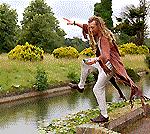
left, Maggie, by daughter Helena
right: Kirkweazle, at the Catweazle Weekend 2007, Brickendonbury
Further notes: I began the Dover War Memorial Project on
Remembrance Sunday, 11th November 2005. Standing in the still
November air, during the silence, I thought about my two great
great uncles named on the memorial. I knew who they were, what had happened
to them, and what they had left behind. But what of all the
others? It was then that I understood that, with the passing of
the years, those who had been loved, lost, and deeply mourned,
would become no more than a list of names on a stone or in a
book. I determined that this should not happen, and that in
honour, in loving memory and respect, I would create memorials
for them so that they could be remembered as the people they
once were.
It has been a long, long trail, and there are many leagues yet
to go. From the first discovery of the minutest details to the
staggering experience of standing for the first time at a war
cemetery, where a foreign field grows a crop of white
gravestones into the very horizon; from seeing, hunched in a
quiet archive remote from the world, the first pictures of our
casualties, staring back at me from dulling paper, to learning
how Dover reverberated with the distress of those, sometimes
tens at a time, who were suddenly bereaved; from reading letters from
the Front, brave letters speaking little of the troubles but
sending love to all at home, to seeing the sad black-edged
mourning cards for those who no longer could send their love,
yet were loved still, I have sat quietly with tears, stood
astounded at bravery and devotion, and wondered always what it
all meant, and why, and how.
 These are questions still I cannot answer. Perhaps it doesn't
matter. But what I can answer is why I, and all the lovely
people who help on our Dover War Memorial Project, do what we
do. It is through remembrance, gratitude, and a determination
that the promise made on our behalf, by generations before, will
be kept. We shall not forget. It is my hope that those
people we lost, those who no longer have a voice, may yet speak
to us all, through this Virtual Memorial and through all the
events we hold in their honour and remembrance, and will remind us of
who they were, and what we will forever owe, when they became no
more. These are questions still I cannot answer. Perhaps it doesn't
matter. But what I can answer is why I, and all the lovely
people who help on our Dover War Memorial Project, do what we
do. It is through remembrance, gratitude, and a determination
that the promise made on our behalf, by generations before, will
be kept. We shall not forget. It is my hope that those
people we lost, those who no longer have a voice, may yet speak
to us all, through this Virtual Memorial and through all the
events we hold in their honour and remembrance, and will remind us of
who they were, and what we will forever owe, when they became no
more.
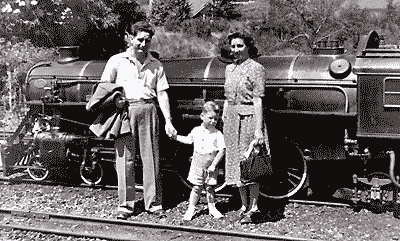
illustration: Post-War: What We Will Forever
Owe. A new life, a new generation, a family together
enjoying a peaceful day trip to the miniature Romney, Hythe and
Dymchurch Railway. Here are Alfie Webb, formerly Atlantic
convoys, and his wife Vera, formerly munitions worker, with
their son Michael, born ten months after VE Day.
The railway saw war service too, carrying troops to and from
their billets, and suffering severe war wounds during the
construction of Pluto, the fuel pipeline under the ocean. There
was even a miniature armoured train, ready to help repel any
invasion, drawn by Hercules, the locomotive that in 1927 pulled
the first train ever to run on the line at its opening in 1927.
From its early days the railway was involved in war work; in
1929 was constructed a dedicated line to aircraft-detection
mirrors, carrying staff daily, and terminating at War Department
Halt.
The engine in the picture is "Christopher Syn". It's named after
the fictional Reverend Doctor Syn, also known as the Scarecrow,
leader of smugglers on the 18th century Marsh.
Maggie S-K's Casualties

Maggie knows of two great great uncles lost in the Great War and
named on the Dover Town Memorial;
Coulson Crascall (known as Harry) and
Edward Crascall, his
brother (Eddie).
They were th e brothers of Maggie's great-grandmother, Mrs
Elizabeth Easton (left).
Mrs Easton's aunt's husband,
George James
Wellard, is also commemorated on the Town War Memorial. e brothers of Maggie's great-grandmother, Mrs
Elizabeth Easton (left).
Mrs Easton's aunt's husband,
George James
Wellard, is also commemorated on the Town War Memorial.
William
Gatehouse, also commemorated on the Town Memorial, is a
first cousin twice removed. Another
first cousin twice removed lost her husband,
William
Willis Collier, who is commemorated in the WWII Book of
Remembrance.
A great uncle lost was Alfred Horace Webb, and after him
Maggie's father, Alfred Harold Webb, was named. Alfred
Horace Webb is remembered
here
The family
connections were discovered during research for the Dover War
Memorial Project; Maggie suspects that further casualties from
Dover and elsewhere will
also prove to be relations. The family roll of honour is below;
it includes seven cousins of Maggie's paternal grandmother,
some of whom are commemorated on the War Memorial at Dartford
(right).
The Stephenson-Knight Family Roll of Honour
* = either on the Town Memorial or in the Book of
Remembrance
|
GREAT WAR |
|
Relatives |
| Alfred Thomas Allen |
26 August 1914 |
La Ferte-sous-Juarre Memorial |
|
France |
|
*Coulson Henry Crascall |
22
September 1914 |
Chatham Naval
Memorial |
Panel 2 |
UK |
|
Harry Phillips |
15
October 1914 |
Chatham Naval
Memorial |
Panel 7
|
UK |
| Alfred
Phillips |
31
January 1916 |
Vermelles
British Cemetery, Pas de Calais |
II A 7 |
France |
|
Alfred Horace Webb |
26
March 1917 |
Jerusalem
Memorial |
Panels 33-39 |
Israel and Palestine |
|
*Edward Francis Crascall |
2
April 1917 |
Euston Road
Cemetery, Colincamps |
IV F 4 |
France |
| John Edward Yarker |
13 April 1917 |
Heilly Station Cemetery, Mericourt L'Abbé,
France, |
VI E 28 |
France |
|
Edward Saxby |
22
September 1918 |
Unicorn
Cemetery, Vendhuile |
1 B 10 |
France |
| *William
Gatehouse |
26
September 1918 |
St James, Dover |
O V 9 |
UK |
|
Albert Edward Chadwick |
4
November 1918 |
Ghissignies
British Cemetery |
A 11 |
France |
| |
|
|
|
|
| Relatives by marriage |
|
|
|
|
*George James Wellard
|
24
April 1915 |
Ypres (Menin
Gate) |
Panel 12 and 14 |
Belgium
|
| *William Alfred Faggetter |
20 May 1915 |
Ypres (Menin Gate) |
Panel 5 |
Belgium |
| *Robert George Mills |
2 December 1916 |
St James |
|
UK |
| *Edward Arthur Evans |
29 April 1917 |
Arras Memorial |
Bay 3 |
France |
| *Maurice William Potter |
8 March 1919 |
St James |
|
UK |
| *Walter Albert Mills |
20 February 1922 |
St James, Dover |
|
UK |
| |
|
|
|
|
|
SECOND WORLD WAR |
|
Relatives |
| Eric
Frank Elkanah Hodges |
27
December 1941 |
Runnymede
Memorial |
Panel 45 |
UK |
| *Ronald William Cadman |
1 October 1942 |
Berlin War Cemetery |
8 B 34 |
Germany |
|
*Bernard Patrick Elworthy |
22
June 1944 |
Sidon War
Cemetery |
3 G 12 |
Lebanese Republic |
|
Victor Jack Ward |
3
September 1944 |
Dumbarton Cemetery |
Sec G Extn 5 Bank 22 Grave 157 |
UK |
| |
|
|
|
|
| Relatives by marriage |
|
|
|
|
|
*Sarah Annie Wildey |
20
September 1940 |
Charlton
Cemetery, Dover |
|
UK |
| *David William Thomas Reynolds |
16 February 1941 |
Aylesbury Cemetery |
South east plot grave 2 |
UK |
|
*William Willis Collier |
28
December 1941 |
Alamein Memorial |
Column 15 |
Egypt |
| Arthur
David Waters |
1
April 1943 |
ashes at
Karrakatta Cemetery, Perth, commem. Woodman Point |
|
Australia |
|
Sydney Bon Robert Knight |
25 September 1944 |
Groesbeek
Memorial |
Panel 8 |
Netherlands |
| |
|
|
|
|
|
OTHER |
|
Relatives by marriage |
| Ronald Stewart Swaffer |
20 January 1948 |
Haifa British Civil Cemetery
(Constable, Palestine Police Force) |
Plot 13 Grave 13 |
Israel |
May They Rest in Peace
|