|
THE
DOVER WAR MEMORIAL PROJECT
|
 |
Latest News
Welcome to Dover's Virtual War Memorial
Patrons:
Dame Vera Lynn, DBE, LL.D,
M.Mus
Admiral of the Fleet the Lord Boyce, KG, GCB,
OBE, DL
Lord Warden and Admiral of the Cinque Ports and Constable of Dover Castle
|
14 December 2014 - Season's Greetings! May we wish ....
|
A
peaceful and fulfilled
Christmas
to you all!
|
|
 9 November 2014 - Remembrance Sunday 9 November 2014 - Remembrance SundayOn this Remembrance
Sunday Maggie and Simon attended Remembrance ceremonies at Wolverton and, in
the afternoon, at the clock tower memorial in New Bradwell, Buckinghamshire
(left).
 For some time now we have wished to create a Virtual
Memorial for the Fallen of our local town, Newport Pagnell, Buckinghamshire.
Today, in their honour, we began this commemoration -
"Newport Pagnell Remembers" For some time now we have wished to create a Virtual
Memorial for the Fallen of our local town, Newport Pagnell, Buckinghamshire.
Today, in their honour, we began this commemoration -
"Newport Pagnell Remembers"
We have already discovered connections between the two
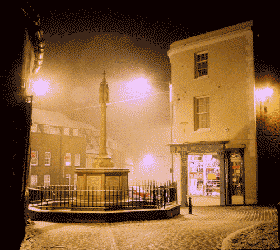
towns - more information will follow! The Memorial at Newport Pagnell is on
the right, pictured in the snow. |
|
11
October 2014 - The Tower of London
 The commemoration of
the Great War, entitled "Blood Swept Lands and Seas of Red", will
see
888,246 ceramic poppies placed in the moat of the Tower of London between 5
August and 11 November. The commemoration of
the Great War, entitled "Blood Swept Lands and Seas of Red", will
see
888,246 ceramic poppies placed in the moat of the Tower of London between 5
August and 11 November.
Every night some 180 names of the Fallen are read,
followed by the sounding of the Last Post. On 12 October the name of Able
Seaman Daniel Cannon will be amongst those spoken. He died, aged 21, on New
Year's Day, 1915, when HMS Formidable was torpedoed off Portland Bill.
On 21 October Lieutenant Tommy Eaves will be named. He
died on 3 October 1916 on the Somme. His body was never found, and he is
commemorated on the Thiepval Memorial. We understand that the school at
which he taught, St Martin's, Dover, was one of two primary schools invited
to the opening event.
Also to be remembered, on 13 October,
is Bill Dabson, relative of DWMP supervolunteer Joyce Banks.
The last names will be read on 10 November. Currently nominations are still open, and may be requested
here photo of the poppies by Dean
Sumner |
 5
October 2014 - A Flag at the Memorial? 5
October 2014 - A Flag at the Memorial?
A
request has been made that a flagpole be erected behind the bronze figure of
Youth on the
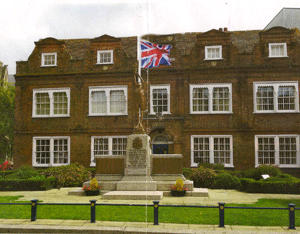 Memorial in order to fly daily the national flag (impression -
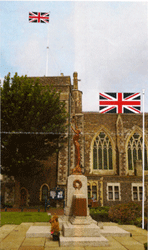
see right). Amongst the fifteen flagpoles already available in Dover is one
on the Town Hall, next to the Memorial (see left). Memorial in order to fly daily the national flag (impression -
see right). Amongst the fifteen flagpoles already available in Dover is one
on the Town Hall, next to the Memorial (see left).
The Town Council have opened the question for
consultation and are asking everyone for their views. If you wish to comment
on this proposal, the contact details for the Council are
here
They have asked that comments be in by 13 October.
images by courtesy of Dover Town Council |
|
22 September 2014 - The "Live Bait" Squadron
 Exactly one
hundred years to the day after the cruisers Hogue, Cressy, and Aboukir, were
torpedoed and sunk in 90 minutes by enemy submarine in the North Sea, a
memorial event was held at Chatham Historic Dockyard. Attended by hundreds
of relatives of the crews, the drumhead service was led by The Right
Reverend Dr Stephen Venner DL and The Reverend Scott brown, Chaplain of the
Fleet. Exactly one
hundred years to the day after the cruisers Hogue, Cressy, and Aboukir, were
torpedoed and sunk in 90 minutes by enemy submarine in the North Sea, a
memorial event was held at Chatham Historic Dockyard. Attended by hundreds
of relatives of the crews, the drumhead service was led by The Right
Reverend Dr Stephen Venner DL and The Reverend Scott brown, Chaplain of the
Fleet.
 HRH The Duke of Kent
KG unveiled a commemorative plaque, and the Worshipful Mayor of Medway handed
a wreath to the Mayor of The Hague to be laid at a further ceremony in
Holland on 24 September. 837 men survived, with two Dutch merchant ships,
Flora and Titan, the first rescuers at the site, but 1,459 men died. Bodies
were washed up on the coast of Holland for weeks after the tragedy. HRH The Duke of Kent
KG unveiled a commemorative plaque, and the Worshipful Mayor of Medway handed
a wreath to the Mayor of The Hague to be laid at a further ceremony in
Holland on 24 September. 837 men survived, with two Dutch merchant ships,
Flora and Titan, the first rescuers at the site, but 1,459 men died. Bodies
were washed up on the coast of Holland for weeks after the tragedy.
The plaque reads:
First World War 100th Anniversary. To commemorate the loss of three Chatham
Division Cruisers, His Majesty's Ships Aboukir, Hogue, and Cressy, and 1,459
men on 22nd September 1914 as a result of enemy action in the North
Sea. |
|
13 September 2014 - Dem Bells!
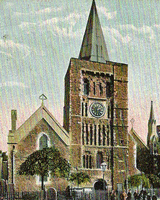 Bellringers at St Mary's,
Cannon Street, have commemorated several World War anniversaries in the last
couple of weeks. Ten days ago they marked the 75th anniversary of the
declaration of war against Germany and remembered people who lost their
lives in that war by ringing a quarter-peal - 1250 changes - of Ibberton
Surprise Major. For the ringers it was the first time any of them had rung
the method. Bellringers at St Mary's,
Cannon Street, have commemorated several World War anniversaries in the last
couple of weeks. Ten days ago they marked the 75th anniversary of the
declaration of war against Germany and remembered people who lost their
lives in that war by ringing a quarter-peal - 1250 changes - of Ibberton
Surprise Major. For the ringers it was the first time any of them had rung
the method.
On 30 August the bells were half-muffled bells for a peal
- 5058 changes - of Yorkshire Surprise Major in memory of Dover
bellringer Lance Corporal
Archibald Percy Randolph Gibbs, killed in action on 26 August 1914. He
was the first bellringer die in the Great War. A half-muffled quarter peal
of Grandsire Doubles was also rung on 26 August.
There was also, on 25 July, a peal of 5024 Spliced
Surprise Major, comprising eight different methods. This was rung just
before a visit to France and Belgium in memory of members of the Ancient
Society of College Youths who died in the Great War. The Ancient Society is
a change-ringing society in the City of London, established in 1637.
The peal was the 50th achieved on the St Mary's bells.
" ...
the peculiar combination of joy and sadness in bell music .... is
very typical of England" - A. N. Wilson
illustration - detail from a postcard dating approximately
1908 |
|
5 September 2014 - Palmer's Coachbuilders Roll of Honour at Dover Transport Museum
 Exciting news! In a unique Great War centenary commemoration at the
Transport Museum ... on display now for the first time is a Roll of Honour
from Palmer's, the coachbuilders. It lists employees who served - and those who
never returned. Do visit - the Museum is open
three days a week until the end of October, and then Sundays throughout the
winter; details are
here.
There's much more to see besides! Exciting news! In a unique Great War centenary commemoration at the
Transport Museum ... on display now for the first time is a Roll of Honour
from Palmer's, the coachbuilders. It lists employees who served - and those who
never returned. Do visit - the Museum is open
three days a week until the end of October, and then Sundays throughout the
winter; details are
here.
There's much more to see besides!
We offer grateful thanks to Ted Smith at the Transport
Museum, and to Jean Marsh, who is transcribing and researching the names.
It's a work-in-progress as many of the letters are very faded - but
here is
the preliminary list of names.
The Transport Museum are hoping to restore the Roll of
Honour. We wish them every success! photo by
Ted Smith |
|
 31
August 2014 - Woe, Woe, and Thrice Woe! 31
August 2014 - Woe, Woe, and Thrice Woe!
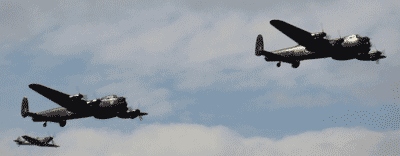
A visitor from our Canadian friends brought a unique
opportunity to see flying together
the only two airworthy Avro Lancasters in the world.
"Vera", as she is known, joined the Battle
of
Britain Memorial Flight Lancaster in a number of events in England.
The pair were due to fly over
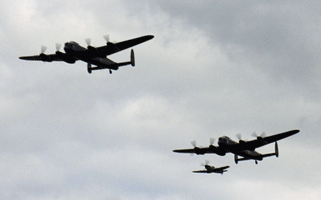 Buckinghamshire today, en route from Shoreham
to Nottingham. Very many people turned out to see them. Sadly though, Vera
had developed engine trouble, and has been on the
ground since 29 August. Buckinghamshire today, en route from Shoreham
to Nottingham. Very many people turned out to see them. Sadly though, Vera
had developed engine trouble, and has been on the
ground since 29 August.
Fortunately Dean Sumner was at Headcorn - and captured
just a bit of the magic for us. Thank you, Dean! And get well soon, Vera!
photos by Dean Sumner
|
 August
2014 - Wreaths in France August
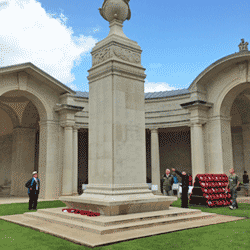
2014 - Wreaths in FranceThe wreaths arrived safely at the
Arras Flying
 Services
Memorial, where 990 airmen who have no known grave are commemorated. There
are a further 2,647 men buried in the Faubourg d'Amiens cemetery, and 34,774
men commemorated on the Arras Memorial. Amongst them is the renowned Walter
Tull. Services
Memorial, where 990 airmen who have no known grave are commemorated. There
are a further 2,647 men buried in the Faubourg d'Amiens cemetery, and 34,774
men commemorated on the Arras Memorial. Amongst them is the renowned Walter
Tull.
The Right Worshipful the Town Mayor of Dover, Cll Mrs Pam
Brivio, far right, accompanied by former Mayor Cllr Mrs Ronnie Philpott,
represented our town, laying a wreath. For Mrs Philpott this was especially
a poignant journey as a member of her own family, Robert Charles Watson, was
reported missing on 3 May 1917. He was one of the many thousands in the
Great War who were never to see home again.
photos by courtesy the Right Worshipful the
Town Mayor of Dover, Cllr Mrs Pam Brivio
photo of the Councillors by a member of Dover Sea Cadets |
 14
August 2014 - Wreaths for France 14
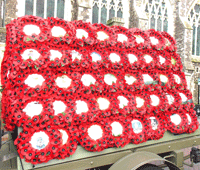
August 2014 - Wreaths for FranceIn a mission of
Remembrance organised by the Western Front Association eighty-five wreaths
left London for France on
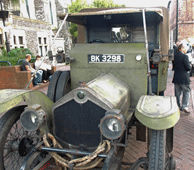 10
August. The wreaths represent the units of the British Expeditionary Force
in 1914, with wreaths for the Merchant and Royal Navies included. 10
August. The wreaths represent the units of the British Expeditionary Force
in 1914, with wreaths for the Merchant and Royal Navies included.
They arrived in Dover on a Great War aircraft recovery
trailer pulled by a Crossley Royal Flying Corps light tender; here
they are outside the Town Hall.
photos by courtesy of Brian Dixon
Other events in Dover to commemorate the entry of Britain
into the Great War included a service at the Town War Memorial on the
morning of 4 August, with a candlelit ceremony held there in the evening,
and on 12 August, as part of the Western Front Association commemorations, a
convoy of Harley-Davidsons riding from Netheravon Airfield in memory of the
first two RFC casualties, Lt Skene and Air Bechanic Barlow, who died on 12
August 1914 as No 3 Squadron RFC took off for Swingate, Dover. The convoy
laid wreaths at the crash site, at the graves of the airmen, and at Swingate
and then continued to France. |
 12 August 2014 - Get Well Soon! 12 August 2014 - Get Well Soon!
We're really sorry to hear that our supervolunteer, researcher
extraordinaire and all-round lovely lady, has broken her ankle. She works hard finding out more about all our Fallen;
she identifies casualties and solves mysteries; she ferrets out
information and is like a bloodhound on a trail!
Every day brings exciting new emails to our inbox.
We're missing you, dear lady, and know you're
missing doing your research. We hope that you'll soon be up and
about again. With
love to you and your husband - and wishing you well again very
soon! |
  10
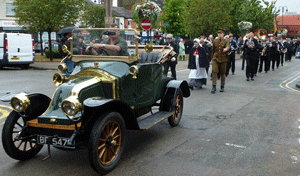
August - 100 years on 10
August - 100 years onAt Wolverton,
Buckinghamshire, famed for over 150 years for its railway works,
forces representatives and cadets paraded in honour of the Great War
centenary. Led by a 1914 Renault and the Wolverton Town Band,
they marched from the War Memorial to the old Drill Hall.
The Wolverton Drill Hall too was celebrating its centenary,
having been built in June 1914 for use by the Buckinghamshire
Battalion (Territorials) of the Oxfordshire and Buckinghamshire
Light Infantry. After the unveiling of a plaque commemorating the
men who left the hall for the Western Front, all participants
enjoyed Great War inspired refreshments: sandwiches filled
with paste or cheese or corned beef and pickle, with home-baked
sponges and - of course - a good strong cup of tea!
Notes: Drill halls are a part of our military heritage, usually
funded and constructed by local communities for the use of volunteer
forces. Purpose-built, they consisted of a large room used by
volunteers for marching and manoeuvring and training in skills such
as signalling or weaponry, along with other rooms such such as a
kitchen and an office. Used almost nightly they were seen as a great
benefit to the community, offering discipline and physical
improvement to men, and to the country in preparing a skilled
military force. The halls were often also used for fêtes and
functions, some of which contributed funds to maintenance.
 Footnote: Footnote:
Wolverton is twinned with Ploegsteert, hence the Belgian flag for
the unveiling. As part of their initiatives marking the Great War
Centenary, the Belgian Tourist office would like to hear from
descendents of the famed Christmas Truce football match which took
place at "Plugstreet" in 1914. If you can help, do
please email them at truce(AT)belgiumtheplaceto.be (substitute @ for
AT) or ring 0207 531 0390. |
| 10 August 2014 - The Poppy Sculpture
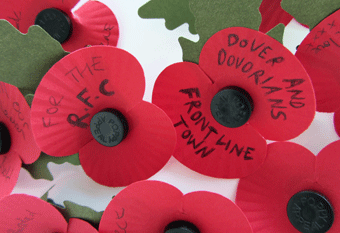 In
some of the shopping malls in the United Kingdom are poppy
sculptures, designed by Mark Humphrey for the Royal British Legion. In
some of the shopping malls in the United Kingdom are poppy
sculptures, designed by Mark Humphrey for the Royal British Legion.

Each sculpture can hold 3,000 poppies, which can be dedicated to
those who have died in conflict. Of course we dedicated one to our
Dovorians - and another to those brave pioneers of the skies, many
of whom took off behind our castle for France just after the Great
War began - the Royal Flying Corps. Poppies around
ours were dedicated to named individuals and "To Granddad", "Respect
- Thank You", and "With Love XXX".
photos courtesy HR |
 7
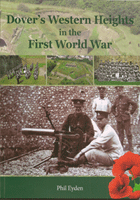
August 2014 - Dover's Western Heights in the Great War 7
August 2014 - Dover's Western Heights in the Great War
We're really pleased to welcome Phil Eyden's new book! Filled
with photographs and facts, its 96 pages shine a much-needed light
on the hidden history of troops-in-waiting.
Built in Napoleonic times, the Western Heights,
Dover's Forgotten Fortress, became a key site both for training
troops for the trenches and for the first defence of the Gateway to
England should the unthinkable happen.
Meanwhile,
much-needed lights literally did sometimes shine through the
black-out as local volunteers
under the RNVR signed up for the new Dover Anti-Aircraft Corps.
Until they were superceded, they were the life-savers of the early
war, slilentily listening and scanning the skies for the enemy.
Covering two hard-to-research areas, Dover's
Western Heights in the Great War is a must-read - and, helping keep
our hidden history alive, proceeds go directly to the Western
Heights Preservation Society. The book is £12 - contact Phil at
phileyden(AT)doverwesternheights.org (substitute @ for AT) for your
copy. |
 6
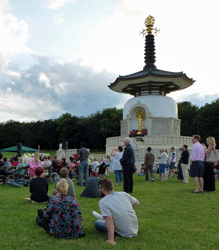
August 2014 - Hiroshima-Nagasaki Day 6
August 2014 - Hiroshima-Nagasaki DayThe first
Peace Pagoda built in the West was constructed at Willen, Milton
Keynes by Buddhists of the Nipponzan-Myōhōji Order.
 Every
year the anniversary of the dropping of the first atomic bomb, on
Hiroshima, Japan, is commemorated by a service at the Pagoda. Every
year the anniversary of the dropping of the first atomic bomb, on
Hiroshima, Japan, is commemorated by a service at the Pagoda.
Participants then process to the lake where
monks and nuns float over a hundred decorated candle-lit lanterns on
the water in memory of some 200,000 people who died.
  |
 4
August 2014 - Centenary of the Great War 4
August 2014 - Centenary of the Great WarOne
hundred balloons released into the sky - one for each year that has
passed since the outbreak of the Great War. Our area held several
events to mark the centenary; this one was at the football stadium
at Denbigh North, Milton Keynes and was attended by The National
Chairman of the Royal British Legion and the Mayor of Milton Keynes.
At the War Memorial in Newport Pagnell many
people
 gathered
for a candlelit tribute. The service, during which the names of the
Fallen were read, was held in St Peter and St Paul's church, with
the candles blown out at exactly 11pm. gathered
for a candlelit tribute. The service, during which the names of the
Fallen were read, was held in St Peter and St Paul's church, with
the candles blown out at exactly 11pm.
"The lamps are going out all over Europe; we
shall not see them lit again in our life-time", are words attributed
to Sir Edward Grey, the British Foreign Secretary, on the eve
of the entry of Britain into what was to become the Great War.
Recalling this, many homes in the town were in virtual darkness. |
| 6 June 2014 - 70th Anniversary of D-Day
 70
years on - but their memory never fades. We remember all those who
were camped across Southern England, suddenly and silently to
disappear in the night as the reclamation of occupied France began. 70
years on - but their memory never fades. We remember all those who
were camped across Southern England, suddenly and silently to
disappear in the night as the reclamation of occupied France began.
Several of our Dovorians died on the very first
day. Amongst them were John Murphy, aged 27, from 28 Goschen
Road, who left his wife of two years, Joyce; Leonard Gates,
aged 26, from Temple Ewell, who also had married, to Evaline, just
two years previously; Harry Suckley, aged 23, newly married
to Beatrice; Francis Hughes, aged 28, from 15 Erith
Street, whose five-months son Anthony Francis had died on 29 May,
just the week before; and Morgan Price, aged 21. They are all
buried or commemorated at Bayeux, France.
Above, right, dug in to trenches and holding
their position, are members of the Tommy Atkins Society. Teaching
schoolchildren and demonstrating to the public, they represent the
men from ‘B’ Company, 1st Battalion, The Leicestershire Regiment,
who served as part of the 49th West Riding Division in France,
Holland and through to Germany, entering Normandy just after D-Day.
The memory of our Fallen lives on, their actions
are never forgotten, our honour never ends.
photo courtesy of HR |
| 31 March 2014 - Quarterly Newsletters Owing to
changed circumstances we have had to suspend for the time being
our quarterly newsletters "From the Front". However, news articles
and information will continue to appear here and new articles are
accessible through our Information
index. Newsletters and yearly news items are archived
here. |
|
 Dear
Friends, Dear
Friends,
Welcome to 2014!
And what of 2013? Well, last year for the
DWMP was a year of two halves. A significant change
in family circumstances in July, compounded by Maggie becoming unwell in
August, meant that the last five months on the DWMP were necessarily been rather
quieter than the normal frenetic activity!
Of course, our work of Remembrance carried on
behind the scenes, answering queries, helping others with
research, and especially maintaining and updating Dover's
Virtual Memorial in memory of all our Fallen. There is much
still to be written up. One aspect coming very much to the fore
is how many casualties were related to one another, and thence
how many families were left to mourn multiple losses of loved
ones. We thank Joyce Banks for her sterling work in
rediscovering these connections.
A family deeply bereaved was the Bowlts. In
just over three years Olive and William Bowlt lost two sons and
two sons-in-law. Their younger son, Frederick, just 19, was
killed during the Zeebrugge Raid. He was serving on the
Vindictive. The DWMP was, in May 2013, privileged to be present
when the town of Ostend resited and rededicated the bows of the
Vindictive, in the presence of the King and Queen of Belgium. It
is a memorial to all who fought and died during the raids on
Ostend and Zeebrugge in 1918.
Meanwhile, in Mauny, France, the Second World
War was remembered when a memorial was unveiled to members of
the Black Watch who fell in the liberation of the town in 1944.
Corporal James O'Keefe was a Dovorian commemorated there; unlike
many we have so far been unable to trace his family. But
his comrades continue to remember him, as does Dover, where he
is commemorated in the Book of Remembrance
After much discussion with the Town Council,
the first half of the year also saw
the updating of our War Memorial in June to include a
further 21 names of our Fallen, requested by their families. At
the same time the Memorial was rededicated by the Bishop of
Dover to include and commemorate those who fell in all
conflicts. A full report will appear in From the Front, issue
15.
This New Year, 2014, will be a notable year
of Remembrance. In August we mark the centenary of the outbreak
of the Great War. Seen by many as the Great Adventure, a chance
to travel a world far beyond the reach of the ordinary working
person, it was an opportunity to be taken - for it would
be over by Christmas.
As we now know, this was not to be. 1914 was
instead the beginning of four years of what some have called
madness, bringing the death of around 17 million people -
and that was before the following pandemic "Spanish" 'flu, said
to have begun in and been spread by the troops, which killed
three to six times as many, some 3% to 6% of the global
population.
We also have the 70th anniversary of D-Day,
when the Allies silently crossed the channel and landed on the
beaches of Normandy, beginning the liberation of occupied
peoples. Across the south of England troops and vehicles,
equipment and ammunition, were built up, camouflaged in leafy
lanes and dumped in deep woodlands. Meanwhile, each night in
Dover more and more landing barges would appear in the harbour -
in plain view they were dummies to convince the enemy that any
crossing would take the shortest route. Then, quietly and
suddenly, all the bustle ceased and ovenight all the men, were
gone. Many never returned; following their route eastwards in
occupied France and up through Belgium and into the Netherlands
are graveyard after graveyard, marking where they fell.
Dover celebrates its own anniversary this
year too, in September. On 26 September it will be 70 years
since the town was liberated from cross-channel shelling. In a
flurry of attacks during that month forty-two civilians were
killed in Dover, more than the previous two years combined.
Though the ordeal was over and Dovorians celebrated in the
streets, there was still a long dangerous path to travel as
families and friends waited quietly and anxiously for news of
their loved ones overseas. Nor was it entirely safe at home; a
V2 landed in the sea near Dover in January 1945 and the warning
siren wasn't finally silenced until March. It would be nearly a
year after the Normandy landings before the Second World War was
officially ended.
In 2014, especially, then, let us keep close
in our hearts the memory of all those who have lost and who
continue to lose their lives owing to conflict. Equally too, let
us be thankful that there were so many who, when called, bravely
gave as much as they possibly could, for the sake of their
homes, their loved ones, and for us, the future they would never
know.
We wish you all a peaceful and fulfilled New
Year.
Maggie
(Marilyn Stephenson-Knight)
January 2014
|
|