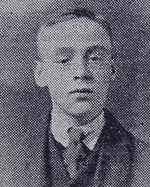
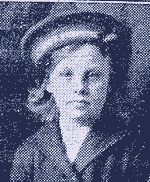
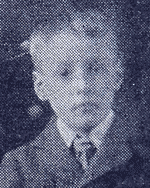
|
World War I
CIVILIANS Surnames
A to M
B
|
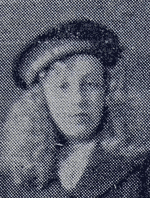 Boorman, G. E.
M. Boorman, G. E.
M.
Gertrude Evelyn Mavis Boorman was 13 when she was killed in the early hours of 16
February1918. Just after midnight there was loud gunfire with falling
bricks and slates. The assault lasted barely three minutes. A
 submarine,
according to official reports, but a destroyer according to witnesses
outside the breakwater, had been firing shells at the town. Some sixteen or seventeen had struck
houses and buildings but mainly unoccupied portions. submarine,
according to official reports, but a destroyer according to witnesses
outside the breakwater, had been firing shells at the town. Some sixteen or seventeen had struck
houses and buildings but mainly unoccupied portions.
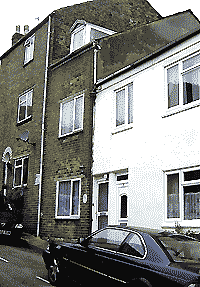
The exception was the Boormans' home at number 4 on Cowgate Hill. Four children
had gone to bed at ten o'clock in the evening and been asleep at the top of the house.
Their step-father, Sydney Surrell, was a stoker on the King George V. Their mother, Mrs
Ellen Surrell,
wakened by gunfire, ran upstairs to fetch the children. She took Sydney
out of bed calling to the others to come. They got out of bed and as
their mother reached the door of the room there was a loud crash. A
shell had gone through the neighbouring house, blown down the wall
between the houses, and burst in their room.
The children were rushed to hospital. Gertrude was so
seriously injured that she died shortly after arriving. She is buried at
St Mary's in the same grave as her previously deceased father and very
many floral tributes were sent, including those from her friends and
schoolfellows.
William, two
years older, had a badly damaged leg and shrapnel in his body. It was
feared he would lose his leg, and eventually he did. The other two
children, Amelia, 11 years old, and
Sydney, 9, were injured less badly.
 |
 |
| Albert |
Henry |
Two sons of the family were away
serving, Henry in a labour battalion and Albert on a hospital
transport Gertrude was one of the
casualties remembered in the Service of
Remembrance
for Civilians - November 2007 Note: No 4 is
the central house next to the cream one in the image above right. A
disjointed roof line presumably a result of the shell damage can clearly be seen.
The occupants of No 3 were in the room when the shell burst through but
only one Mr F C Shovelier, sustained slight injuries. He is believed to
be the father-in-law of Donald Scott

picture and transcription with thanks to Joyce
Banks |
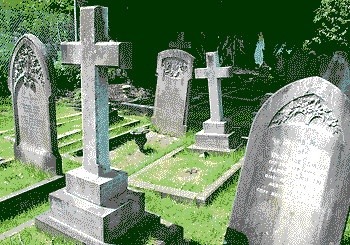
Gertrude's grave is in the lower area of St Mary's. The
words on the base of the cross read:
"Girlie"
In Loving Memory of
our darling
Gertrude E. M. Boorman.
Born 25 October 1904,
Killed 16 February 1918
By German Submarine Bombardment
Loved By All
Also William Boorman
Father of the above,
Died 2nd May 1910
Aged 38 years.
|
| Cowgate Hill. The road leads to the old cemetery nestling
beneath the Napoleonic fortifications of the Western Heights.
Gertrude's home is on the right in the middle of the block
|
 |
|
1919 - In loving memory of our darling (Girlie) Gertrude E M
Boorman who was killed in submarine bombardment February
15-16 1918 aged 13½
years
Could I have raised her dying head,
Or heard her last farewell,
The pain would not have been so hard,
For I who loved her so well.
We do not forget her, we loved her too dearly
For her memory to pass from our life like a dream.
The lips need not speak when the heart mourns sincerely,
And tears often flow where they seldom are seen
From sorrowing Mum, Dad, Brothers, and Sister
|
1919 - In ever loving
remembrance of my dear sister, Gertrude, Evelyn Mavis Boorman,
who was killed by enemy bombardment, February 16 1918. Gone,
but not forgotten by her sorrowing brother, Harry
|

|
In memoriam notice from February 1940
In ever loving memory of (Girlie) Gertrude E M Boorman killed
in German bombardment, February 16 1918. Always remembered -
Dad, Mum, Brothers and Sisters in February 1943
the in memoriam notice was from "Mum Brothers and Sisters
(Peterborough)" |
In 1920, on 19 August, Mr and Mrs Surrell had a baby
girl whom they named Evelyn. The family moved to London six years
later in search of work and after a further six years to Peterborough. In
1939 they were living at 9 Serjeant Street, Peterbrough, with Mr Surrell
working as a night watchman. Mr Surrell died in 1941 and Mrs Surrell, Gertrude's mother,
died in 1952. *
Notes: In 1911 the Boorman family
were living at 8 Chapel Place. Ellen Sarah Philpott, born 15 July
1876, had married
William Edwin Slader Boorman on 6 November 1898 at St Mary's,
Dover; all the children would later be christened there. Mr Boorman was
then a steward on the pilot service; he would later be employed as a
labourer and as a painter.
In 1911 Mrs Boorman, widowed, was 34 and was working as a charwoman. With
her was her brother, Edward Philpott, 28, who was working as a barman.
The children then were Henry George Slader, born 31 December 1898, Albert William
Slader, born 31 August 1900, William Edward, born 4 February 1903,
Gertrude, Amelia Ellen, born 3 November 1906, and Sydney Gordon, born 14
December 1908. On 20 April 1913 William accidentally scalded himself
badly after tripping backwards over a fender and bringing a saucepan of
boiling water upon himself. On 20 March 1914 Henry lost an eye in an
electrical explosion at the jeweller's, Hart & Co*, where he was
working, having opened the fuse box and laid copper wire across the
terminals. (In 1918 he was given an extension of six weeks excusal from
active service by the Dover Tribunal owing to having the right eye
missing and the left eye being weak.) On 23 April 1914 Mrs Boorman
married Sydney Vernon Surrell, a leading stoker, at Christchurch,
Hougham. Mrs Boorman's address was then 5 Cowgate Hill.
4 Cowgate Hill was also the home in 1911 of
Albert Willson and of
George Saunders in 1901
* Hart & Co may have been the
company directed by Philip T Hart OBE, whose wife employed
Edith Stoker |
C
|
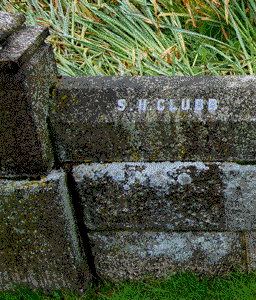 Clubb, S. H. Clubb, S. H.
Sydney Herbert
Clubb was a victim of the Great Munitions Explosion at
Faversham on 2 April 1916.
Born in March 1882, he was
the son of James Clubb and Nora, his wife, née Connell.
In 1908 he married in Dover Frances Louisa Holman, and
they had three daughters, Mabel, Nora, and Kathleen. In
1915 the family were living at 138 Union Road, Dover
left: his name on the mass
grave at Faversham. Mr Clubb was one of the casualties
whose remains could not be identified, therefore he was
accounted for by virtue of being subsequently missing.

Ernest Legg, Sidney Holbourn, below, and
George Robus were other
casualties; the list is
here
The mass grave at Faversham is covered with daffodils in
the spring |
F
|
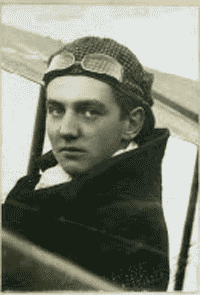 Fitzsimons, J. B. Fitzsimons, J. B.
John Bernard
Fitzsimons (known in the family as Bernard) was born on
16 June 1896 in Gravesend to John George and Margaret
Fitzsimons. Bernard attended Dover County
School from 1909-1911. He probably took part in a
tug-of-war event at the school in 1911, his team losing
in the final.
A street index gives their address
for 1909-1910 as 11 Crabble Hill Villas. In 1911 the family are recorded
at Rosendale, Lower Road, River, Dover, with Mr John
George Fitzsimons working as a preventive officer for HM
Customs and Excise. He had been born in Liverpool, and
his wife Margaret in Buckinghamshire. Bernard was then
14, and his brother, Gerald, also born in Gravesend, was
13.
The family then moved to Ilford
and Bernard went to work for the Port of London Authority. As
a boy, Bernard was interested in model aeroplanes, so it
was no surprise when he obtained his Aviator's
Certificate on 9 August 1915 at the Ruffy-Baumann School
at Hendon, flying a Caudron Biplane.
Having obtained his Aviator's
Certificate, Bernard immediately joined the Royal Flying
Corps and was quickly confirmed in the rank of Second
Lieutenant. He was posted to the Expeditionary Force in
France on 27 January 1916, serving with 32 Squadron,
16 Squadron, and finally 1 Squadron. However, Bernard
had an accident on 1 August 1916 and had to resign his
commission.
Nevertheless, Bernard was soon
flying again, when he took up test flying of new
aircraft. On 26 March 1917, he was testing a new type of
single-seat biplane - the Nestler Scout - at Hendon.
Unfortunately, there was a very high wind that day, and
the fabric was stripped off the wings. The aircraft
dived through the roof of a hangar below and was
completely wrecked. Though none of the men in the hangar
were injured, Bernard was killed.
An inquest was held at Hendon two
days later, when a verdict of "Accidental Death" was
returned.
John Bernard Fitzsimons had been
living at 83 Endsleigh Gardens, Ilford, when he died. He was buried
at the City of London cemetery on 30 March 1917, plot
222 grave 85594. The
headstone reads:
|
 |
In Loving Memory
Of
John Bernard
The Beloved Son Of
-
J G and M Fitzsimons
Aged 20 Years
Killed Whilst Testing A New Aeroplane
At The Hendon Aerodrome On 26th March 1917
After Having Served In France For 6 Months
As Sec. Lieut. In The R.F.C.
-
Also John George Father Of The Above
Who Passed Away 27th Dec'r 1941 Aged 68 Years
Also Margaret Loving Wife And Mother
Who Passed Away 22nd March 1948
Aged 73 Years |
with thanks to Andrew Dawrant © Royal Aero Club Trust
For further information please contact the Trust through
their
website |
G
|
Gould, J.
Mrs Jane Gould
was born at Buckland, Dover. In 1911 she lived
at 3 Crabble Hill in 1911, and later at 77 Crabble Hill and was bedridden. She was shocked
and injured during a raid on 24 September 1917 which
killed her neighbours the Kenwards. She was taken
to hospital and later to the home of her granddaughter
at Glen Lyn, Maxton. She died there at the age of 86
on 16 October
She was
buried at Buckland, D 24, with Mrs Scott, her daughter, and Mr
Head, her son, following. There were no flowers by
request |
H
|
 Hall,
F. A. Hall,
F. A.
Francis Amos Hall died during an air raid on 19 March
1916, aged seven years and eleven months.
Francis
was the youngest child of George Frederick Hall, born 26
April 1869, and his
wife Dora Elizabeth, née Amos, born 23 July 1871,
who had married in 1893. Miss Amos was then living in
Birchington, Mr Hall in Clapham. In 1901 Mr and Mrs Hall
and their two daughters, Mabel Winifred, born about 1894
in Battersea, and Lilian Beatrice, born about 1898 in
Dover, were living at 48 Winchelsea Street in Dover. By
1911 they were living at 24 Winchelsea Street, and two
new brothers, Frederick George, born 1904, and Francis
had joined them.
Francis lived
at 23 Winchelsea Street, Dover, and had been on his way
to Sunday school (he is named on the Salem Baptist
church memorial). When the raid began he ran as quickly
as he could back to his home; his mother hearing
the planes rushed out to find him. She saw a bomb strike
close to her youngest son. A gentleman ran to help but
the lad was terribly injured. A witness stated that his
"eyes seemed to move once" and then he died. He was sent
in a car with Edith Stoker, another
victim, to the hospital
His
father was a railway guard and had just left Dover on
the London train. He could not be informed of the
tragedy until his train reached London. He had the
distressing experience of having his dead son sent out
again from the hospital before he could claim him, the
blood unwashed from his face as the hospital staff were
overwhelmed by casualties from the raid. Later he
expressed his gratitude to the many people who had
sheltered and comforted his wife "as best they could"
until his return.
Francis
Hall was buried at Charlton, YQ 13, on Monday 27 March
1916. Rev C S M Playfair officiated and amongst the
mourners were his parents, his brother, and his sisters. Mr Smith, the headmaster of St Martin's
school, was also
present.
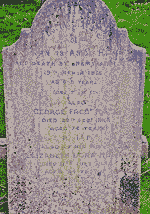 The headstone on the grave
reads: The headstone on the grave
reads:
|
In Loving Memory
of
Francis Amos Hall
met death by enemy air craft
19 March 1916
aged 8 years
"Gone to Rest" |
Also
George Frederick Hall
died 29 February 1944
aged 74 years
RIP |
Also his wife
Elizabeth Dora Hall
died 11 July 1966
aged 94 years |
Floral tributes
laid when he was buried included:
"To darling Tiddles, from his broken-hearted Mum and Dad"
"To darling baby Tiddles, from his loving brother and
sorrowing sisters"
*
|
In Memoriam |
.Hall - In
ever loving memory of our youngest
child, who met his death on March 19
1916 aged 8 years
|
Three years
have passed, and none can tell
The loss of
him we loved so well:
Forget him?
No, we never will,
As years
roll on we'll love him still
|
|
From his loving
Mum, Dad, Sisters and brother Fred
March 1919 |
In 1921 Mr and Mrs Hall were possibly living at 4
Winchelsea Street, and Mr Hall had a garden in Markland road he tended. In 1939
Mr and Mrs Hall were living at Sunnybank, Martin Mill. Mr Hall died there.
picture of grave and transcriptions with thanks to Joyce
Banks
We Remember 4 |
|
 Hall, W. H. Hall, W. H.
William Henry Hall was one of
the casualties of the Folkestone air raid on 25 May
1917 when 72 people were killed.
He was born in Dover around
1853, and married Isabelle Lewis there in 1879. He
traded as a pork butcher in Folkestone. He received
severe injuries to his head whilst in his shop.
He is buried at Cheriton
cemetery, Folkestone, 1705 (c) in the picture his grave is beside
the cross in the background.
The words on his headstone read:
|
In
loving memory
of
William Henry Hall
who died on May 27 1917
from injuries received
during the
German air raid on Folkestone
on May 25 1917.
Aged 64 years
Peace perfect peace with loved ones far away
In Jesus
keeping we are safe and they |
Also of Isabelle wife of the above
who died on the 2 March 1930
Aged 75 years
Forever with the Lord
The plaque, below, is situated
in Tontine Street |
 |
|
Holbourn, S. W.
 Sidney
William Holbourn was born in Dover in 1877. In 1881 he
was living with his parents Edward a carpenter and
Harriet at 8 St Catherine's Place, Charlton, Dover.
They then had five children, Ernest, Emily, Frank,
Sidney himself, and Percy, who was then six months old.
By 1901 the family was at 20 Granville Street and an
older daughter Hilda was with them. Sidney was by then
a bricklayer In 1916 Sidney's parents were living
at 24 Granville Street, Dover Sidney
William Holbourn was born in Dover in 1877. In 1881 he
was living with his parents Edward a carpenter and
Harriet at 8 St Catherine's Place, Charlton, Dover.
They then had five children, Ernest, Emily, Frank,
Sidney himself, and Percy, who was then six months old.
By 1901 the family was at 20 Granville Street and an
older daughter Hilda was with them. Sidney was by then
a bricklayer In 1916 Sidney's parents were living
at 24 Granville Street, Dover
Sidney was one
of over a hundred people killed in the great explosion
at the Faversham munitions factory on 2 April 1916. He
is buried with many other casualties in a mass grave at
Faversham Borough Cemetery. the service was conducted by
the Archbishop of Canterbury on 6 April 1916, and a long
procession followed from the town to the cemetery.
His
mother from 24 Granville Street, Charlton, requested that his name should be included on the
Town
 Memorial but her request was refused as her son
had never been on active service. However
Kitchener Secretary of State for War had in 1914 written to the Cotton Powder
Company which worked the Uplees site that the
workforce were "carrying out the great work of supplying
munitions of war" and so were "doing their duty for
their King and Country equally with those who have
joined the Army for active service in the field" Memorial but her request was refused as her son
had never been on active service. However
Kitchener Secretary of State for War had in 1914 written to the Cotton Powder
Company which worked the Uplees site that the
workforce were "carrying out the great work of supplying
munitions of war" and so were "doing their duty for
their King and Country equally with those who have
joined the Army for active service in the field"
In the centre of the grave
is a large cross. At the base are the words "Sacred to
the memory of the men who died in the service of their
country 2 April 1916. Father in thy gracious keeping
leave we now thy servants sleeping"

Sidney Holbourn was one of
those whose remains could not be identified. .The list
of casualties is
here
Sydney Herbert Clubb
(above) from Dover was also buried in the mass grave
Ernest Legg, of Eythorne, was another casualty of
the explosion. He was buried there but his name is
recorded on a stone by the mass grave at Faversham with
others whose relatives and friends wished to bury their
bodies elsewhere
George Robus of Eythorne was also a casualty of the
explosion, and is buried in the mass grave. His name is
on the wall to the right of the wreath |
J
|
 James,
J James,
J
In 1911 Mrs Jane James, born in
Littlebourne, was a widow living at 29 Snargate Street
with her sister, Annie Elizabeth, her brother-in-law
William George White. William was the licensee of the
Marquis of Anglesey in 1900 to 1901, and from 1910 to
1921 of The Gothic, in Northampton Street. They had two
daughters, Gladys and Violet. Living there too was
Harry, the son of Mrs James, then aged 9, and Mrs Ann
Stewart, mother-in-law and widow, aged 69.
On 19
March 1916, four enemy bombers flew over Dover,
Ramsgate, and Deal. Beginning at approximately 2pm,
thirty-six bombs were dropped on Dover. Mrs James ran a
refreshment house but had been ill all morning and eaten
her breakfast in bed at 40 Snargate Street. She had risen
and was by the window as the bombers struck; a bomb hit the back of Mr Barwick's workshop in Northampton Street near her
home. The fragments from the explosion fatally injured the
right side of her chest and stomach
Mrs
James was buried at St Mary's, E1, on 24 March. Amongst the floral
tributes were,
"to my
dear daughter, from her sorrowing mother" (Mrs Stewart)
"to my darling mother, from her heart-broken Harry"
 Mrs
Maude Lloyd left, was seriously injured. One arm had to
be amputated the other suffered a compound fracture.
She also had a fractured jaw and a cut on her head.
She was the widow of a soldier with several children Mrs
Maude Lloyd left, was seriously injured. One arm had to
be amputated the other suffered a compound fracture.
She also had a fractured jaw and a cut on her head.
She was the widow of a soldier with several children
Note: a subsequent report
stated that they were not by the window but well back in
the room. The house was severely damaged and rendered quite open
to the street
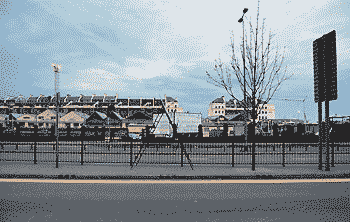
The picture above shows the
approximate site of Mrs James' house. It is close to the
western docks. Northampton Street has now been
demolished and replaced by a throughway to the eastern
docks. |
K
|
Keates, A. and E.
Annie and
Evelyn Keates. They were buried at Charlton, Dover, 2 G1, on 29
September 1917 and the headstone
reads:
 |
"Sacred
to the memory of
my beloved Annie
also of our darling daughter
Evelyn Annie Keates
who lost their lives in the
air-raid 24 September 1917
In death not divided
R. I. P.
Also of John Alfred Keates
who died 29 August 1926
aged 52 years" |
Annie, formerly White, née Keal, was 52 years old and Evelyn was 12,
born on 1 April 1905.
They had moved to 40 Glenfield Road when their previous home in 19 Wood
Street had been damaged by an air raid. The back of their new home was
 blown
in by a bomb that had fallen into the back yard. It was said at the
inquest that over 25 bombs had fallen in the area blown
in by a bomb that had fallen into the back yard. It was said at the
inquest that over 25 bombs had fallen in the area
Mr Keates was an engine driver and working when
the air raid occurred at around 7.20 in the evening. He was some distance away from Dover before a
message was received at a station and passed on to him. He returned
to find that Annie had been killed outright; Mr Keates then had the
melancholy job of identifying her body at the mortuary. Mrs Keates
had been sitting in the back room which was demolished, her back to
the window. She was found lying on her side terribly injured
having caught the full force of the explosion. Evelyn had
been taken to hospital where Mr Keates visited her. She later died
from her serious injuries (on 26 September?). Mr Keates's sister-in-law was also
injured but survived
Mother and daughter were buried on 29
September in the afternoon at Charlton, 2GI. Mr Keates and son Ernest,
born 2 March 1894, were amongst
the mourners. Among the floral tributes were:
"From her broken-hearted husband. Sudden death, Sudden glory."
"To dear Babs, from her devoted daddy"
"In tender remembrance of our dear Mother, from Ernie and Louie"
Notes:
The "John Alfred Keates" named on the headstone may be Alfred John Keates, whose death at the age of 52 was registered in Dover in
1926; if so then at the home of his sister, Mrs Castle, at 9 Park
Street. He had lived with her for some years. He had worked 34
years for the Southern Railway and was a Freemason of the Peace and
Harmony Lodge 199. He was the brother of Frederick Keates, whose daughter
Dorothy Gregory was killed in an
air raid on 24 August 1943. Alfred's probate was given to Emily Jane Castle in London
on 27 September 1926. Ernest, Alfred's son with Mary Susannah, née Marsh,
who married Alfred at St Mary's on 5 November 1893, was unable to attend the
funeral, being in the Royal Navy and on service in the Mediterranean
with the Royal Oak. Ernest married Louise M Friend in Thanet in
1917.
Emily Jane Castle was the wife of William F Castle,
whom she had married in Dover in 1912. She had previously been the
wife of William Wyles, whom she married in 1891 in the Camberwell
area. Née Keates, and born in 1867, she was probably the daughter of
William and Mary Ann Keates, and so sister to John/Alfred and
Frederick. In the 1901 census Ernest was recorded with his aunt,
Emily Jane Wyles, at 6 Camperdon Road, Great Yarmouth where she was
letting apartments. In 1911 she was at 38 Mount Park Road, Ealing, a
widow and a nurse.
Another sister, Mary Ann Philadelphia Keates, born in
Dover in 1865, married Thomas Stephen Datlen in 1885. Between 1916
and 1929 Mr Datlen was the licensee at the Red Lion pub, Charlton
Green, Dover. Mrs Datlen died on 28 January 1924, after
falling over the cliff near the Royal Oak pub, Capel-le-Ferne. The
verdict at the inquest was of suicide.
Amongst the floral tributes were those from Mr and Mrs A. Lund,
Bob and Elsie. They were Maggie S-K's great-grandparents and
grandparents, Elsie being the daughter of Mr and Mrs Lund and Bob
being her husband. Another tribute was from
Elsie's sister Winnie then aged about 10. She wrote "In loving
remembrance from Winnie Lund to dear Evelyn" with thanks to Joyce Banks
|
|
 Kenward, E and E. M Kenward, E and E. M
Edwin and Ellen Marie Kenward. They lived at 75 Crabble
Hill and Miss Kenward died on 24 September 1917 when a bomb struck the house.
Edwin was 75 (77?) and was blown into the fireplace and pinned beneath the debris; he died at the
hospital(?) on 13 October
Mr Kenward was a former employee of Mr Chitty, and in
1911 had been a foreman flour miller. They lived then at Mill Cottage,
Charlton Green.
Ellen, aged 55 had been on her way to help a bedridden neighbour Mrs
Jane Gould who later also died. Ellen was buried in the ruins of the front part of the house
apparently struck as she was entering. Her body had been cut in two and
such had been the blast, her clothes had been blown off. The body was so
dreadfully mutilated that it could not be identified. The jury at the
inquest decided it must have been she as the build and hair colouring
(dark going grey) were similar to hers
 Poignantly eight days before Mr Kenward died a
notice "In loving memory of Ellen Maria Kenward second daughter of Edwin Kenward who was accidentally
killed on Monday 24 September. Deeply mourned by her sorrowing
Father and Sister, Brother-in-Law, Nieces and Nephew" was inserted in
the Dover Express Poignantly eight days before Mr Kenward died a
notice "In loving memory of Ellen Maria Kenward second daughter of Edwin Kenward who was accidentally
killed on Monday 24 September. Deeply mourned by her sorrowing
Father and Sister, Brother-in-Law, Nieces and Nephew" was inserted in
the Dover Express
Ellen was buried at Charlton on 29 September, QU 32, the grave of her mother who died in
1900. Her brother-in-law and sister Mr and Mrs C S M Wells and
daughters Mrs Smith and Ilene Wells were amongst the
mourners. Just 17 days later they had returned with Miss Lucy Wells
also for the funeral of Ellen's father
The image above shows the gap, where no's 75 and 77
once stood. The site is now occupied by a garage. Left is a view of the
backs of the houses still standing no's 75 and 77 would have been
to the left
|
In loving
memory of Mary,
Wife of Edwin
Kenward,
Died 7
February 1900
Aged 58 years
For whoever
giveth his beloved sleep
|
In loving
memory of Edwin Kenward,
Husband of the
above,
Who died 13 October 1917
Aged 77 years
Peace, perfect peace |
In loving
memory of
Ellen Maria
Kenward
Who died 24 September 1917
Aged 55 years
In the midst of life we are in death
|
 |
transcription and gravestone picture by
Joyce Banks |
L
|
 Little, E. Little, E.
Edward Little aged 72/73 lived at 4 Widred Road with
his sister. On 4 September 1917 he was out at the
back. He had just called to his son-in-law George
Smith "Did you hear that, George?" when the family
heard a "sissing noise" Mr Little's sister said, "Oh,
the devils!" and then knew no more
A bomb had fallen and smashed in the backs of numbers
4 and 6. Mr Little was killed outright. He was
discovered buried under rubble with his head blown
 completely away. His daughter,
Minnie Smith and her
husband were also buried and it took some little time
for a constable and others to clear away the debris
covering them and remove them. Mr Smith sustained a
fractured leg but Mrs Smith was critically hurt with
injuries about her arms, body, and head. When rescued
she was conscious enough to enquire after her father as
did also her husband. Mrs Smith died over a month later
in hospital. The three children in the house
suffered only cuts and bruises completely away. His daughter,
Minnie Smith and her
husband were also buried and it took some little time
for a constable and others to clear away the debris
covering them and remove them. Mr Smith sustained a
fractured leg but Mrs Smith was critically hurt with
injuries about her arms, body, and head. When rescued
she was conscious enough to enquire after her father as
did also her husband. Mrs Smith died over a month later
in hospital. The three children in the house
suffered only cuts and bruises
On 8 September, after a service at St
Bartholomew's, Mr Little was buried at Charlton
cemetery in the same grave, TJ 17, as his
wife, Lydia Mary, who had died on 9 May 1899. He was a
retired gas fitter and the gas company was
represented by three members. They accompanied the
mourners including Mr Edward John Little, Mrs Clara Johncock, Mrs
Annie Ledner, and Mrs Emily Filmer, his children. There
was a further son Sydney. In 1881 and 1891 the family
had lived at 43 Tower Hamlets Street; in 1899 they were
living at 10 Avenue Road.
with
thanks to Joyce Banks
Edward Little was the grandfather of
Florence Minnie
Johncock, and Minnie Smith was her aunt
Images:
above - the gap is where 4 Widred Road once stood
right - the backs of the houses; the gap is where no 4
once was. Flats are now being built behind and the
former 4 Widred Road is the access road |
|
 Long, H. J. H. Long, H. J. H.
Henry James Holman Long a clerk was killed on 4h September 1917
at 1 Priory Hill the home of his father. They had heard
an aeroplane at 10.30pm and had gone to the front of the
house as they had believed it was a British plane.
However, they identified it as an enemy machine from the
distinctive noise of the engine and at that moment bombs
began to fall
They shut the door and almost at
once there was a loud noise. Masonry fell down around
them. Mr Long the father and his daughter had crouched
under an arch but the son was not with them. When it
was still Mr Long called his son but there was no
reply. Switching on the light he found his son on the
landing up the stairs his head over the last step and
completely unconscious
Beside him was a hole in the wall.
This was probably caused by the force of a bomb
explosion and Henry would have felt the full blast. He
was bleeding from his head and hand although there
seemed to be no visible injury. Mr Long ran for an
ambulance. Henry was still just alive when he arrived at
the hospital but died shortly afterwards. He was 29
 He was buried at St Mary's on
8 September 8Z LB with his
mother, Harriett, who had died on 22 March 1915. His father Charles
Thomas
Long who was an accountant and his uncle W S Long attended, along with Messrs
F C Wright and H Davis (AMR) fellow employees from
Wiggins Teape and Co, Dover. There were many floral
tributes He was buried at St Mary's on
8 September 8Z LB with his
mother, Harriett, who had died on 22 March 1915. His father Charles
Thomas
Long who was an accountant and his uncle W S Long attended, along with Messrs
F C Wright and H Davis (AMR) fellow employees from
Wiggins Teape and Co, Dover. There were many floral
tributes
Mr Long at the inquest said that there had been no siren
warning of the hostile aircraft and that had there been
they would have gone to a safe place. He believed his
son had died running up the stairs to get his collar.
This was probably so that he might be respectably
dressed to take refuge with other people
The cross of Mr Long's grave has become dislodged from
the base which had been covered by ivy so the
inscriptions were no longer visible. The cross is
normally now laid flat for safety reasons, the
inscriptions on the grave read:
|
In loving memory
of James Long
born March 8 1824
died January 22 1904 |
also
Jane Grayling Long
widow of the above
born 17 October 1835
died 18 August 1923 |
also Harriet Long
daughter-in-law of the above
born 29 March 1850
died 22 March 1915 |
also
Henry James Holman Long
born 2? September 1888
grandson of the above
killed by hostile aircraft
4 September 1917 |
with thanks to Joyce Banks
note: Henry was christened at
Littlebourne on 14 October 1888. His father was then a
private tutor. |
|