|
World War I
CIVILIANS Surnames
N to Z
P
|
Philpott, J.
Julia Philpott, née Golder, was born at Ringwould
about 1844. She was married on 19 August 1866 at St Andrews, Buckland, to
John Philpott. In 1871 they were living at Union Road, Dover, with Mr
Philpott working as a stable man. Also there were Mrs Philpott's father
John Golder, a gardener, and four children, Mary, 12, Frederick, 7,
Ellen, 4, and John, 1.
The family were at 41 Castle Place in 1881, with Mrs Philpott working as
a charwoman and her husband as a general labourer. At home then were
Ellen, an unemployed domestic servant, John, and William, then seven.
Ten years later they had moved to 115 Castle Place, with Mr Philpott
citing his occupation as an ostler, although he had become an invalid.
They had been joined by a new son, Reginald, then six.
Mr Philpott died in 1895, and by 1901 Mrs Philpott was living at 2
Golden Cross Passage, Russell Street, with her sons John, an
agricultural labourer, and Reginald, an errand boy. Both sons had become
general labourers by 1911, when the family were still at 2 Golden Cross
Cottages.
It is believed that Mrs Philpott was injured in an air raid on 23
January 1916, dying five months later at the age of 71.
Reginald died on 11 November 1927 at Preston Hall Hospital, Aylesford. |
R
|
 Robus
G. F. Robus
G. F.
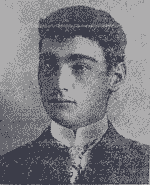
George Frederick Robus (left) of 2 Chapel
Cottages Eythorne died in the great munitions explosion at Faversham on
2 April 1916. He was 35. He was buried in the mass grave at Faversham;
his name is on the wall to the right of the steps. His remains were
amongst those that could not be identified.
George
 was
the son of the late Mr Frederick Robus and his wife Emily, née Townsend, of 24
Oakleigh Terrace, Westbury Road, Dover, who had married in 1878. The
couple were living at 5 Clarendon Street in 1881, then moved to 178
Clarendon Place for the next decade or two. was
the son of the late Mr Frederick Robus and his wife Emily, née Townsend, of 24
Oakleigh Terrace, Westbury Road, Dover, who had married in 1878. The
couple were living at 5 Clarendon Street in 1881, then moved to 178
Clarendon Place for the next decade or two.
Born in Dover in about 1883 and christened at St John Mariner on 9 May
1893, George was one of eleven children. Sadly Alice Maud, born in 1892,
died the following year at the age of 14 months. George's other siblings
were: Ethel Townsend, born about 1879, Grace Emily, 1880, Annie
Elizabeth, 1881, then George, then Alfred William, 1884, Albert Atkins,
about 1886, Harry, 1887, Frank Arthur, about 1889, then
finally Bertie, 1894, and Ernest Charles W. about 1898.
 George
married Mabel Edith Cox in 1910 and the couple had three children; Ruby
P V born 1911, Ernest G F, 1913, and Rhoda Q C, 1915. George
married Mabel Edith Cox in 1910 and the couple had three children; Ruby
P V born 1911, Ernest G F, 1913, and Rhoda Q C, 1915.
Ernest Legg, Sydney Clubb,
and Sidney Holbourn were
other victims of the tragedy. The list of casualties is
here
George's
brother E Robus (right) (probably Ernest Charles) was a gunner in the Royal Garrison
Artillery. He was wounded on 22 July 1917 and
convalesced in Oust Gew Hospital Rouen. Before he
enlisted he was employed for five years by Mr Pexton of
Snargate Street. He was the youngest son of the family,
and died on 19 February 1940 at Ashford, Kent, hospital.
Mr Frederick Robus died on 17 May 1915 at his home at 24
Westbury Road, aged 61, after a lengthy and painful illness. He was
buried at St James. Mrs Emily Robus died on 23 September 1928 at 61
Westbury Road, Dover, aged 74. She was buried in the same grave as her
husband. One of their sons, Alfred, had emigrated to Canada; another,
Frank, to Australia.
George's brother, Frank Arthury, married in 1912 Maude Ellen Farrell,
the sister of
William Henry Farrell. She later
married later married Samuel Wakerell, and
they became the parents of
Leslie Wakerell. She remarried in 1955 to Charles J Handley, who
may have been the brother of
Walter Ernest Handley.
Ethel Townsend Robus married on 27 December 1902 at Christchurch,
Hougham William James Back, a gasfitter.
They became the parents of Leslie
Joseph R Back. |
S
|
 Sladden, H Sladden, H
Henry (Harry) Richard Sladden
aged 43
was a widower born in London, and occupied as a casual labourer.
He was said to
have been a very nice man, steady, and with a wonderful
memory. He may have acted as barman at the Red Lion in St James Street.
He had lived there for some eight or nine
years; the pub also was a lodging house. In 1911 there
were in ten rooms including the kitchen 39 men lodging
there as well as ten in the landlord's family. In 1901
pensioned policeman Richard Sladden, born in
Shepherdswell, and his wife Elizabeth Hannah from
St Pancras were living at 1 Randolph Road; there also
was Harry, then 29, also born in St Pancras, and working
as a navvy. Mrs Sladden died on 18 April 1901, Mr
Sladden in April 1906; they are buried at Buckland.
Harry had
been sleeping in a first floor room on the night of
22/23 January 1916. At 12.47 on the Sunday morning a
bomb fell on the roof perhaps some nine feet away and
burst. The roof was blown off and debris and a joist
fell into the room. The chimney breast was riddled and
there was a strong smell of gas when the assistant
manager entered. Harry Sladden was on the bed by
the wall beneath the window covered with debris. His
body was still warm but he was probably already dead and
certainly was so by the time the doctor arrived.
The
doctor stated that Harry had compound fractures of both
bones of his right leg below the knee and that these
were probably caused by shrapnel wounds. The fatal
injury was a severe lacerated wound of the wall of the
stomach through which intestines were protruding. It was
a clean cut and as there was no burning as would have
been expected had it been a shrapnel wound it may have
been caused by a falling slate. The clothes had been
blown away.
At the
inquest there was a short discussion as to whether a
verdict of murder could be returned. The Coroner
however stated that this would be of no avail that they
were at war and that Harry had been killed by a bomb
thrown from a hostile aircraft.

Harry
Sladden was
buried at St James cemetery on Thursday afternoon, 27 January 1916, M J 5.
Large crowds were in the streets to see the cortège
pass and Alderman J W Bussey his employer was amongst
the mourners. Floral tributes included those from "Two
old friends, Mr White and Mr Madden", "J. Skinner and
family and fellow lodgers", "four old workmates"
"from his mates".
There
had been three others in the room who escaped with
injuries. One of them aged aged 67 remembered hearing
a bomb but knew nothing till half past six the
following morning. A bed between him and Harry Sladden
had been thrown on top of him and "Dick"* had removed
it. He had been so stunned he had gone downstairs with
no clothes on but he remembered neither that nor being
seen by a doctor. Nor did he recall having gone up and
downstairs two or three times after the explosion. His
head had been affected and he was still dizzy by the
Tuesday after the bomb fell. Post
Script: The assistant manager giving evidence at the
inquest rather wryly noted that the proprietor of the
Red Lion was an invalid but that when the bomb fell the
proprietor getting out of the property displayed
greater energy than the assistant manager had known him
have for two and a half years!
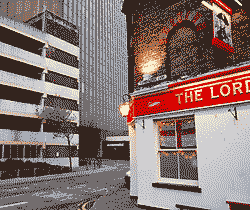
illustrations: The
site of the Red Lion - opposite the Lord Nelson, and now
a redundant multi-storey car park
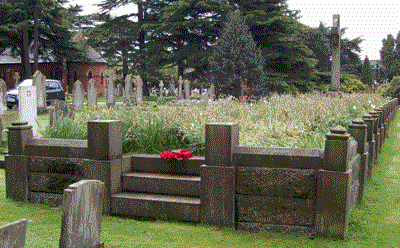
site of Harry Sladden's grave, with thanks to Joyce
Banks
*could "Dick" have
been the brother of Harry Sladden? In the 1901 census
Dick A is recorded at Randolph Road.
see also the chip
on the
Rifles monument |
|
Smith, M. R.
Minnie Rhoda Smith,
her husband George, a bakery carman, and her father,
Edward Little, were
sitting in the kitchen at home on 4 September 1917
when a bomb when a bomb smashed the backs of numbers
4 and 6 Widred Road. They were buried in the ruins; Mr
Smith suffered a broken leg and was knocked unconscious
and his wife sustained injuries in her head and breast.
Mr Little was killed outright.
Mrs Smith was taken to
hospital; she died at the Royal Victoria Hospital on 11
October, aged 40, from septic poisoning.
Born on 21 September 1877, she was the daughter of
Edward Little and Lydia Mary née Taylor, who had
married on 25 July 1867 at St Mary's. Minnie was
christened at St Mary's on 6 January 1878, when her
father was employed as a labourer, and was the
fourth daughter to be born to the family, the others
being Clara, born 10 June 1868, Annie Elizabeth,
born 5 June 1871, and Emily Sarah, born 28 May 1875.
She also had two younger brothers, Edward John, born
3 March 1880; and Sydney Gilbert in 1882.
Minnie married George William Smith on 28 December
1899 at Charlton; her father by then was a gas
fitter. In 1901 the couple were living at 21
Prospect Place, Dover; by 1911 they had moved to 4
Widred Road. They had three children; George Robert
Edward on 16 September 1901, Harold John Frank on 3
September 1903, and Kathleen Minnie on 21 September
1909. They fortunately were only cut and bruised in
the raid.
Mrs Smith's husband and her sons George and
Harold, along with her sisters Mrs Clara Johncock,
Mrs Annie Ledner, and Mrs Emily Filmer, and sister-in-law Mrs Aldhouse, were amongst the mourners when she was
buried on 17 October at Charlton, 2 C6. The first
part of the funeral service took place at the
church and her
coffin was borne to the grave by fellow employees (from the
Co-operative Society?) of her husband: Messrs
Potter, Evans, May, and Culmer.
Floral tributes included those "From her loving
husband and children", and "Employees of the
Co-operative Society".
with thanks to Joyce Banks
Mrs Smith was the aunt of
Florence Minnie Johncock
|
|
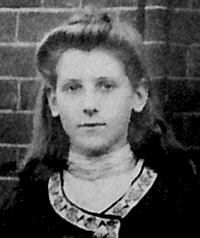 Stoker, E. M. Stoker, E. M.
Edith Mary Stoker
(pictured left in about 1906) was
killed on 19 March 1916. She was a housemaid in the
service of Mrs Philip Theodore Hart (Birdie Hannah) from
2 Temple Villas, Maison Dieu Road. On her
Sunday afternoon off she was cycling to Folkestone,
probably to see her sweetheart.
An
exploding bomb, which hit the tram track in Folkestone
Road by St John's Terrace, threw her from her bike and
drove her through the door of Mr Harold Tarrant's stationer's
shop on the other side of Folkestone Road, at number 131.
She was discovered lying in the entrance and was taken
to hospital in a car with Francis Hall, another casualty,
where she died from her dreadful injuries.
She was
23 and the daughter of a Sergeant Major pensioner from
the Royal Garrison Artillery. She and her brother
Frederick had been born in Singapore; another brother,
William, and two sisters, Mabel and Annie, were born in Dover, as was
her mother, Annie Louise, while her brother George and
sister Winifred were born in Portsmouth. The last child
of the family, Dorothy, was born in South Africa.
Miss
Stoker's parents lived at 13
Church Road, Dover, in 1916. In 1901 the family had been at the Clarence
barracks in Portsmouth, and in 1911 Miss Stoker was
working as an assistant in a confectionary business in
Ashford, Kent, staying at 14 Bank Street, Ashford, while
her family were at 156 Christchurch Road in Ashford. Mr
Stoker had by then become an army pensioner and was working as
an insurance agent.
|
 |
|
Flowers laid on Miss
Stoker's grave after her funeral
Amongst them were some from
"her broken-hearted Boy", probably Miss
Stoker's sweetheart |
| |
|
|
Third page of Mourning
Card for Miss Stoker |
 |
In Loving Memory
of
Edith Mary
the beloved daughter of
Regimental Sergt-Mjr & Mrs Stoker
(RGA)
who died 19th March 1916
(An Air Raid Victim)
aged 23 years and 5 months
Oh how our hearts do ache
When we think of how she died |
| Right - the front of the card. On page
two a verse reads: We miss the handclasp,
miss the loving smile;
Our hearts are broken, yet a little while
We too shall pass the golden gates.
God help us, God comfort us while we wait. |
 |
 |
Edith Stoker is buried
at St James, with other war casualties.
The words at the foot of her headstone
read:
Sacred to the memory
of
Edith Mary
Second
daughter of
George W. and
Annie L. Stoker
Who died from enemy action
19
March 1916. Aged 23 |
 |
The Stoker Family in the summer of 1906
From left to right - Annie Louisa Stoker
(née Bartholomew) holding Winifred (about 18 months);
Frederick Charles (11); William James (16); Annie (19)
with her granddad, Finnis Bartholomew in
front; Edith (13) with Mabel Elvina (9) in front;
George Henry (4), and George William Stoker. The
last child in the family, Dorothy (Dollie),
was born in 1907.
Mr and Mrs Stoker were married in Dover in
1885.
|
|

Dollie Stoker, at a peace treat for
Church Road on 21 August 1919. She is in
the second row from front, seventh from
right.
|
 |

opposite: Folkestone Road looking
towards Folkestone. The car is parked outside the
shop where Miss Stoker was blown from her bike. It
is still a newsagent's today (2009). Little Francis
Hall was also killed in this area on the same date.
Jane James died in Snargate Street.
Mr Tarrant wrote a verse regarding the tragedy,
which appeared in the Dover Express the following
Friday.

Post Script: six weeks after losing
his daughter, Sgt Major Stoker was unfortunate
enough to receive a fine of 10s for permitting
lights to be seen at his home after the siren had
sounded on 25 April 1916. He stated that the light
was on only for two minutes and that his wife had
gone upstairs with a candle to see if the children's
clothing was all right.
Mrs Annie Stoker died on 2 October
1953, and Mr Stoker on 24 September 1936.
Note: One report gives Miss Stoker's name as Miss Alice Stokes
photo of grave and transcription with thanks to Joyce Banks
In memoriam card and flowers with thanks to David
Stoker and Ann Blyth
Family photographs with thanks to Jill Stoker |
|
Stokes, F. C.
Frederick Charles Stokes
was a telegrapher, and brother to William, below. Born
in Dover in 1876, he was injured in the raid on
Folkestone on 25 May 1917, and never fully recovered. He
died on 11 October 1918 from phthisis and pulmonary
haemorrhage. He left his second wife and six children. |
|
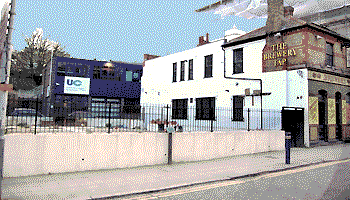 Stokes, W. H. Stokes, W. H.
William Henry Stokes was
one of two Stokes brothers who ran the greengrocers'
shop in Tontine Street in Folkestone which shop, now
destroyed (right), was the
focus of the Gotha Raid devastation on 25 May 1917
He
was born in Dover around 1871 and married in 1895. Mr
Stokes received very bad injuries to his back and legs
and died that night. His
son Arthur also died; a newspaper report cites a William
Edward Stokes who crawled out of the destroyed shop over
the wreckage but subsequently developed gas gangrene
from the wounds to his legs. The funeral report names
him William Henry Stokes.
They are buried at Cheriton
cemetery, Folkestone, 3653 (u) The words on the
headstone (in the centre) read:

|
In
Ever Loving Memory
of
my dear husband
William Henry Stokes
who died 25 May 1917
aged 46 years |
also
of my son
Arthur Ernest Stokes
who died 28 May 1917
aged 15 years
(Victims of the air raid)
In the midst of life we are in death |
|
also of Jane
widow of the above W. H. Stokes
who died 23 October 1953
aged 90 years
Reunited
|
above right, the spot
where the bomb fell |
W
Ward, R. H.
Robert Henry Ward, Boy Scout -
see here |
|
Wall, L.
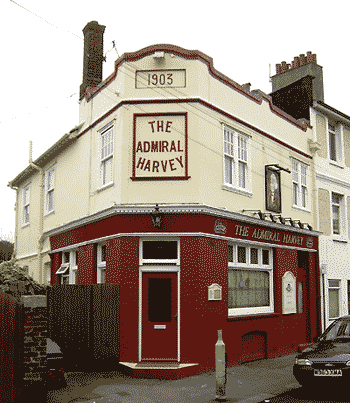 Lucy
Wall was a
servant girl at the Admiral Harvey public house. She was killed on 22
August 1917 during the last of the daylight Gotha air raids when some
seven or eight of the craft in formation flew over the town. Most of
their bombs fell into the harbour but three or four bombs were dropped on Dover
by one plane that flew directly over the town. The largest bomb, it is
said, fell at the back of the Admiral Harvey where it did a
great deal of damage. The only occupant at the time was Lucy and she was
found at the back of the house very badly injured. She died on the way
to hospital. Lucy
Wall was a
servant girl at the Admiral Harvey public house. She was killed on 22
August 1917 during the last of the daylight Gotha air raids when some
seven or eight of the craft in formation flew over the town. Most of
their bombs fell into the harbour but three or four bombs were dropped on Dover
by one plane that flew directly over the town. The largest bomb, it is
said, fell at the back of the Admiral Harvey where it did a
great deal of damage. The only occupant at the time was Lucy and she was
found at the back of the house very badly injured. She died on the way
to hospital.
Lucy was the daughter of Stephen William Wall, who in 1891 was an
agricultural labourer, and his wife Fanny, née Hawkes. The couple had
married in 1883, and both had been born in Ash, Kent as had their first
two children, Thomas Cecil and and Ivy Mabel. The family were living in
Guston, where, in 1901 they were living at 38 Guston Street. Mr Wall was
working as an agricultural cattle yard man, while Thomas was a
waggoner's horse boy. There were then three more children; Hilda, aged
8, born in Westcliffe, Kent, and Albert, 3, and Lucy, aged 1.
Mrs Wall died in 1905, and at Lucy's inquest, her father,
widower, of 27 Union Road and
formerly of 21 Prospect Place, said he had identified
the body of his daughter. Mrs Jane Sutton, who was a widow living at 20 Paul's Place,
said "I was standing on a table in the back bedroom looking at the
German aeroplanes. I saw the deceased standing at the back door and she
shouted "Are they Germans?" and I replied "Oh yes!" She came outside
the door a little bit further to watch them. I said "You had better go
further back inside" as the guns were getting louder and louder. At
that moment something came down and blew me off the table on to the bed
and I lost myself for ten minutes. When I woke up I was covered with
glass. The flame was something dreadful. The bomb burst ten yards away
from me. I was only bruised and scratched a bit. Afterwards I saw them
taking the poor girl away on a stretcher".
Mr E W Ewell was a
special constable and a chemist, and he said "When the firing commenced
I was in High Street and after the bomb dropped I saw the smoke and ran i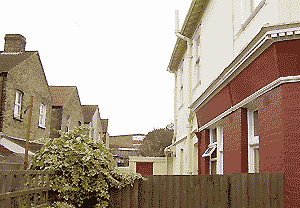 n its direction. I could not see where the bomb dropped and enquired
at several houses and then had to take refuge owing to the shrapnel
dropping. I was afterwards told that the girl was in this public house
alone. I climbed over the wall and searched the house and found the
body lying partly in and partly out of the back door. She was not dead
but unconscious. She however died before we put her on the stretcher. I
sent her on to the Hospital then. There was a bad wound under the left
breast and other smaller ones. She was 30 feet away from where the bomb
burst and all around her on the wall were marks where fragments had
hit. At the Hospital Dr Clarke said that she was dead". n its direction. I could not see where the bomb dropped and enquired
at several houses and then had to take refuge owing to the shrapnel
dropping. I was afterwards told that the girl was in this public house
alone. I climbed over the wall and searched the house and found the
body lying partly in and partly out of the back door. She was not dead
but unconscious. She however died before we put her on the stretcher. I
sent her on to the Hospital then. There was a bad wound under the left
breast and other smaller ones. She was 30 feet away from where the bomb
burst and all around her on the wall were marks where fragments had
hit. At the Hospital Dr Clarke said that she was dead".
Mr Frank Rogers, the landlord,
said that the girl was by herself in the house, his wife having gone to
London. The only living thing in the house was a dog that had a piece of
bomb in its paw and he took that out the previous night.
Lucy was buried at Guston churchyard with
the cortège leaving from the Duke of York's School lodge house, the home of her sister.
Lucy's grave is now not locatable.
Post Script: A pear tree
at the rear of the Admiral Harvey was blasted by the bomb; its leaves
withered and the pears fell off. But by October it was budding again and
even in bloom. An observer remarked, "the tree didn't
mean to be beaten by the Hun!"
Note: Mr and
Mrs Rogers were later to lose their only son
Charles Rogers in World War II and
three months later Frank Rogers was also
killed. Ivy Victoria Laura née Ashby, Mrs Rogers' daughter with her
first husband, Albert Ashby, lost her husband,
William Ferry Raper, on 31 May 1915. They had been married just a
year before, on 29 April 1915, at St Paul's church, Dover. The
succeeding licensees, Mr and Mrs Harper, also lost their only son,
Cyril Harper. |
|
Wood, D. E.
 Dorothy Eleanor Wood
had just begun duties as a typist at the Town Clerk's
office, and was attending Miss Pilcher's shorthand
and typewriting class on the ground floor of the house of Mr Smith at 10 Folkestone Road. She lived at 9
Alfred Road and was the daughter of Henry Wood, a carpenter born at
Malling, Kent, and his wife Lilly, from Brighton. Dorothy Eleanor Wood
had just begun duties as a typist at the Town Clerk's
office, and was attending Miss Pilcher's shorthand
and typewriting class on the ground floor of the house of Mr Smith at 10 Folkestone Road. She lived at 9
Alfred Road and was the daughter of Henry Wood, a carpenter born at
Malling, Kent, and his wife Lilly, from Brighton. On 24 September 1917 the siren sounded for an air
raid warning. The ladies in Miss Pilcher's class put up the wooden shutters inside the windows
to prevent the glass injuring them should there be a near hit from a
bomb. They then continued with their lesson Nine
minutes after the class had begun the second bomb fell. According to the
Chief Constable it exploded in the garden some four to six yards from
the window and damaged the front of the house. One young lady had a
lucky escape as she had not arrived at the class when the warning siren
had begun and had instead run home but in the class several of the
ladies were wounded, three seriously. Miss Wood was found just inside the
front window and was badly injured in both her upper arms and one of her
legs. A piece of the bomb had also injured her spine
Her father had been informed she was hurt and believed her injuries
serious. She was taken to hospital while heavy bombing was continuing.
However Miss Wood had told the hospital they need not "bother as she was
not hurt much". Sadly she deteriorated and died at four o' clock in the
morning of Tuesday 2 October
Miss Wood was 17½ years old. She is buried at
Buckland, 2061
with thanks to Joyce Banks
image above right: the houses no longer exist and the
site is a garage
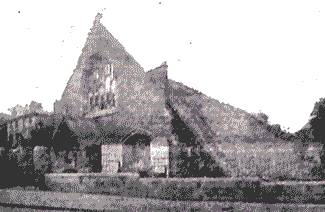 Right:: the Wesleyan Chapel next door
to Miss Pilcher's class was struck by the previous bomb. The
rear wall was demolished and the roof slid off the sides Right:: the Wesleyan Chapel next door
to Miss Pilcher's class was struck by the previous bomb. The
rear wall was demolished and the roof slid off the sides

Left: the open roof - the chairs are still neatly in their blocked rows
inside the damaged chapel .More about this chapel may be seen
here.
(We have further better quality pictures - set 2048) |
|
