
The Battle of Britain Homes |
 |
|
There was a fund launched in 1945 to
create the Battle of Britain Memorial Hospital in Dover.
Winston Churchill had stated that "The Union Jack of
Freedom will for ever fly from the White Cliffs of
Dover". Names of airmen who had died in the Battle would be
preserved in the hospital. However, with the beginning of the NHS in 1948 the
monies in the fund were no longer needed. It was decided instead to use much of
the money to builds residential homes in the area of
York Street. In memory, once they were built, they
retained the name "Battle of Britain" |
 |
We believe these stamps may have been
sold for fund raising for the hospital, and/or used to
decorate postal envelopes to help advertise the
campaign.
Thanks to Dean Sumner
for the picture |
|
|
|
|
|
|
|
An evocative reminder of the dangers
faced by citizens of our frontline town, is the ARP post
by Dover Priory station. It has reinforced walls and
roof and a baffled entrance to protect against blasts.
The structure is listed. |
 |
|
|
|
|
People who grew up in Dover will also
remember the many pillboxes around the area - and
probably will have played in them! A useful map is
here. Other mementoes include anti-tank pimples in
various places around the town and reconstructed houses,
for example at Mayfield Avenue and Barton Road, and at
Glenfield Road, where the numbers of the houses are
no longer completely sequential. |
|
|
|
|
|
|
 |
 |
| The Zeebrugge Bell - 23rd April 1918 |
It hangs outside the Town Hall |

This plaque was installed on 20 April
2001 |
Erected to the lasting friendship of
Dover and Zeebrugge
The Zeebrugge Bell
The bronze bell above you was a gift of the King of the
Belgians and is a memorial to the sacrifice of British
Servicemen in the Raid on Zeebrugge on 23rd April 1918.
This bell is struck at noon every year on the
anniversary.
The Naval Raids on Zeebrugge and Ostend were carried out
by volunteers and denied the effective use of the ports
to the Germans. Eleven Victoria crosses and 679 other
decorations were awarded. Some 200 British Servicemen
were killed and 400 were wounded. A number of the fallen
are buried in St James' Cemetery, Dover.
The Dover Society
Stad Brugge
Onthuld ter ere van de langdurige vriendschap tussen
Dover en Zeebrugge |
|
The bell hanging above was taken from
the Belgians by the Germans in the War 1914-1918 and
fixed on The Mole at Zeebrugge to give warning of
approaching aircraft and naval attacks by the Allies. It
was presented to the corporation of Dover by HM the King
of the Belgians through Vice-Admiral Sir Roger Keyes
Bart KCB KCVO etc as a souvenir of the Naval Raid on
Zeebrugge on St George's Day 1918 |
 |
| |
|

This grappling iron is one of many used by the British
Eascort and the Royal Marines to hold HMS Vindictive
against the Mole during the raid on Zeebrugge on 23rd
April 1918.
Made at Chatham
Dockyard, it bears the scars it received during the
fierce battle when the raiding party landed in the face
of heavy enemy gunfire at point blank range. |
The Zeebrugge Bell
above the Town Hall is rung at noon on the anniversary
each year by the Town Mayor. It commemorates the raid,
the success of which denied the enemy use of the Belgian
canal for the remainder of the war.
Eight Victoria Crosses were awarded
for a battle lasting only 70 minutes
Royal Marines Association
City of London Branch
|
A
ceremony is held each
year, prior to the ringing of the bell, at St James'
cemetery, Dover, where some of the casualties and
Roger Keyes, Admiral of the Fleet 1st
Baron Keyes, GCB KCVO CMG DSO are buried. |
| |
|
| |
|

Two benches, in the sunken gardens on the seafront |
 |
| |
|
 |

Named after the welcoming Soldier's Club in Poperinghe,
Belgium, Toc H is committed to building a more fair
society. In Dover it had strong links with the Boys'
Grammar |
| |
|
| |
|
 |
 |
|
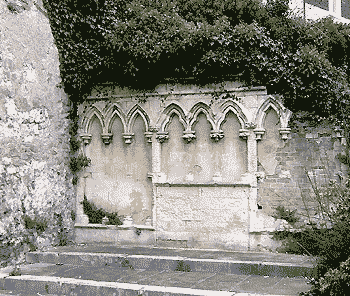
St James Church. was nearly destroyed
in WWII by shells fired from France by enemy gunners.
The ruins were kept to form a monument for Dovorians,
encapsulating in stone the bombardment they had suffered. The church dated from Saxon times,
and was also used until 1831 as an official court for
the Barons of the Cinque Ports. The last Lord Warden to
preside here was the Duke of Wellington |
|
|
|
|
|
|
|
  left
- the monument, and right, the chip, below the name
"Rohilcund" left
- the monument, and right, the chip, below the name
"Rohilcund" |
The Rifles monument in Camden Square
was chipped during the first moonlight raid on Dover on
23 January 1916 by an enemy seaplane which dropped nine
bombs. The second bomb fell in the middle of the road
outside Cambridge Terrace, chipping the memorial.
The fourth killed
Harry
Sladden at the Red Lion Inn and injured three other
men. Subsequent bombs injured three children and an
elderly woman.. |
|
|
|
|
|
|
|
On the post-war Buckland housing
estate, the roads were named in honour of the many
Allies of World War II Here are some of the many
examples

 |
 |
 |
 |
|
|
|
|
 |
|
This flowerbed, on the lawns in front
of the Gateway Flats, is designed to represent the
Norwegian flag. The plaque (right) in the bed reads:
This plaque honours the men of
the Royal Norwegian Navy
who operated from Dover between
1940 - 1945
. . .
23rd May 1998 |
 |
 |
A new plaque was unveiled on 3
September 2014 |
|
|
|
|
 |
Dover Grammar School for Boys
unveiled on 11th November 2010 a weathervane in
commemoration of The Few and other airmen who were
former pupils of the school. The weathervane was
designed by Harry Platts and dedicated by Revd Andy
Bawtree
The design represents aircraft taking
off over the White Cliffs of Dover. |
|
|
 |

Cast in 1895 at a foundry in Smethwick, this bell was
hung in the harbour as a navigational aid to shipping.
The triangular indentation on the rim is believed to
have been caused by enemy fire around the time of the
Battle of Britain. The bell is now in the de Bradelei
Wharf shopping outlet, Cambridge Road, Dover |
|
|
|
The bell (right) stands in the foyer of
Harbour House, Dover Harbour Board, Waterloo Crescent,
on the seafront at Dover. We have been unable to
confirm whether it is the bell from HMS Glatton, sunk in
Dover Harbour on 16 September 1918. If you have any
further information, please
let us
know
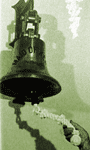 On
6 November 1967, the bell from the hospital ship Maid of
Kent (left), was presented by Herr Egedius Wagner to
British Railways Southern Region on the bridge of SS
Maid of Kent. The hospital ship was sunk in Dieppe
Harbour on 21 May 1940, and Herr Wagner had had the bell
since 1944. The bell used to be in the foyer of
Southern House, formerly the Lord Warden Hotel, Dover,
where it was unveiled on 21 May 1982; it is now in the
foyer of the Transport Museum, Dover (below) On
6 November 1967, the bell from the hospital ship Maid of
Kent (left), was presented by Herr Egedius Wagner to
British Railways Southern Region on the bridge of SS
Maid of Kent. The hospital ship was sunk in Dieppe
Harbour on 21 May 1940, and Herr Wagner had had the bell
since 1944. The bell used to be in the foyer of
Southern House, formerly the Lord Warden Hotel, Dover,
where it was unveiled on 21 May 1982; it is now in the
foyer of the Transport Museum, Dover (below)
.
 
|

There are two plaques beneath the
Maid of Kent bell (left) The first dates from the
placing of the bell on the second "Maid of Kent", and
reads: "This bell once belonged to the previous SS "Maid
of Kent", a railway passenger ship laucnhed in 1925,
bombed and sunk at Dieppe in 1940. It was returned to
this ship, which carries her name by Herr Egedius Wagner
of Niedersessmar, Rhineland, Germany, on 6th November
1967." The second dates from the
placing of the bell at Southern House, and reads: "This
bell was taken from the S/S Maid of Kent II, which was
withdrawn from service in 1982. It was placed here on
21st May 1982 in the presence of the survivors of the
1940 incident at Dieppe, in Memory of their colleagues." |
|
|
|
The local Cinque Ports battalion of
the Territorial Force mustered in Dover Castle in 1914
before travelling to the Front. The officers of the
battalion presented the church of St Mary in Castro with
a clock for the vestry in token of their appreciation.
Many members of the battalion lost their lives. |
|
|
|
A sculpture of a life-sized Spitfire
was unveiled on 22 December 2014 at the Cruise Terminal,
Dover. Designed to mark the Christmas truce of 1914, it
was created by Anthony Heywood from the university of
Creative Arts, Canterbury, and is entitled "The Dove of
Peace".
From an idea originating in 1994, the
sculpture weighs a little under seventeen hundredweight
and is constructed from steel and some 8,500 gallons of
acid-free paper especially developed at the former
Buckland Paper Mill, Dover.
The scuplture was previously shown in
the Netherlands and in Hartlepool. Unveiled during a
ceremony including readings from letters from the
trenches and carols in English and German which were
sung during the truce, it will remain in place until the
centenary of the Armistice. |
