|
World War II
CASUALTIES ON THE
MEMORIAL Surnames A to D
A
Abbott, H. H.
Horace Harold
Abbott, added to the Memorial on 11 November 2009 See
this page |
|
Adley, R. C.
Ronald
Charles Adley,
633816. He was an Aircraftman 1st Class, Royal Air Force. He was taken
as a Far East prisoner of war in 1942, held at Thailand (Hintok), and he died from cholera on 1
August 1943, aged 21. He had been helping to nurse his sick and wounded
comrades who
 had been working on the Siam-Burma Railway. When his friend
George
returned to camp in the evening he was told that Ron had died, along
with five others. He helped to cremate Ron's body had been working on the Siam-Burma Railway. When his friend
George
returned to camp in the evening he was told that Ron had died, along
with five others. He helped to cremate Ron's body
Ron's ashes were
buried at the Hintock River cemetery, and later moved by the CWGC to
the War Cemetery at Chungkai, Thailand, 8 H 5 which is a hamlet by the River Kwai Noi
George never forgot
his
friend,
and regularly inserted
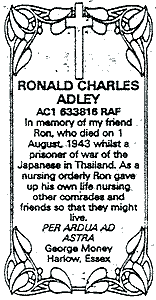
"in memoriam" notices in the Dover
Express and
Folkestone Herald. Ron's
name was added to the Town War Memorial in 2000 and he is also
commemorated at the
 Far East POW church at Wymindham,
Norfolk. A tree was planed in his memory at the National Memorial
Arboretum on 1 January 1998 Far East POW church at Wymindham,
Norfolk. A tree was planed in his memory at the National Memorial
Arboretum on 1 January 1998
Ron had brothers and sisters: Charlie, Doris, Fred,
Robert, and Rose. They were the children of Charles Outridge and Minnie Gertrude Adley,
of 22 Primrose Road, Dover, and grandchildren of Ellen Mary Adley.
On his gravestone is inscribed "Always faithful, good, and kind, A
beautiful memory left behind"
with thanks to Rose King
the announcement reads: Ronald Charles Adley, AC1633816
RAF. In memory of my friend Ron, who died on 1 August 1943 whilst a
prisoner of war of the Japanese in Tahiland. As a nursing orderly Ron
gave up his own life nursing other comrades and friends so that they
might live. Per Ardua Ad Astra. George Money, Harlow, Essex
Ronald Adley's Father, Grandmother, and a
Brother

 |
left: Charles Otridge Adley. He was born
in 1885 in London, and died in 1960 in Dover
right: Ellen Mary Adley, Charles' mother,
born in 1867 in Dover. Her brother Fredrick was father to
Sidney Adley, Great War
casualty
left: Frederick William Adley, brother to
Ronald, born at Lewisham in 1918. and died 1978 in Dover
with thanks to
Lee Adley Stevens
more on this family can be found on the
Adley-Stevens
website |
 |
(article)
(Exhibition 06) (cousin
Sidney Adley) |
Archer, A. E.
Albert Edward
Archer, added to the Memorial on 11 November 2009 See
this page |
B
|
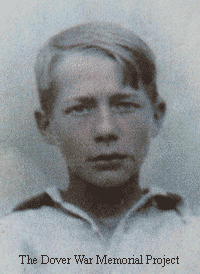 Baker,
S. M. Baker,
S. M.
Stanley
Mark Baker was a Steward's Boy, and was serving on the Hospital Ship Maid of Kent when
she was bombed in Dieppe Harbour on 21 May 1940.
He was the son
of William Mark Baker, a marine porter, born 13 June 1890, and his wife Annie Elizabeth née Lee,
born 5 June 1893, who
had married in 1918. Stanley was christened at St Bartholomew's, Dover,
on 4 May 1922; his brother Bernard Robert was
christened
there the year before, on 6 March 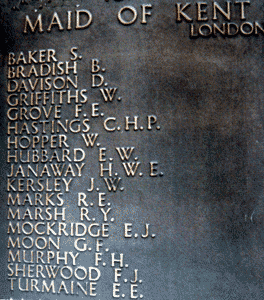 1921.
They also had a sister, Edith A, born 8 February 1928. In 1939 the
family were living at 3 Bridge Street, Dover. 1921.
They also had a sister, Edith A, born 8 February 1928. In 1939 the
family were living at 3 Bridge Street, Dover.
Stanley was 18 when he
was killed, and his body was never recovered. He is commemorated on the
Tower Hill Memorial, London, panel 66.
Stanley's brother, William Ronald, was to lose his life some twenty years after
Stanley's death. Aged 43 and a bosun on the cross-channel ferries; he was
fatally injured on 9 February 1962 aboard SS Hampton Ferry,
while helping unload railway carriages at Dunkirk.

See also:
"Luftwaffe Destruction of the Maid of
Kent" by Richard Thwaites (.pdf)
and "Notes on the Hospital
Carrier Maid of Kent"
photos with thanks to Richard Thwaites |
Bean, R.
P.
Robert Patrick
Bean was added to the Memorial on 29 June 2013. See
this page |
|
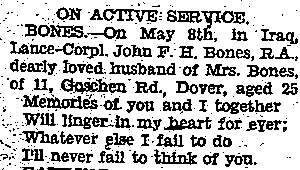
 Bones,
J. F. H. Bones,
J. F. H.
John Frederick Harry Bones, 934810 was the son of John Richard Bones and
Elizabeth Maria, née Gatehouse. The couple had married at St Mary's, Chilham on 16 January 1919, when Mr Bones was still serving with the
British Expeditionary Force in France. John was born at 67 Bulwark Street, the
home of his maternal
 grandfather, Alex Gatehouse,
an engine firelighter on the railway. grandfather, Alex Gatehouse,
an engine firelighter on the railway.
Before enlisting John had been employed as a miner at Betteshanger, and, from
1936, as a lorry driver for Mr
Sneller.
In 1937 he
married Elsie Margaret Croucher. The couple in 1938 were living at
Lowther Road with the first of their five sons.
John joined up
to become
a Lance Bombardier in the 24 Field Regiment, Royal Artillery. He was working as a fly driver transporting jerry cans of fuel, when, on 8 May 1943, a
long range struck one of the cans and it ignited. He and his companion,
Newman, below, tried to throw the cans from the lorry, but the fire spread and
the lorry blew up. John Bones was 23 when he died from his burns.

His family had been evacuated to Bognor
Regis from Dover, but they were sent home when the roof was destroyed by
bombing. A week
after they returned to Dover the telegram arrived at Goschen Road,
announcing Mr Bones' death. It reads:
 "REGRET INFORM 934810 JOHN FREDERICK HARRY BONES DIED
IRAQ 8 MAY 43 CONFIRMATION FOLLOWS ARTILLERY RECORDS SIDCUP" "REGRET INFORM 934810 JOHN FREDERICK HARRY BONES DIED
IRAQ 8 MAY 43 CONFIRMATION FOLLOWS ARTILLERY RECORDS SIDCUP"
John Bones is
buried in the Baghdad (North Gate) War Cemetery in Iraq, 23 H 14.
Mrs Bones
remarried in 1958, to Mr John Townley, who died in 1995. Mr Bones' name was added to the Town Memorial
in 2000.
with thanks to Raymond Mercieca
photos and further information with thanks to Bev Keen
John ("Jack") Richard Bones served during the Great War;
in India, and then in France from mid-1915. He was awarded the Military
Medal at the Cambrai/St Quentin battle of 1918. His brother Harry also
was awarded the Military Medal. Another brother, Walter James Bones,
died at the age of 20 on 31 May 1915, having been injured just a couple
of weeks after arriving in France in 1915. In his last letter home he
mentions having a broken thigh, owing to being hit by shrapnel, and that
he was "going on first class" and would soon be home in England. Sadly,
he deteriorated rapidly, dying two days afterwards. He is buried at Boulogne,
France, where an inscription on his grave reads "With Glory Crowned", and
is commemorated at Chilham, Kent. Jack, Harry, and Walter were sons of Harry and
Ellen Bones. |
Booth, F. R.
Frank Robert Booth.,
added to the Memorial on 11 November 2009 See
this page |
|
Bourner, A. (E.) J.
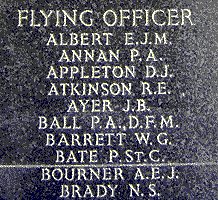 Albert Edward James Bourner,
89074, of 123 Lewisham Road, Dover. Known as Bert or "Dusty", he was a Flying Officer in the RAF
Volunteer Reserve, 48 Squadron. He went to St Martin's school, and later
worked on the Dover trams and the East Kent buses Albert Edward James Bourner,
89074, of 123 Lewisham Road, Dover. Known as Bert or "Dusty", he was a Flying Officer in the RAF
Volunteer Reserve, 48 Squadron. He went to St Martin's school, and later
worked on the Dover trams and the East Kent buses
His Hudson was reported missing over Norway during
the night of 6-7 January 1942. He is commemorated on the Runnymede
Memorial, Panel 66, and on the River Memorial.
He left a wife, Mary Rosetta Bourner, née Eckhoff
(daughter of the well-known councillor Roly Eckhoff), to whom probate
was given. His parents were at the time staying at
41 Holden Park Road, Southborough, Tunbridge Wells
A gravestone at River reads:
 |
In Loving Memory of a
Dear Dad
Albert Thomas Bourner
Died 2 March 1949
Aged 64
And his wife
Florence May
A dear mum
Died 8 July 1987
Aged 99 |
Also of their eldest
son
Albert Edward James
Missing in action
7 January 1942
Aged 28
Reunited |
 |
FO Bourner was the grandson of Eliza Ann
Bourner,
transcribed by Joyce Banks
pictures:
F/O Bourner's name on the Runnymede memorial by Dean Sumner
gravestone by Joyce Banks
the memorial at St Peter's and St Paul's, River |
Brading, C. F.
Charles Frederick
Brading, added to the Memorial on 11 November 2009 See
this page |
Bradish, B.
Barrington Bradish,
added to the Memorial on 29 June 2013. See
this page. |
Brett,
R.
Raymond Brett, added
to the Memorial on 29 June 2013. See
this page. |
C
Cock, C. E.
Charles Edward Cock,
added to the Memorial on 11 November 2009 See
this page |
|
Coe, C. R.
Cyril Rupert Coe,1409939, was a Sergeant Air Gunner in the
 RAF Volunteer Reserve.
His nephew has constructed a most beautiful
written memorial to his uncle. What follow are extracts from that
memorial RAF Volunteer Reserve.
His nephew has constructed a most beautiful
written memorial to his uncle. What follow are extracts from that
memorial
Cyril was born on 26 August 1922 at 95
Clarendon Street, Dover, one of 6 children of John and Adelaide C. A,
(née Austen) Coe both born Dovorians. The children in order of birth were
Ada A., Reginald J., Percival C. (he died aged five years whilst his
father was on active service in France with the army during the First
World War), Douglas V., Cyril R., and Eric W. Coe. All of the boys
served their country during the Second World War, all surviving except
Cyril
Cyril attended Christ Church School. After leaving
school he worked at The International Stores which was a grocer's in Woolcomber Street. He was a member of the Western Heights Church Choir
and served in the Home Guard in Dover until 1941
The family house where he was lived
was 95 Clarendon Street and was also the family Greengrocery Shop. It
suffered a direct hit by bombs dropped by a pair of Messerschmitt 109's
on Wednesday 2 October 1940. His mother and a customer whom she
was serving at the time escaped with only minor injuries, but his mother
from then on did suffer hearing problems. The house was completely
demolished. His mother and father were offered shelter in South Wales
near to where Eric the youngest son had been sent as an evacuee from
Dover in 1940
Cyril stayed in Dover until 1941 an d then moved to
South Wales, probably Cwmbran, to join his family prior to joining the RAF. Whilst awaiting
entry to the RAF he worked for a short time at Saunders Valve Works, in
Cwmbran, South Wales. Cyril volunteered for service in the RAF and
enlisted on 25 June 1941 d then moved to
South Wales, probably Cwmbran, to join his family prior to joining the RAF. Whilst awaiting
entry to the RAF he worked for a short time at Saunders Valve Works, in
Cwmbran, South Wales. Cyril volunteered for service in the RAF and
enlisted on 25 June 1941
Whilst serving with the RAF and seeing first hand
the crews returning from operations he told his family that he was not
doing enough, so volunteered for air crew as an Air Gunner, starting his
training on 13 July 1943. Nearing completion of his
training as a Middle Upper Gunner he was sent to 1661 Heavy
Conversion Unit at RAF Winthorpe near Newark, Nottinghamshire, which
flew Sterling Bombers
On the night of 17 May 1944 they
took off from Winthorpe at 23.34 in Stirling III Bomber EE956, on a night gunnery/navigation exercise. Within twenty
minutes severe icing was encountered. This led to loss of control of the
aircraft, which spiralled down. According to the official report "The
aircraft broke up in cumulus cloud and caught fire following loss of
control, the icing index was high. It was thought that the excessive
loads imposed by the loss of control caused a structural failure of the
tail." (I have been told this was quite common on Stirling Bombers)
III Bomber EE956, on a night gunnery/navigation exercise. Within twenty
minutes severe icing was encountered. This led to loss of control of the
aircraft, which spiralled down. According to the official report "The
aircraft broke up in cumulus cloud and caught fire following loss of
control, the icing index was high. It was thought that the excessive
loads imposed by the loss of control caused a structural failure of the
tail." (I have been told this was quite common on Stirling Bombers)
The Board of Inquiry considered
that the pilot had not been given sufficient training on instrument
flying in view of previous reports indicating a weakness in this
respect. The pilot was assessed as being weak on instrument flying,
which may have been a contributory factor
At around 23.53, most of the debris
crashed into an Iron Stone Quarry a mile northwest of Rothwell, near
Kettering, Northamptonshire. All the crew consisting of nine men were
killed. Four were members of the Royal Canadian Air Force, the rest
being normal Royal Air Force crew
The crew members were:
|
Sgt. Murray, Frederick Graham |
Pilot, Captain |
RCAF |
Age 28 |
|
Sgt. England, William Henry |
Air Bomber |
RCAF |
Age 20 |
|
Sgt. Wolowiec, Joseph Michael |
Navigator |
RCAF |
Age 27 |
|
Sgt. Huppe, Alan Wilfred |
Air Gunner |
RCAF |
Age 20 |
|
Sgt. Bingham, Norman |
Wireless Operator |
RAF |
Age 20 |
|
Sgt. Hoffie, William |
Flight Engineer |
RAF |
Age 29 |
|
Sgt. Hebbes, Arthur Percy |
Flight Engineer |
RAF |
Age 22 |
|
Sgt. Coe, Cyril Rupert |
Air Gunner |
RAF |
Age 21 |
|
Sgt. Foster, Kenneth |
Flight Engineer |
RAF |
Age 20 |
(Sgt Arthur P. Hebbes. Flight Engineer from
Faversham, Kent had been married only a few weeks).
A local historian, who as an adult remembered the
crash, wrote, "One thing that I do remember is that the wreckage was
over quite a large area. The crash must have been very bad because
we found a pair of flying boots, but one boot was still occupied. This
was very upsetting for me as an 11 year old boy"
The main crash site of Stirling Bomber EE956 was in
an Iron Stone Quarry that was filled in when work in the quarry
finished. A spinney of trees was planted over the site of the Quarry.
The spinney was in 1994 named "Stirling Spinney" in remembrance of the
crew who perished there
.

Cyril Coe's name was placed on the Town Memorial in
1995. He is buried in St James' cemetery, Dover. FR 22
 |
1409930 Sergeant
C.R. Coe
Air Gunner
Royal Air Force
17 May 1944 Age 21
Though he passed the way of heroes, we
proudly mourn our loss
R.I.P |
Cyril Coe's grave is close to
Jack Pulham's, another RAF casualty from Dover
illustrations:
Stirling Spinney
from a Christmas card from Cyril to his
brother, 1942
the escape hatch from the bomber
Cyril's lucky heather; probably picked when he visited his parents
in Wales |
with thanks to Peter Coe
(We Remember 06) |
"Treasured and happy memories
that never fade of a dear son and brother, Sergeant C. R. Coe A/G.
who was killed in a flying accident 17 May 1944." From
his loving Mum, Dad, Sisters and Brothers, 1948
|
Collier, G
George Collier,
added to the Memorial on 11 November 2009 See
this page |
|
Coombe, E. B.
Ernest Boucher Coombe was a World War I casualty, added to the memorial
in the 1990s. Information about him
may currently be found
in this article |
Cork,
H.
Harry Cork was
added to the Memorial on 29 November 2013. See
this page |
Cork, N.
Nelson Cork was a
post-WWII casualty, added to the Memorial on 11 November 2009 See
this page |
|
Craven, A.
Alfred Craven, 1896929, a Flight Sergeant in the RAF,
was 5' 7" tall, with blue eyes and light brown hair. He
 was
born in Wainfleet, Lincolnshire on 19 September 1911 to Ellen Craven,
the daughter of William and Elizabeth. He went to Wainfleet Wesleyan
School, and between 1924 to 1925 he was a member of the football team at
the school. On 26th September 1927 he joined the 2nd Battalion of the
Lincolnshire Regiment. There he played the flute and the euphonium as a
musician in the army band was
born in Wainfleet, Lincolnshire on 19 September 1911 to Ellen Craven,
the daughter of William and Elizabeth. He went to Wainfleet Wesleyan
School, and between 1924 to 1925 he was a member of the football team at
the school. On 26th September 1927 he joined the 2nd Battalion of the
Lincolnshire Regiment. There he played the flute and the euphonium as a
musician in the army band
In March 1928 Alfred went to India with his regiment,
and in December 1928 to Sudan. They then returned to England, where the
regiment was eventually stationed at the Old Park Barracks in Dover.
Alfred often played with the band on the bandstand at Dover seafront.
There he met Elsie Sharpe, who was to become his wife. Soldiers then
were not allowed to marry until they were 34 years old, and had to buy
themselves out of the service for £30 in order to get married. This
Alfred did, and he joined the Dover Fire Service in 1934
The couple married in October 1936, and lived at
Malmains Road, Dover. Their daughter Patricia was born there in July
1937, and the next year the new family bought a home at Farthingloe
Road. The year after war broke out and Alfred continued his work in the
 Fire
Service, with alternating duties in London and Dover. But although this
occupation
was exempt from military service and Alfred was doing a dangerous and much-needed
job, the taunts of neighbours led to Alfred's joining up. In 1943 he
became an airgunner in the RAF Fire
Service, with alternating duties in London and Dover. But although this
occupation
was exempt from military service and Alfred was doing a dangerous and much-needed
job, the taunts of neighbours led to Alfred's joining up. In 1943 he
became an airgunner in the RAF
In July 1944, following the completion of
his training, Alfred was serving with No.44 (Southern Rhodesian)
Squadron. On the night of 26 July, Alfred and his crew took off from
Dunholme Lodge, Lincolnshire, at 21.19 in Avro Lancaster PB346 PG-J,
which had been borrowed from No.619 Squadron. It was their first
mission, a raid on the Railway Yard at Givors, central France, with 178
Lancasters and 9 Mosquitos taking part.
Two Mosquitos and four Lancasters were
lost. Alfred Craven's was one of them. They were returning from Givours
in the early hours of 27 July when they were shot down and crashed near
La Boissiere sur Evre, France. The bodies were so badly burnt that all
seven of them were buried there in just three coffins in a collective
grave.
The crew that were lost were:
| Flying Officer Donald
Neil McKechnie |
Captain (pilot) |
aged 24 |
| Sergeant Anthony Barker
|
Flight engineer |
aged 28 |
| Sergeant Wilfred Robert
Little (RCAF) |
Navigator |
age unknown |
| Sergeant Robert Geoffrey
Dean |
Bomb aimer |
aged 22 |
| Sergeant Richard Arthur
Williams |
Wireless operator |
age unknown |
| Sergeant Ernest John
Courtenay |
Air gunner |
aged 19 |
| Sergeant Alfred Craven |
Air gunner |
aged 33 |
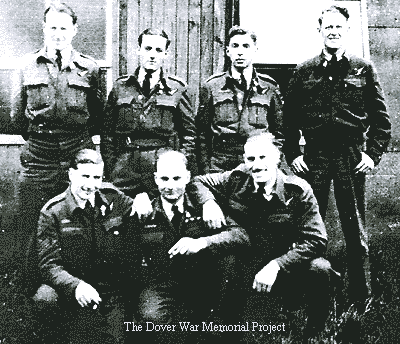
They are pictured above, right. In the back row,
left to right are A. Barker, A. Williams, E. Courtney, W. Little. In
front, left to right, are G. Dean, D. McKechnie, A. Craven
A ten foot high marble monument stands in the field
where the Lancaster crashed. The crew rest at La Boissiere sur Evre,
near Angers, France. There are headstones by the graves. Alfred's reads,
"Deep in our hearts a memory is kept.
We loved him too dearly to ever forget"
with thanks to Patricia Davis
with thanks to Dean Sumner, for RAF information
Notes: There is a reference on p115 in "Hell's Corner"
1940, published by Kent Messenger, by author H R Pratt Boorman
that he had "met Leading Fireman Craven, who had the first shell go
through his house". This may refer to Alfred Craven. With thanks to
Richard Moseling for pointing this out.
Sergeant Anthony Barker is commemorated at Niton, Isle of
Wight, and Bray, Berkshire. There is a biography of him on the website
Memorials and Monuments of the Isle of Wight. With thanks to Janet
Griffin |
D
|
Dixon, W. A.
William Alfred Dixon
died in Ireland in 1920. His name was added to the Memorial on 11
November 2009 See this page |
Drury, F. A.
Frank Arthur Drury
was added to the Memorial on 29 June 2013. See
this page |
Dummer, F. C.
Frederick Charles
Dummer was added to the Memorial on 29 June 2013. See
this page |
Dyer, W. A.
William Albert Dyer
was added to the Memorial on 11 November 2009 See
this page |
|